

Statistics
Flat-Faced Dog Breed Health Statistics UK 2026: Breathing, Lifespan and Costs
Between half and two thirds of French Bulldogs, Pugs and Bulldogs have clinically significant breathing problems when tested. Figures from 51 sources on their health, lifespan, costs and the fall in their popularity.
What this guide covers
Between half and two thirds of French Bulldogs, Pugs and Bulldogs have clinically significant breathing problems when tested, and the French Bulldog's median lifespan is 9.8 years, against 12.8 years for medium-faced pure breeds [1][2]. After a decade of campaigning by vets and charities, demand has collapsed: the three breeds fell from 22.8% of Kennel Club registrations in 2018 to 7.0% in 2025 (our calculation) [3][4]. Yet French Bulldog types taken in by the RSPCA rose from 6 in 2016 to 234 in 2025 [5][6]. This page brings together vet records, breathing tests, lifespan studies, insurer data and rescue figures from 51 checked sources.
64.6%
of Pugs were clinically affected by breathing problems on a breathing test
[1]
9.8 years
median lifespan of French Bulldogs, against 12.8 years for medium-faced pure breeds
[2]
7.0%
of Kennel Club registrations were French Bulldogs, Pugs or Bulldogs in 2025, down from 22.8% in 2018
[3]
58%
of owners whose dogs had breathing problems said their dog didn't have one
[7]
38 times
the odds of skin fold infection in Bulldogs, compared with other dogs
[8]
3,800%
rise in French Bulldog types taken in by the RSPCA, 2016 to 2025
[5]
Which dog breeds are flat-faced?
Flat-faced, or brachycephalic, dogs have a muzzle that is short compared with their skull. About one in five dogs under vet care in the UK (18.74% in 2016) belongs to a brachycephalic breed [9].
How short the muzzle is matters most. In one study, BOAS breathing problems only appeared in dogs whose muzzle was less than half the length of their skull, and more than 80% of dogs with the very shortest muzzles were affected [10]. The French Bulldog, Pug and Bulldog are the most extreme and the most common, which is why most research focuses on them.
A 2026 study graded the breathing of 898 dogs from 14 breeds and grouped them by risk [11]:
| Breathing risk | Breeds |
|---|---|
| High | Pug, French Bulldog, Bulldog, Pekingese, Japanese Chin |
| Moderate | Boston Terrier, Dogue de Bordeaux, Griffon Bruxellois, King Charles Spaniel, Shih Tzu |
| No clinically affected dogs found | Maltese, Pomeranian |
Source: Tomlinson et al. 2026 [11]; Liu et al. 2017 [1]
Only 10.9% of Pekingese and 17.4% of Japanese Chins tested had fully normal breathing, no better than the three best-known breeds [11].
How popular are flat-faced breeds now?
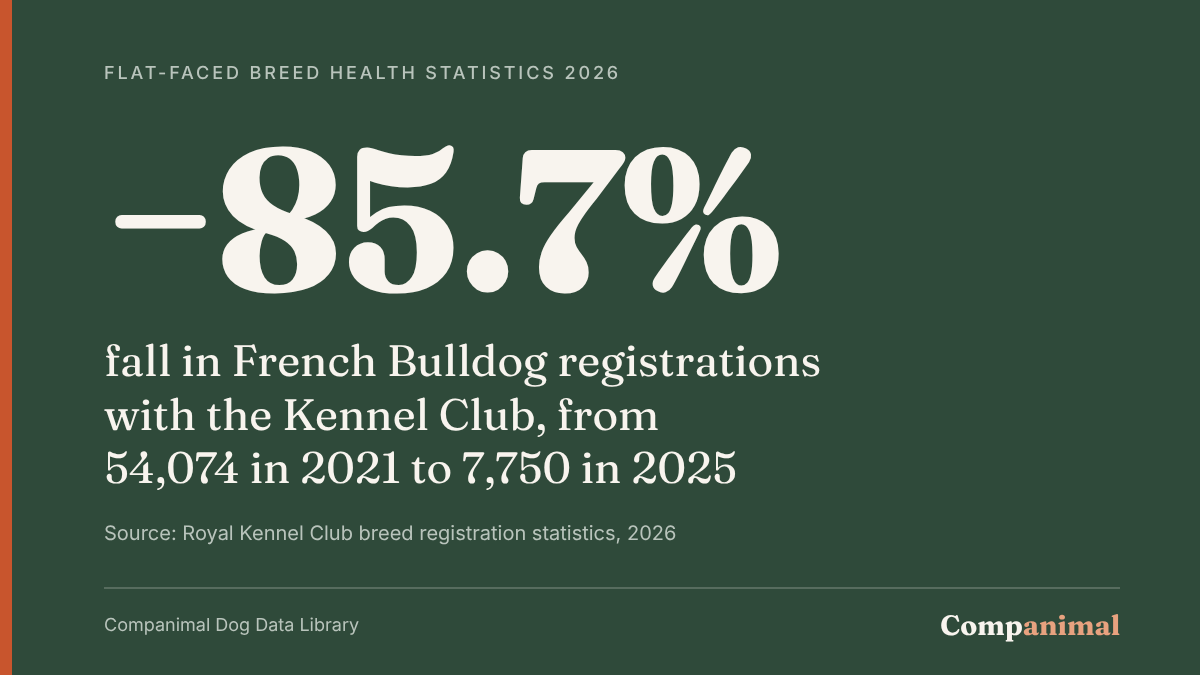
Far less than at their peak. French Bulldog registrations fell from 54,074 in 2021 to 7,750 in 2025, down 85.7%, and the Pug has lost 92% of its registrations since 2016 [3].
| Year | French Bulldog, Pug and Bulldog registrations | Share of all registrations |
|---|---|---|
| 2016 | 39,663 | 17.4% |
| 2018 | 57,192 | 22.8% |
| 2021 | 75,599 | 21.7% |
| 2023 | 35,622 | 15.7% |
| 2024 | 18,970 | 10.1% |
| 2025 | 11,295 | 7.0% |
Source: Royal Kennel Club registrations [3]; totals and shares are our calculation.
Source: Royal Kennel Club [3]
Our calculation from the breed tables. Registered pedigrees only; years not shown were not calculated.
Show the data
| Share of all registrations | |
|---|---|
| 2016 | 17.4% |
| 2018 | 22.8% |
| 2021 | 21.7% |
| 2023 | 15.7% |
| 2024 | 10.1% |
| 2025 | 7% |
The fall is continuing. In the first three months of 2026, French Bulldog registrations were down 37%, Bulldogs 34% and Pugs 43% on a year earlier [12]. Across the first nine months of 2026, French Bulldogs were down 34.5%, Bulldogs 19.3% and Pugs 18.6% on the same period of 2025 (our calculation) [13]. Our ten-year analysis of rising and declining dog breeds found the French Bulldog had the biggest one-year fall and the Pug the biggest ten-year fall of the breeds it ranked.
Outside the Kennel Club, the French Bulldog has dropped from 6th (2.3%) at its peak to 17th (1.2%) among newly acquired puppies in the Dogs Trust survey [14], and it is no longer the most advertised puppy on Pets4Homes for the first time in a decade [15].
That still leaves a large population. VetCompass estimates there are about 504,000 French Bulldogs, 187,000 Pugs and 132,000 Bulldogs in the UK [16], and Kennel Club figures don't cover the many that are never registered or are imported [4].
How many flat-faced dogs have breathing problems?
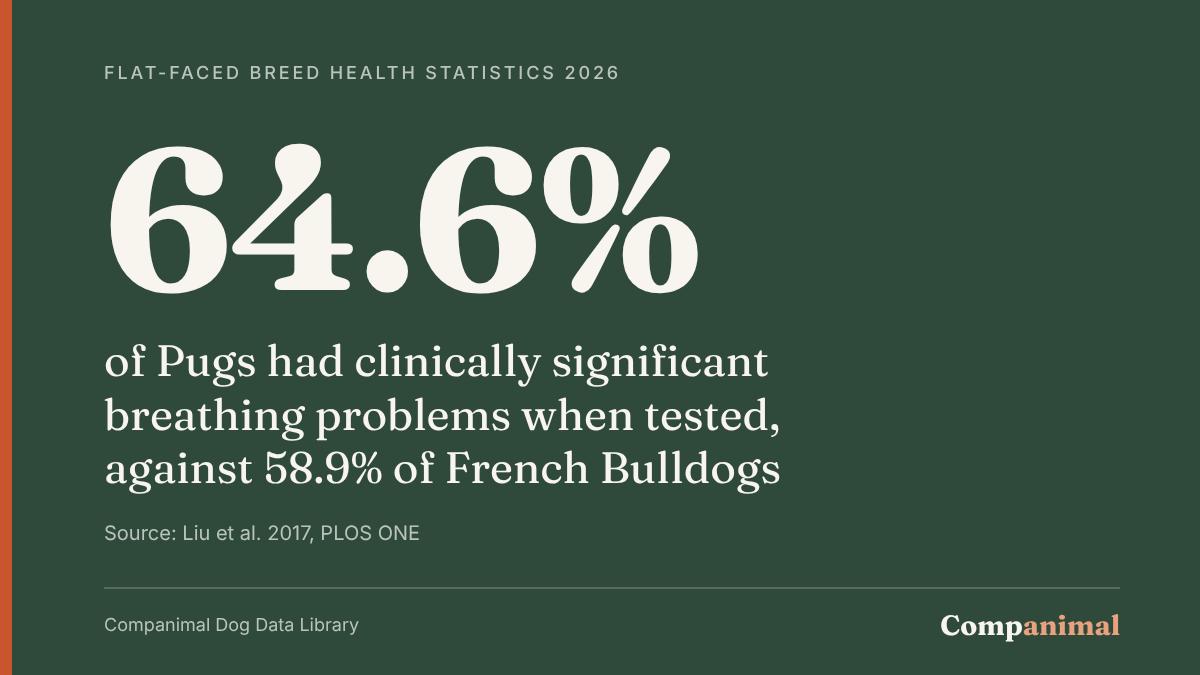
Most of them, when they are tested. On a standard breathing test, 64.6% of Pugs, 58.9% of French Bulldogs and 51.2% of Bulldogs were clinically affected by brachycephalic obstructive airway syndrome (BOAS), and only 4.8% to 10.9% breathed completely normally [1].
BOAS is a set of airway problems caused by the short muzzle: narrow nostrils, a long soft palate and crowded tissue in the throat. Affected dogs snore, struggle with exercise and heat, and can have trouble sleeping.
| Breed | Clinically affected on a breathing test (Grade II or III) [1] | Diagnosed with BOAS in vet records, 2016 | Odds of a BOAS diagnosis vs other dogs |
|---|---|---|---|
| Pug | 64.6% | 6.6% [17] | 53.92 times [17] |
| French Bulldog | 58.9% | 5.5% [18] | 30.89 times [18] |
| Bulldog | 51.2% | 4.2% [8] | 19.20 times [8] |
Source: Liu et al. 2017 [1]; O'Neill et al. [18][17][8]
The gap between the two measures is the point. Breathing tests grade every dog examined; vet records only count dogs whose problem a vet wrote down. The researchers say noisy breathing is often accepted as normal for these breeds, so it goes unrecorded [8].
What the Kennel Club's breathing scheme shows
The Royal Kennel Club and the University of Cambridge run a Respiratory Function Grading scheme, mainly for dogs being bred from. Of 4,660 registered dogs graded since 2019, 15.5% of French Bulldogs, 18% of Bulldogs and 18.5% of Pugs were Grade 2 or 3, the grades linked to clinical signs (our calculation from the published counts) [19].
These dogs were put forward by their breeders, so the results describe tested breeding stock rather than the breeds as a whole. From Crufts 2026, Grade 2 and 3 dogs of the three breeds can't be shown [20].
Do owners notice breathing problems?
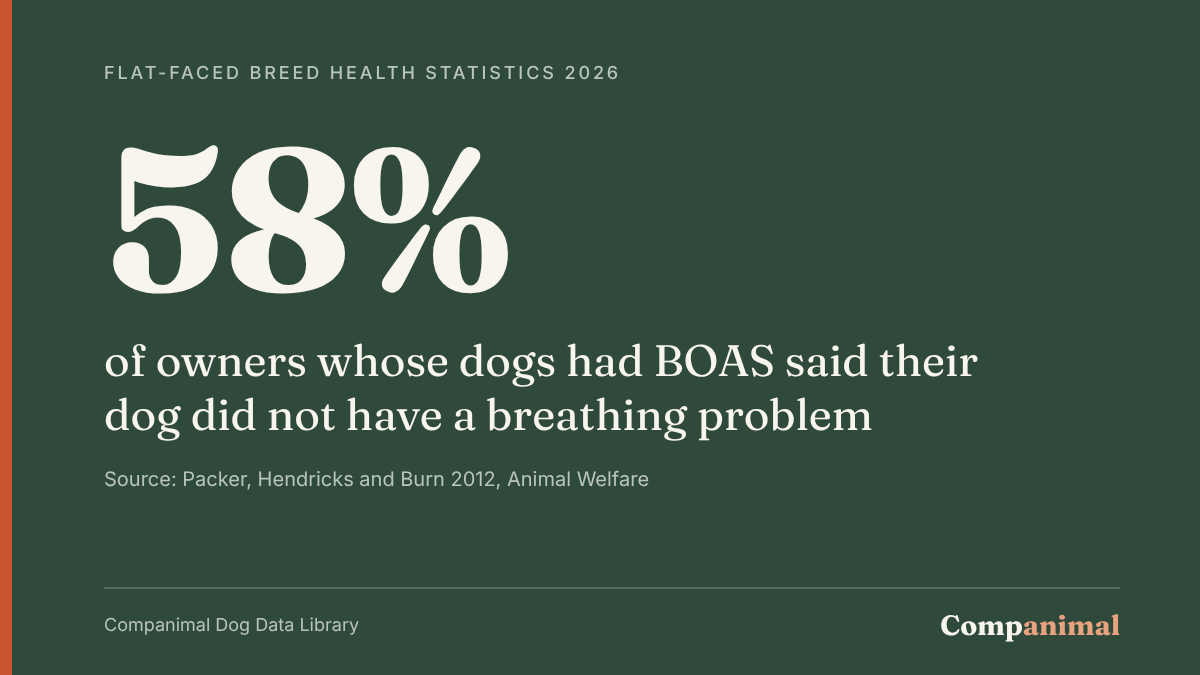
Often not. In a study of dogs examined at a vet hospital, 58% of owners whose dogs had BOAS said their dog did not have a breathing problem [7].
Snoring and snorting are easy to see as part of the breed's character rather than a sign of difficulty. Owners of these breeds are also, by and large, very happy with them:
| What owners say | Figure |
|---|---|
| Rated their dog in very good or the best possible health | 70.9% |
| Thought their dog less healthy than average for its breed | 6.8% |
| Reported breathing problems in their dog | 17.9% |
| Reported heat regulation problems | 36.5% |
| Dog had already had surgery linked to its body shape | 19.9% |
Source: Packer et al. 2019, survey of 2,168 owners of Pugs, French Bulldogs and Bulldogs [21]. The dogs had a median age of 2 to 2.5 years.
Most dog owners now accept the link: in 2025, 78% of dog owners agreed that having a flat face harms a dog's welfare [22]. But knowing isn't always the same as acting on it: 61% of adults say health matters when choosing a breed, yet only 39% would actively avoid a breed with known health problems [23].
In the BVA's 2018 survey, vets estimated that 75% of owners of flat-faced dogs hadn't known about the breed's potential problems before choosing it [24].
What other health problems are flat-faced dogs prone to?
Eyes, skin folds, ears and heat. Across UK vet records, brachycephalic dogs have higher odds of corneal ulcers (8.40 times), heart murmurs, hernias and several skin and ear problems than other dogs [9].
Each of the three main breeds has its own pattern. These are the problems with the highest odds compared with other dogs in UK vet records for 2016:
| Problem | French Bulldog [18] | Pug [17] | Bulldog [8] |
|---|---|---|---|
| Narrow nostrils (stenotic nares) | 42.14 times | 51.25 times | |
| Corneal ulcers | 4.38 times | 13.01 times | |
| Skin fold infection (dermatitis) | 11.18 times | 10.98 times | 38.12 times |
| Ear discharge | 14.40 times | 9.61 times | |
| Cherry eye | 26.79 times | ||
| Any disorder at all | 0.89 times | 1.86 times | 2.04 times |
Source: O'Neill et al. [18][17][8]. Blank cells mean the problem wasn't among those reported for that breed. Each figure compares the breed with all other dogs in the same records.
French Bulldogs show lower odds of having any disorder because the population is so young, with a median age of 1.5 years [18]; they had higher odds for 20 of the 43 common disorders studied [18]. Bulldogs stand out for skin folds and eyes, with by far the highest odds of skin fold infection in the table.
| Other risk | Figure | Source |
|---|---|---|
| Corneal ulcers, Pugs | 6.8% affected in a year, against 0.7% of other dogs | [17] |
| Heat-related illness, odds vs Labradors | Bulldog 13.95 times, French Bulldog 6.49, Pug 3.24 | [25] |
| Spinal malformations | Hemivertebrae in 93.5% of French Bulldogs with no neurological signs | [26] |
| Obesity, Pugs | 17.4% vs 6.9% of other dogs | [17] |
The Royal Kennel Club moved the French Bulldog to Category 3 of its Breed Watch list from January 2025, naming breathing difficulty, pinched nostrils and protruding eyes among its concerns [27][28]. The Pug is also listed in Category 3, the group of breeds with the most visible health concerns [28].
How long do French Bulldogs, Pugs and Bulldogs live?
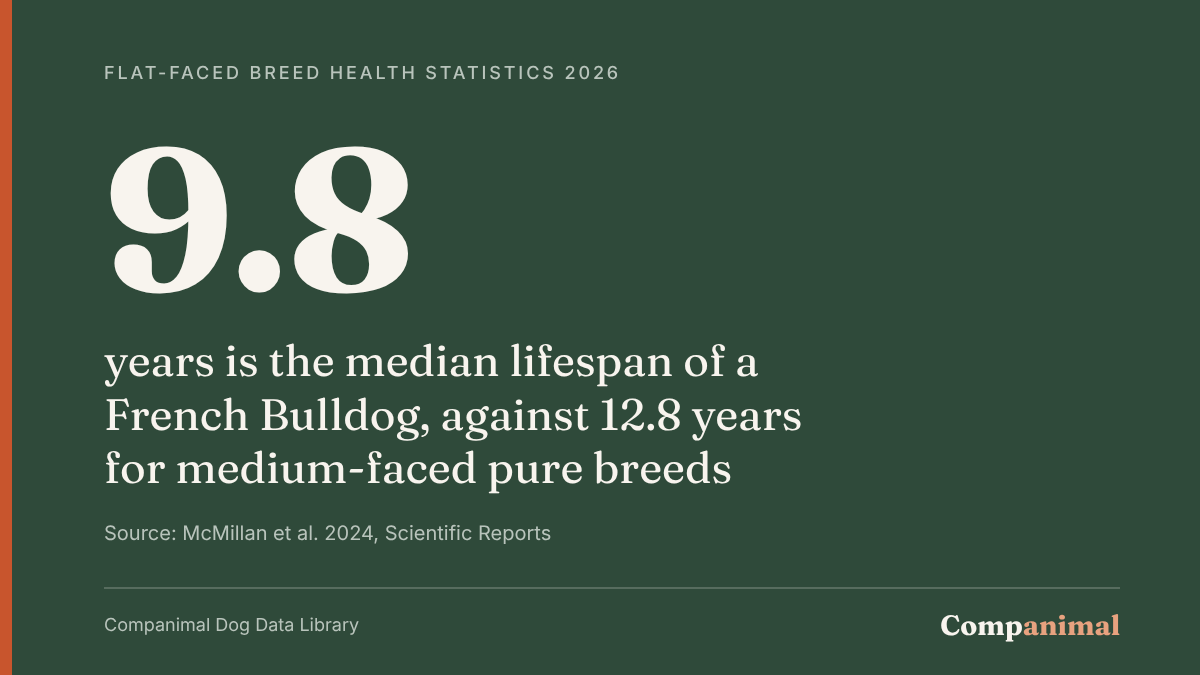
The largest UK study puts the median lifespan at 9.8 years for French Bulldogs and Bulldogs and 11.6 years for Pugs, against 12.8 years for medium-faced pure breeds [2]. French Bulldogs had 2.2 times the risk of dying early of crossbreeds, among the highest of any breed studied [2].
| Group | Median lifespan |
|---|---|
| Medium-faced (mesocephalic) pure breeds | 12.8 years |
| Crossbreeds | 12.0 years |
| All flat-faced (brachycephalic) breeds | 11.2 years |
| Pug | 11.6 years |
| Bulldog | 9.8 years |
| French Bulldog | 9.8 years |
Source: McMillan et al. 2024, Dogs Trust study of 584,734 UK dogs from 18 sources, including vets, insurers and breed registries [2].
Why you may see much lower figures
A 2022 study of UK vet records gave French Bulldogs a life expectancy at birth of just 4.53 years, against 11.23 years for all dogs [29]. The authors warn this is partly because the French Bulldog population was so young at the time, after registrations rose from 2,771 in 2011 to 39,266 in 2020 [29].
With so few older French Bulldogs in the records, deaths at a young age weigh heavily. The 9.8-year median from the larger study is the better guide, but both point the same way.
Do flat-faced dogs struggle to give birth?
Many do. Among bitches seen at UK emergency vet clinics, French Bulldogs had 15.9 times and Pugs 11.3 times the odds of a difficult birth (dystocia) of crossbreeds [30]. In 2016 vet records, 1.3% of French Bulldogs had a recorded difficult birth, against 0.1% of other dogs [18].
The often-quoted caesarean figure comes from an older survey of breed club owners, covering litters born up to 2004, which found that more than 80% of Boston Terrier, Bulldog and French Bulldog litters were delivered by caesarean [31]. No more recent UK caesarean rate by breed has been published.
How much do flat-faced dogs cost to insure and treat?
More than most dogs. One insurer's average claim for BOAS treatment is £2,387 for a French Bulldog and £2,382 for a Bulldog [32], and French Bulldog owners pay about a third more for cover than the average dog owner (our calculation) [33]. There is no independent UK study of insurance costs by breed, so these figures come from individual insurers.
| Measure | French Bulldog | Bulldog | Pug | Source |
|---|---|---|---|---|
| Average claim, breathing (BOAS) | £2,387 | £2,382 | Animal Friends, 2024 claims [32] | |
| Average claim, eye | £1,190 (eye ulcers) | £1,383 (cherry eye) | £1,071 (eye ulcer) | Animal Friends, 2024 claims [32] |
| Average premium a month (average dog £11.09) | £14.67 | £20.70 | £13.54 | MoneySuperMarket quotes, August to October 2026 [33] |
| Policyholders who claimed in 2025 | 34.6% | 24.8% | The Insurance Emporium, via MoneySuperMarket [33] |
French Bulldogs ranked first of all breeds for the number of claims at that insurer [33]. In a 2026 study, owners put the median cost of vet care for a Pug at £41.67 a month, against about £10 for Pug crosses [34].
Are flat-faced dogs ending up in rescue?
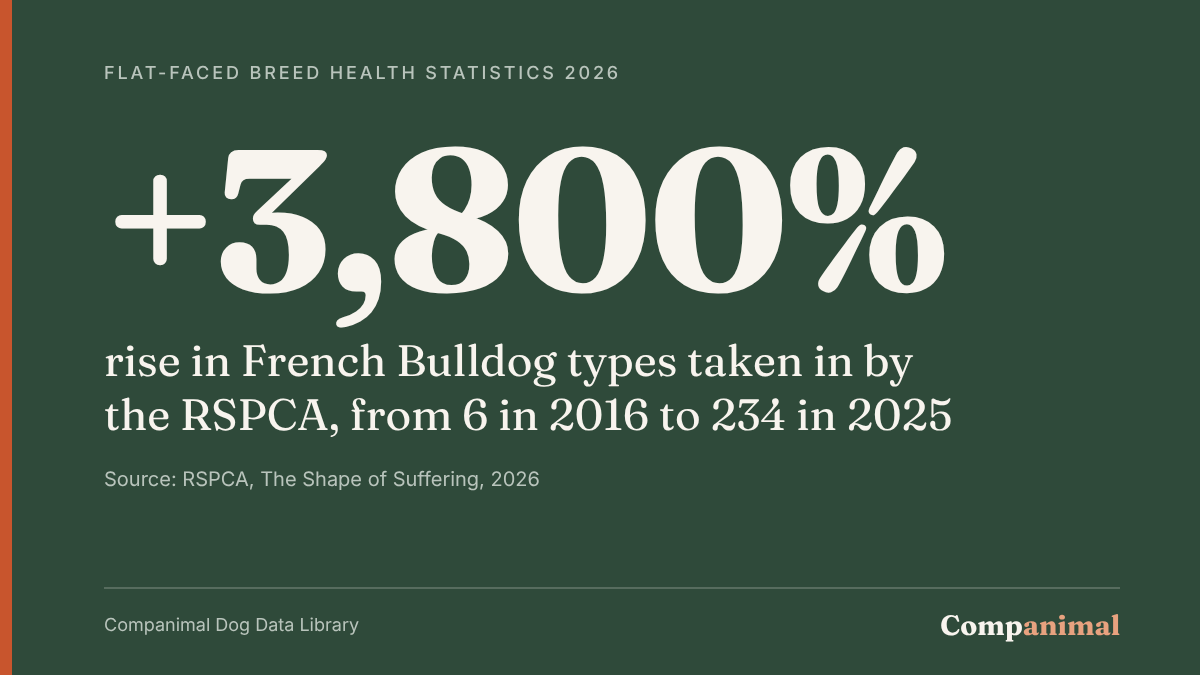
Yes, in growing numbers. The RSPCA took in 234 French Bulldogs or French Bulldog crosses in 2025, against six in 2016, according to its launch figures as reported by Nation.Cymru [6], a rise its own report puts at 3,800% [5].
| Dogs taken in by the RSPCA | 2016 | 2025 | Change |
|---|---|---|---|
| French Bulldog types | 6 | 234 | +3,800% [5][6] |
| Pug types | 25 | 73 | +192% [5][6] |
| English and Old Tyme Bulldogs | 2 | 31 | +1,450% [6] |
| French Bulldog and Pug types combined | 31 | 307 | Almost 10 times (our calculation) [5] |
Source: RSPCA [5]; RSPCA launch figures via Nation.Cymru [6]. The RSPCA's figures come from its own records and haven't been published in full, and other rescues don't publish a breed breakdown.
Illegal imports add to the problem. In 2024, 20% of small animal vets said they had seen a suspected illegally imported puppy, and French Bulldogs were the breed named most often, by 48% of them [35]. Between 2015 and 2018, 63% of puppies seized at the border were French Bulldogs, Pugs, English Bulldogs or Dachshunds [36].
Does crossbreeding help?
For Pugs, the early evidence says yes. In a 2026 UK study, every Jug (Jack Russell x Pug) and 97.9% of Puggles (Beagle x Pug) breathed normally, against none of the Pugs examined [34].
| Measure | Pug | Jug | Puggle |
|---|---|---|---|
| Normal breathing (Grade 0) | 0% | 100% | 97.9% |
| Owner-reported eye problems diagnosed by a vet | 35.3% | 5.9% | 12.5% |
| Quality of life rated "excellent" by owners | 58.8% | 92.2% | 81.2% |
| Median vet costs a month | £41.67 | £9.65 | £10.17 |
Source: Youens et al. 2026, vet examination and owner survey of 150 dogs [34].
Source: Youens et al. [34]
Small, volunteer sample of 150 dogs.
Show the data
| Normal breathing | |
|---|---|
| Pug | 0% |
| Jug | 100% |
| Puggle | 97.9% |
The crosses kept the Pug's character: the study found behaviour and the bond with owners were similar across all three [34]. The sample was small and owners volunteered, so treat it as a promising early result. The public appears ready for the change: in a survey of 4,899 people, respondents preferred less extreme versions of all three main breeds [37].
What this means if you're thinking about a flat-faced breed
The figures don't mean every French Bulldog, Pug or Bulldog will be unwell, but they do mean the checks matter more than for most breeds.
- Ask for both parents' breathing grades. The Kennel Club's Respiratory Function Grading scheme rates dogs from Grade 0 (no signs) to Grade 3 [19]. Parents graded 0 or 1 are the safer starting point.
- Look at the face, not just the photos. A visible muzzle and open nostrils matter: breathing problems rise sharply as the muzzle gets shorter [10].
- Listen to the parents at rest. Don't accept snoring or snorting as normal for the breed; 58% of owners of affected dogs didn't recognise the problem [7].
- Budget for vet care and insurance. BOAS claims average over £2,300 at one insurer, and French Bulldogs claim more than any other breed at another [32][33].
- Plan for warm weather. Bulldogs have about 14 times the odds of heat-related illness of a Labrador [25].
- Be wary of imported puppies. French Bulldogs are the breed vets most often see illegally imported, named by 48% of vets who saw one [35].
- Consider the alternatives. A less extreme type, a Pug cross [34] or a rescue dog are all worth a look; the RSPCA alone took in 234 French Bulldog types in 2025 [6].
If you do go ahead and look for French Bulldog puppies, every Companimal listing shows what we've checked against official records, such as a council breeding licence or Kennel Club registration, and says so plainly when we can't confirm something.
Methodology, sources and credit
How we compiled these figures
We checked 51 sources across vet records, clinical breathing studies, Kennel Club data, charities, vet bodies and insurers, opened every figure at its publisher on 28 October 2026 and re-checked the latest editions on 3 November 2026. We used primary sources wherever they exist: Kennel Club registrations, UK vet-record studies (VetCompass), clinical breathing studies from the University of Cambridge and the Royal Veterinary College, and figures published by charities and vet bodies. Insurer and marketplace figures are included only where nothing independent exists, and labelled as such. "Flat-faced" means brachycephalic breeds; most figures cover the French Bulldog, Pug and Bulldog, and we say when a source covers more. Vet-record figures count problems a vet recorded, while breathing-test figures grade every dog examined, so we never combine the two. Lifespan figures are given with how they were measured, because young populations make some estimates look much lower. Registration shares and changes are our calculation from the Royal Kennel Club's breed tables, using its published group totals (161,901 registrations in 2025).
Sources (37)
- Liu et al., Conformational risk factors of brachycephalic obstructive airway syndrome in pugs, French bulldogs, and bulldogs, PLOS ONE, 2017
- McMillan et al., Longevity of companion dog breeds: those at risk from early death, Scientific Reports, 2024
- Royal Kennel Club, Breed registration statistics: 10-yearly tables for all seven breed groups, March 2026
- Brachycephalic Working Group, via VetClick, Decade of campaigning sees significant decline in flat-faced dog registrations, May 2026
- RSPCA, The Shape of Suffering, July 2026
- Nation.Cymru, Breeding bombshell: Frenchies looking for homes soar due to hidden costs, July 2026
- Packer, Hendricks and Burn, Do dog owners perceive the clinical signs related to conformational inherited disorders as 'normal' for the breed?, Animal Welfare, 2012
- O'Neill et al., English Bulldogs in the UK: a VetCompass study of their disorder predispositions and protections, Canine Medicine and Genetics, 2022
- O'Neill et al., Unravelling the health status of brachycephalic dogs in the UK using multivariable analysis, Scientific Reports, 2020
- Packer et al., Impact of facial conformation on canine health: brachycephalic obstructive airway syndrome, PLOS ONE, 2015
- Tomlinson et al., A cross-sectional study into the prevalence and conformational risk factors of BOAS across fourteen brachycephalic dog breeds, PLOS ONE, 2026
- PDSA, PDSA responds to decline in flat-faced dogs, June 2026
- Royal Kennel Club, Quarterly breed registration statistics for all seven breed groups, November 2026
- Dogs Trust, National Dog Survey 2025: State of the nation, February 2026
- Pets4Homes, UK Pet Market 2026, March 2026
- Brachycephalic Working Group, Experts warn noisy breathing is sign of suffering in popular dogs, November 2024
- O'Neill et al., Health of Pug dogs in the UK: disorder predispositions and protections, Canine Medicine and Genetics, 2022
- O'Neill et al., French Bulldogs differ to other dogs in the UK in propensity for many common disorders, Canine Medicine and Genetics, 2021
- Royal Kennel Club, Annual RFG Scheme report 2025, 2026
- Royal Kennel Club, Kennel Club updates RFG Scheme Crufts entry criteria, October 2025
- Packer et al., Great expectations, inconvenient truths, and the paradoxes of the dog-owner relationship for owners of brachycephalic dogs, PLOS ONE, 2019
- PDSA, PAW Mini Report 2025, 2025
- Battersea, Cost of Cute, April 2026
- BVA, #Puglife aspirations prompting public to choose unhealthy breeds, say vets, January 2018
- Hall, Carter and O'Neill, Incidence and risk factors for heat-related illness (heatstroke) in UK dogs under primary veterinary care in 2016, Scientific Reports, 2020
- Ryan et al., Prevalence of thoracic vertebral malformations in French bulldogs, Pugs and English bulldogs with and without associated neurological deficits, The Veterinary Journal, 2017
- Royal Kennel Club, The Kennel Club updates Breed Watch for 2025, September 2024
- Royal Kennel Club, Breed Watch: Pug, Category 3 and French Bulldog, Category 3, 2026
- Teng et al., Life tables of annual life expectancy and mortality for companion dogs in the United Kingdom, Scientific Reports, 2022
- O'Neill et al., Canine dystocia in 50 UK first-opinion emergency-care veterinary practices: prevalence and risk factors, Veterinary Record, 2017
- Evans and Adams, Proportion of litters of purebred dogs born by caesarean section, Journal of Small Animal Practice, 2010
- Animal Friends, French Bulldog, Bulldog and Pug insurance pages, 2024 claims data
- MoneySuperMarket, French Bulldog, English Bulldog and Pug pet insurance pages, November 2026
- Youens et al., A solution right under our nose? Crossbreeding extreme brachycephalic dogs results in better health outcomes, Animal Welfare, 2026
- BVA, 1 in 5 UK vets report seeing illegally imported puppies last year, April 2025
- BVA and Dogs Trust, French Bulldog and Pug puppies top list of most illegally imported breeds, January 2019
- Youens et al., Beauty versus the beast: the UK public prefers less-extreme body shapes in brachycephalic dog breeds, Veterinary Record, 2025
Key facts about this page
| What this page is | A cited reference of UK health statistics for flat-faced dog breeds in 2026 |
| Clinically affected by BOAS on a breathing test | Pugs 64.6%, French Bulldogs 58.9%, Bulldogs 51.2% (Liu et al.) |
| French Bulldog median lifespan | 9.8 years, against 12.8 for medium-faced pure breeds (McMillan et al., 2024) |
| French Bulldog risk of early death | 2.2 times that of crossbreeds (McMillan et al., 2024) |
| Share of Kennel Club registrations | French Bulldog, Pug and Bulldog: 22.8% in 2018 to 7.0% in 2025 (our calculation) |
| Owners who missed the problem | 58% of owners of dogs with BOAS said there was no breathing problem |
| RSPCA intake | French Bulldog types: 6 in 2016 to 234 in 2025 |
| Sources | 37 cited here, drawn from 51 checked |
Using these figures? Please credit Companimal with a link to this page. It keeps research like this free.
Ready to look?
Looking for your next dog?
Browse sellers who show their working. Every listing tells you what has been disclosed, and what has not.
How Companimal shows you what a seller has disclosed
Account in good standing with a phone number confirmed by the seller.
A council licence number disclosed, or KC registration declared on the listing.
A credentialled breeder whose council licence we have checked against the register.
Information on a listing is self-declared by the seller and has not been independently checked. Read our methodology
More from this series
Calm, practical reads from the same hub.
Statistics · 10 min read
Puppy Price Statistics UK 2026: Up 16% in a Year, Back to 2019 in Real Terms
The average puppy advertised in the UK costs about £1,059 in 2026, and asking prices are up about 16% in a year. Figures from 19 sources, drawn from 47 checked, on what puppies cost, by breed and nation, and how prices compare with the pandemic peak.
Statistics · 14 min read
Dog Life Expectancy Statistics UK 2026: Between 11.2 and 12.5 Years
A UK dog lives about 11.2 to 12.5 years on average, depending on how it is measured, and breed can add or take away years. Figures from 33 sources, plus our analysis of 155 breeds and ten years of Kennel Club registrations.
Statistics · 16 min read
Most Popular Dog Breeds in the UK 2026: The Labrador Is Still Top Dog
The Labrador Retriever is the UK's most popular dog breed in 2026 on every measure of dogs owned. Our own analysis of 36 sources ranks the breeds across four measures and finds which have the most searches for every puppy advertised.