

Puppy advice: raising, training and caring for your puppy
Puppy Development Stages: An Age-by-Age Guide From Birth to Adulthood
An age-by-age map of puppy development stages, from the neonatal weeks to adulthood, with what your puppy needs and what breeders and owners can do at each step.
What this guide covers
Puppy development stages run from the neonatal weeks, when a puppy can barely crawl, through a short socialisation window, a juvenile phase and a long adolescence before adulthood. The window that does most to shape a dog's confidence closes at around 12 weeks, so what breeders and new owners do early matters most. Here is what happens at each age, what your puppy needs and what you can do to help.
Puppy development stages at a glance
Every puppy's growth and development follows its own pace, and breed size makes a big difference later on, but the order of the puppy stages is the same for all dogs. Most puppies move to their new homes at around eight weeks, in the middle of the socialisation period, which is why the first week at home and the weeks that follow carry so much weight.
| Stage | Rough age | What is happening | What the puppy needs |
|---|---|---|---|
| Neonatal | Birth to 2 weeks | Eyes and ears closed, crawling at 1 to 2 weeks | Warmth, food and their mum; gentle checks from the breeder |
| Transitional | 2 to 4 weeks | Eyes and ears open, first wobbly steps, walking by about 4 weeks | Calm handling and the everyday sights and sounds of a home |
| Socialisation period | 4 to 12 weeks | Rapid brain development, curiosity at its peak | Lots of positive, gentle new experiences, first with the breeder, then with you |
| Juvenile | 3 to 6 months | Teething, puberty begins around 4 to 5 months | Training, chew toys, short outings and steady routines |
| Adolescence | 6 months to about 2 years | Independence, testing boundaries, a second fear period | Patience, consistency and a return to the training basics |
| Adult | About 1 year (small) to 3 years (large) | Physically and mentally mature | Adult food, a stable routine and lifelong learning |
The ages above are guides, not deadlines. Sources describe the stages in slightly different ways, and your vet knows your individual puppy best.
Neonatal stage: birth to 2 weeks
In the first two weeks a newborn pup is completely dependent on their mother. Their world is warmth, milk and the smell of their mum and littermates. Their eyes and ear canals are still closed, and they begin crawling at around one to two weeks old.
What the puppy needs: their mother, a warm and quiet whelping area, and plenty of sleep and milk.
What breeders should do: the Royal Kennel Club describes these weeks as a quiet period while the bond between mother and puppies forms. Gently handle each puppy to check their progress, and talk to a vet about any concerns.
Transitional stage: 2 to 4 weeks
This is when a newborn puppy starts to become aware of the world. The PDSA says eyes open at around 10 to 12 days and ear canals open at around 14 to 16 days, and puppies are usually walking by four weeks. The Royal Kennel Club notes that eyesight is poor at first: puppies can see movement but may not notice objects that are standing still.
The third week is the first week of socialisation and habituation for the litter. Puppies begin to hear their surroundings, start to recognise their mum, littermates and people as family, and are ready to meet the normal sights and sounds of family life.
What breeders should do:
- Handle, cuddle and pick up each puppy regularly, keeping them upright and fully supported
- Let them hear ordinary household noise rather than keeping the litter in silence
- Keep notes on each puppy's progress so any puppy lagging behind gets a vet check
Socialisation period: 4 to 12 weeks
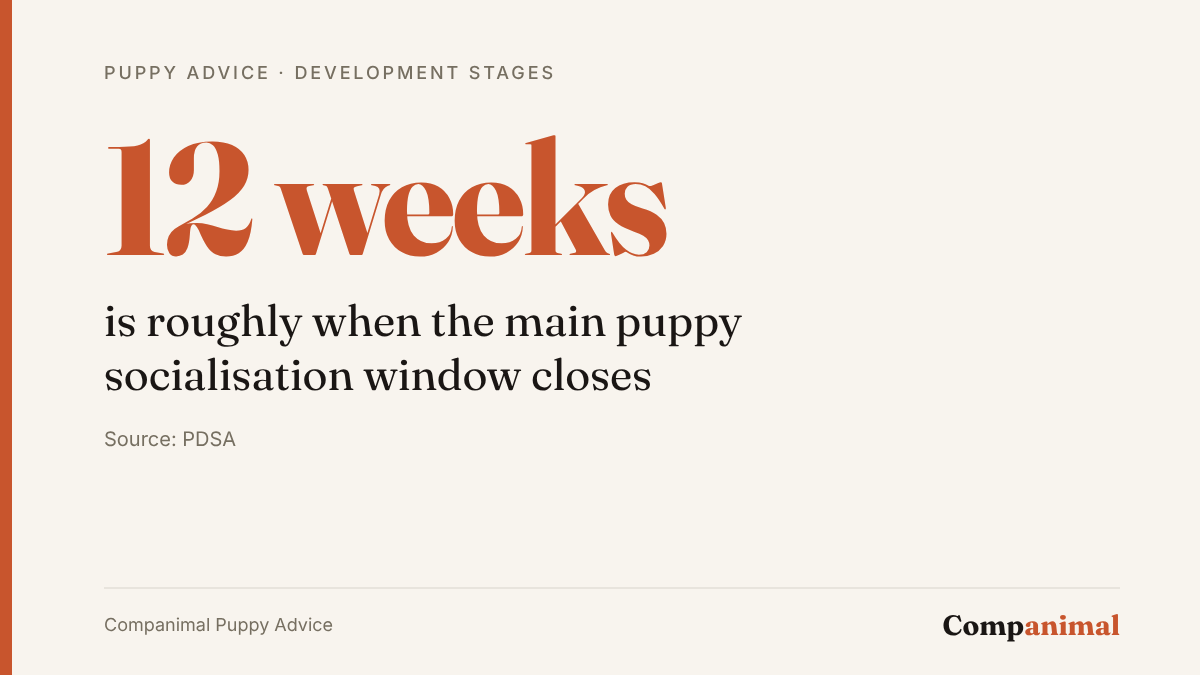
The socialisation period is the most important of all the puppy development stages. It runs from about 4 to 12 weeks of age, starting when puppies can move, see and hear. This is a critical time. Brain development is rapid during this window, and the PDSA warns that this ability to learn new things does not last forever. Puppies who miss out on gentle socialisation are more likely to grow into anxious dogs, and bad experiences at this age can leave lasting fears. Our guide to puppy socialisation covers how to do it well.
With the breeder: 4 to 8 weeks
From the fourth week, play behaviour develops and puppies begin problem solving and learning to cope with frustration. Weeks five to seven are described by the Royal Kennel Club as a crucial period for brain development: puppies are at their most curious and most willing to approach people, and their natural fearfulness is shaped by what they meet. Puppies are also moving on to solid food over these weeks.
What breeders should do:
- Give each puppy short spells away from mum and littermates, building up gradually, to encourage independence and help prevent separation problems later
- Offer toys such as tug toys, puzzle feeders and tunnels, and supervise visits to the garden or patio
- Once puppies are eating solid food happily, feed them from different bowls, including by hand
- Introduce as many different, gentle people as possible
- Begin positive exposure to new things before the puppies leave, which is often around eight weeks
Going home: 8 weeks
For most puppies, week eight is the last week before they move to a new home. Puppies should never be sold under eight weeks old, and buyers should always see the puppy with their mum. A responsible breeder will have a puppy pack, contract and any registration documents ready.
At home: 8 to 12 weeks
The second half of the socialisation window happens with you. Your new puppy still needs lots of calm, positive new experiences: people of different ages, everyday household noises, car travel, wearing a collar and short periods alone. Young puppies also need far more rest than most owners expect, and many take a while before sleeping through the night; our guide to puppy sleep explains how to help.
Until the vaccination course is complete, keep your puppy away from public places and unvaccinated dogs. You can still carry them outside to see the world and meet people, and your own garden is fine if unvaccinated dogs do not use it. Ask your vet when your puppy is protected, and read when puppies can go outside for the details.
What owners should do:
- Keep every new experience short, positive and at a distance your puppy is comfortable with
- If your puppy seems worried, move them away, then try again later from further back
- Settle a routine for meals, naps, toilet breaks and play
- Book your puppy's vet checks and finish the vaccination course
Juvenile stage: 3 to 6 months
The juvenile stage is a busy, fast-growing time. Puppy teething happens between about three and seven months, as the needle-sharp milk teeth fall out and are replaced by adult teeth. Expect lots of chewing and offer safe things to chew instead of your furniture. Our guide to puppy teething explains what to expect.
Puberty begins at around 4 to 5 months of age, as reproductive hormones start to circulate and your puppy grows more interested in exploring. Socialisation does not stop at 12 weeks either: the PDSA says new experiences and training should carry on throughout life.
What owners should do:
- Keep training sessions short, frequent and fun, using positive reinforcement such as treats, praise and play
- Build up exercise gradually, and check how long to walk a puppy for their age
- Follow the food and portion guidance in our puppy feeding guide as your puppy grows
- Keep meeting new people, dogs and places once your vet says it is safe
Adolescence: 6 months to 2 years
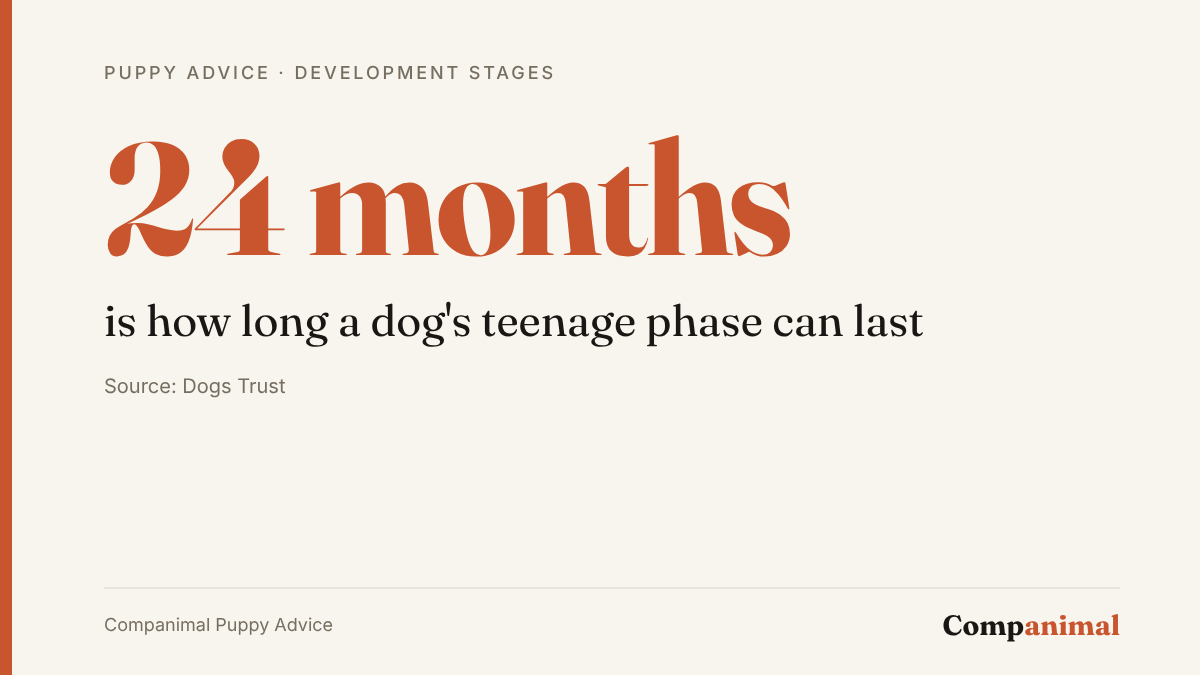
Adolescence is the teenage phase. Dogs Trust says it begins at around 6 to 12 months and can last up to 24 months, with dogs changing physically, emotionally and in their behaviour. Jumping up, pulling on the lead and poor impulse control are all part of normal development at this age. Physical development carries on too, and this is a good time to ask your vet about the right age to spay or neuter your dog.
Research led by Newcastle University found that dogs were more likely to ignore commands from their main carer at eight months than at five months, while their response to strangers did not drop in the same way. The researchers stressed that this is a phase and it will pass.
Dogs for Good describes a second fear period between about 6 and 14 months, linked to sexual maturity, when a previously confident dog may become wary of new things or people. Recall can slip as sniffing and exploring take priority, and chewing often increases between 7 and 12 months. Our page on adolescent dogs goes into more detail.
What owners should do:
- Go back to basics and train in quiet places before busy ones
- Use a long line and harness where recall could fail
- Never punish fear or chewing; give space, build exposure slowly and offer varied chews
- Make sure your dog gets enough sleep, quiet time and a safe place to retreat to
- Find a qualified trainer if you need support
Adult dog: when is a puppy fully grown?
There is no single age when a puppy becomes an adult dog, because growth rate depends so much on breed size. Dogs for Good says small breeds generally mature at about one year, while large breeds may not reach full maturity until about three years old. Large and giant dog breeds therefore take longer to finish growing and maturing than small dog breeds. In large breeds, the second fear period can also last longer.
Your vet can tell you when your dog has finished growing and how long to stay on puppy food, since good puppy nutrition supports healthy growth. Good habits still matter for life: the training you put in during adolescence tends to pay off as your dog matures.
Puppy milestones checklist
Use these puppy milestones as a rough guide when you check your puppy's progress. A puppy that is a little early or late is rarely a concern, but mention it to your vet if they seem well behind their littermates.
- 1 to 2 weeks: crawling
- 10 to 16 days: eyes open, then ear canals open
- 3 weeks: starting to hear, recognising family, early socialisation
- 4 weeks: walking, play and the start of the socialisation period
- 5 to 7 weeks: most curious and keen to meet people
- 8 weeks: the earliest age to go to a new home
- 12 weeks: end of the main socialisation window
- 3 to 7 months: teething
- 4 to 5 months: puberty begins
- 6 months to 2 years: adolescence
When to talk to your vet or a behaviourist
Puppy development varies, and most differences are normal. Call your vet if your puppy:
- Is not feeding well, is losing weight or seems weak in the first weeks
- Is clearly behind littermates in opening their eyes, walking or playing
- Has vomiting, diarrhoea, breathing problems or seems unwell at any age
- Becomes suddenly fearful, snappy or withdrawn, as a health problem can sometimes be the cause
Contact a vet immediately in an emergency. For fear or aggression that does not improve, ask your vet to refer you to a qualified behaviourist.
Frequently asked questions
What are the stages of puppy development?
The main stages are neonatal (birth to 2 weeks), transitional (2 to 4 weeks), the socialisation period (4 to 12 weeks), juvenile (3 to 6 months), adolescence (6 months to about 2 years) and adulthood.
What is the most important puppy stage?
The socialisation period, from about 4 to 12 weeks, is widely seen as the most important. Positive experiences now help a puppy grow into a confident, well-adjusted adult dog.
At what age does a puppy calm down?
Many dogs settle as they leave adolescence, which can last until around 2 years. Larger breeds often take longer to mature.
When do puppies go through a fear period?
A second fear period can happen during adolescence, between about 6 and 14 months. Stay patient, keep experiences positive and avoid forcing your dog towards things that worry them.
Can a puppy leave its mum before 8 weeks?
No. Puppies should never be sold under eight weeks old, and most go to their new homes in week eight.
Ready to look?
Looking for your next dog?
Browse sellers who show their working. Every listing tells you what has been disclosed, and what has not.
How Companimal shows you what a seller has disclosed
Account in good standing with a phone number confirmed by the seller.
A council licence number disclosed, or KC registration declared on the listing.
A credentialled breeder whose council licence we have checked against the register.
Information on a listing is self-declared by the seller and has not been independently checked. Read our methodology
More from this series
Calm, practical reads from the same hub.
Puppy advice: raising, training and caring for your puppy · 13 min read
Bringing a Puppy Home: Collection Day, First Night and First Week
How old a puppy should be to take home, what paperwork to collect, the car journey, the first night and a calm first-week routine, based on UK law and charity advice.
Puppy advice: raising, training and caring for your puppy · 12 min read
When Can Puppies Go Outside? The Garden, First Walks and Vaccinations
When your puppy can use the garden, be carried out to see the world, meet other dogs and finally go for a walk, with a stage-by-stage timeline and a first walk checklist.
Puppy advice: raising, training and caring for your puppy · 13 min read
Male or Female Dog? An Honest Guide to Choosing Your Puppy
Male or female dog? The real differences are smaller than most people think. Here is what actually changes, from size and seasons to neutering and living with another dog.