

Statistics
Cost of Owning a Dog UK 2026: At Least £828 a Year, and Vet Prices Up 86% Since 2015
A dog costs at least £69 to £116 a month to keep in the UK, and about £2,300 to £3,000 in its first year once you buy it. Figures from 32 sources on running costs, vet bills, insurance and the breeds that cost most.
What this guide covers
A dog costs at least £69 to £116 a month to keep in the UK, or £828 to £1,392 a year, before any vet treatment for illness or injury, according to PDSA's costings. Add the average asking price of about £1,059 and the cost of setting up, and the first year comes to roughly £2,300 to £3,000 (our calculation). The fastest-rising part of the bill is the vet: ONS figures for all pets show vet prices rose 86.0% between January 2015 and September 2026, almost twice as fast as prices overall. Figures come from 32 sources, drawn from 63 we checked.
£69 to £116
minimum monthly cost of keeping a small to large dog, before vet treatment for illness
[1]
£2,586
minimum first-year cost of a medium-sized dog, including the purchase price (our calculation)
[1][3]
+86.0%
rise in vet prices from January 2015 to September 2026, against 45.1% for all prices (our calculation, all pets)
[7][8]
£933m
paid out by insurers for dogs in 2024
[19]
£453
a year of expected life for an English Bulldog in purchase price and insurance, against £212 for a Shih Tzu (our calculation)
[3][15][22]
46%
of dog owners say owning a pet is more expensive than they expected
[27]
How much does it cost to own a dog in the UK?
At least £69 a month for a small dog, £83 for a medium dog and £116 for a large dog, on PDSA's estimate of the minimum monthly costs [1]. That covers food, insurance, health checks and boosters, flea and worm treatment, toys and poo bags, but not vet treatment for illness or injury, grooming, boarding or the price of the dog [1].
Over a lifetime, PDSA puts the minimum at £6,200 to £12,000 for a small dog, £9,000 to £14,000 for a medium dog and £8,200 to £18,800 for a large dog [1]. The ranges are wide because PDSA multiplies the yearly cost by life expectancy for each size, and large dogs tend to live shorter lives [1].
| Dog size | Minimum a month | Minimum a year | Set-up costs | Minimum over a lifetime |
|---|---|---|---|---|
| Small | £69 | £828 | £415 | £6,200 to £12,000 |
| Medium | £83 | £996 | £531 | £9,000 to £14,000 |
| Large | £116 | £1,392 | £560 | £8,200 to £18,800 |
Source: PDSA, costs last calculated in 2024 [1]; yearly figures are monthly costs times 12 (our calculation)
Battersea's guide, updated in October 2026, is higher: it says a dog typically costs around £1,800 to £2,000 a year [2]. The gap is mostly what each one counts. Battersea's figure includes grooming, treats and pet sitting or day care, which PDSA leaves out, and budgets £20 to £60 a month for insurance [2].
Why the estimates differ
| PDSA [1] | Battersea [2] | |
|---|---|---|
| Headline | £828 to £1,392 a year (our calculation from monthly costs) | Around £1,800 to £2,000 a year |
| What it counts | Food, insurance, routine health care, flea and worm treatment, toys, poo bags | The same, plus grooming, treats and 14 days of pet sitting a year |
| What it leaves out | Vet treatment for illness or injury, grooming, boarding, training, buying the dog | Vet treatment for illness or injury, buying the dog |
| Prices from | Online retail prices, calculated in 2024 | "Costings at the time of writing", page updated October 2026 |
| Basis | A stated minimum | A typical cost |
What does a dog cost in its first year?
About £2,300 to £3,000, depending on size, once you buy the dog (our calculation). We added the average asking price of £1,059 across 96,656 Pets4Homes adverts in the 12 months to November 2026 [3] to PDSA's set-up costs and a year of its minimum monthly costs [1].
| Dog size | Purchase price | Set-up costs | First 12 months | First-year total | Purchase price as a share |
|---|---|---|---|---|---|
| Small | £1,059 | £415 | £828 | £2,302 | 46.0% |
| Medium | £1,059 | £531 | £996 | £2,586 | 41.0% |
| Large | £1,059 | £560 | £1,392 | £3,011 | 35.2% |
Source: Pets4Homes breed price pages, average asking price weighted by adverts [3]; PDSA set-up and monthly costs [1]; totals and shares are our calculation
- Purchase price
- Set-up costs
- First 12 months
Source: Pets4Homes [3]; PDSA [1]; our calculation
The purchase price is one average asking price for all sizes. PDSA's costs are minimums calculated in 2024 and leave out vet treatment for illness or injury.
Show the data
| Purchase price | Set-up costs | First 12 months | |
|---|---|---|---|
| Small | £1,059 | £415 | £828 |
| Medium | £1,059 | £531 | £996 |
| Large | £1,059 | £560 | £1,392 |
These are floors, not typical bills. PDSA's costs date from 2024, and the ONS price index for pets, related products and services has risen 8.5% since its 2024 average (our calculation, all pets) [6]. PDSA's set-up list already includes initial vaccinations, wormers and neutering [1].
Some first-year costs are set by law. Every dog in the UK must be microchipped and registered by 8 weeks old, with a fine of up to £500 if it isn't [5]. In Northern Ireland a dog licence costs £12.50 a year [4].
How fast are vet bills rising?
Much faster than prices in general. The ONS consumer prices index for veterinary and other services for pets rose 86.0% from January 2015 to September 2026, against 45.1% for all items (our calculation) [7][8]. After allowing for general inflation, vet prices are about 28.2% higher than in 2015 (our calculation).
- Vet and other services for pets
- All items
- Products for pets
Source: ONS consumer prices index [7][8][9]
Index, 2015 = 100. Yearly averages, then the latest month. The pet series cover all pets, not only dogs.
Show the data
| Vet and other services for pets | All items | Products for pets | |
|---|---|---|---|
| 2015 | 100 | 100 | 100 |
| 2016 | 102.2 | 100.7 | 98 |
| 2017 | 105.4 | 103.4 | 99.7 |
| 2018 | 108.2 | 105.9 | 100.7 |
| 2019 | 113 | 107.8 | 102 |
| 2020 | 117 | 108.7 | 102.3 |
| 2021 | 121.6 | 111.6 | 103.3 |
| 2022 | 131.8 | 121.7 | 115.7 |
| 2023 | 148.1 | 130.5 | 130.2 |
| 2024 | 161.6 | 133.9 | 128 |
| 2025 | 173 | 138.4 | 128.1 |
| Sep 2026 | 183.8 | 144.1 | 132.8 |
Vet price inflation beat general inflation in every year from 2016 to 2025 except 2022, when it was 8.4% against 9.1% [7][8]. Its yearly average peaked at 12.3% in 2023, and in September 2026 it was still 4.8%, against 3.5% for all items [7][8].
| Price index (all pets) | January 2015 | September 2026 | Change |
|---|---|---|---|
| Vet and other services for pets | 98.8 | 183.8 | +86.0% |
| All items | 99.3 | 144.1 | +45.1% |
| Products for pets (including food) | 99.9 | 132.8 | +32.9% |
Source: ONS consumer prices index, 2015 = 100 [7][8][9]; changes are our calculation
The Competition and Markets Authority found the same pattern in its investigation of vet services. Between January 2016 and December 2023, average vet prices grew by 63% and average first-year treatment costs by 53%, while general services inflation grew by 32% (all pets) [10]. On the ONS index, vet prices rose 44.9% over 2016 to 2023, against 29.6% for all items (our calculation) [7][8].
The CMA also found that large vet groups owned 60% of practices, up from 10% in 2013, and that practices owned by the five largest groups charged prices 18.3% higher, on average, than independents between January 2023 and July 2024 [10]. Pet owners spent over £6.7 billion on vet and other services in 2024, about £390 per pet-owning household (all pets) [11].
What do common vet treatments cost?
A consultation cost £53.20 on average in 2023 in one insurer's claims data analysed by the CMA (all pets) [10], and neutering prices ranged from £200 to £600 on a small sample of practice websites the CMA reviewed [10]. Treatment for illness or injury can run into thousands: insurance claims for cruciate ligament damage averaged £2,918 in 2025 at one insurer [14], and the CMA cites cruciate surgery costing up to £5,000 [11].
| Routine item | Price | Source |
|---|---|---|
| Consultation | £53.20 average (2023, one insurer's data) | CMA [10] |
| Consultation | £45 | University of Liverpool vet practice, September 2026 [12] |
| Puppy vaccination course | £115 | University of Liverpool vet practice [12] |
| Annual booster | £75 | University of Liverpool vet practice [12] |
| Microchip | £22 | University of Liverpool vet practice [12] |
| Castration | £190 (under 25kg) to £475 (60kg and over) | University of Liverpool vet practice [12] |
| Spay | £235 (under 25kg) to £620 (60kg and over) | University of Liverpool vet practice [12] |
| Prescription fee | Median £18 at independents, £22.97 at large groups (2023) | CMA [10] |
Source: as listed. The Liverpool prices are one practice's published list, shown as an example
Medicines are a large part of many bills. The CMA estimated that vets appeared to sell medicines at two to five times what they paid for them, on average [10]. From 23 March 2027, large vet businesses must cap prescription fees at £21.40 for the first medicine and £12.70 for each extra one [13].
| Condition (dogs) | Average claimed, 2025 |
|---|---|
| Fractured leg | £3,308 |
| Cruciate ligament damage | £2,918 |
| Bladder stone | £2,251 |
| Cataract | £2,155 |
| Diabetes | £1,639 |
| Hip or elbow dysplasia | £1,578 |
| Foreign body | £1,320 |
| Cancer | £1,254 |
Source: Animal Friends, average vet fees for conditions claimed by dog owners in 2025 [14]; one insurer's customers
How much does dog insurance cost?
The typical quote for a dog was £11.09 a month in September 2026 on MoneySuperMarket, measured as the middle of its quotes for one pet with no pre-existing conditions [15]. Premiums roughly double with age, from £9.31 a month for a dog under one to £19.14 for a dog over seven [15].
| Dog's age | Average monthly quote, Aug to Oct 2026 |
|---|---|
| Under 1 | £9.31 |
| 1 to 2 | £7.99 |
| 3 to 4 | £9.07 |
| 4 to 5 | £12.06 |
| 6 to 7 | £15.41 |
| Over 7 | £19.14 |
Source: MoneySuperMarket [15]; quotes, not prices paid
The type of cover matters too. Lifetime policies averaged £12.16 a month, maximum benefit £14.92, time-limited £13.20 and accident only £3.75 [15]. Quotes fell in 2025: Go.Compare's average monthly dog quote dropped 12%, from £13.24 in January to mid-May 2024 to £11.68 in the same period of 2025, for lifetime cover on pets aged one and under [16].
Comparison site figures are quotes, not prices paid, and Battersea budgets more, £20 to £60 a month [2]. PDSA found 67% of dogs were insured in 2026 [17], and the Dogs Trust National Dog Survey found cover falls as dogs age, "probably due to increasing insurance premiums" [18].
How much do insurers pay out for dogs?
Insurers paid £933 million in claims for dogs in 2024, out of £1.23 billion for all pets [19]. Dogs account for 75.9% of all pet insurance payouts (our calculation). Across all pets, the average claim was £685, and a record 4.6 million owners took out insurance [19].
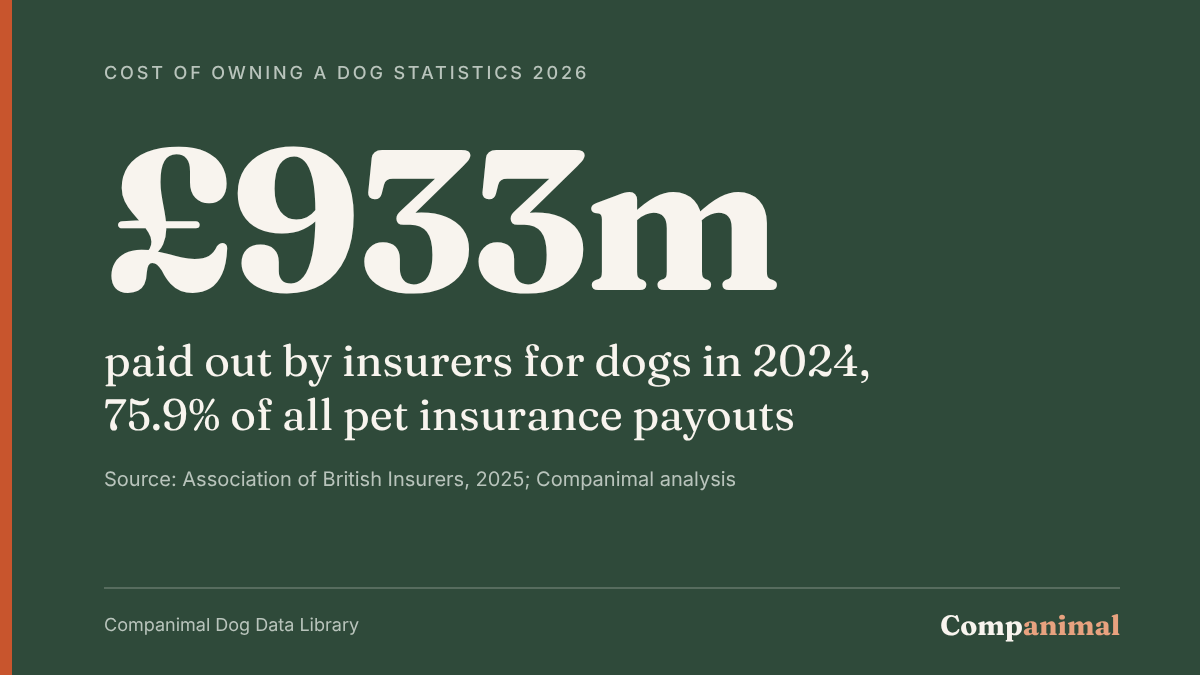
Payouts for dogs grew faster than vet prices. They rose 56.0% between 2020 and 2024, from £598 million to £933 million [19][21], while the ONS vet price index rose 38.1% (our calculation) [7]. The difference reflects more claims and more treatment as well as higher prices: in 2022 insurers handled 1 million dog claims and paid £800 million, about £800 a claim (our calculation) [20].
Source: Association of British Insurers [19][20][21]
We found no ABI dog payout figure for 2021 or 2023. ABI data covers its participating member firms only.
Show the data
| Claims paid for dogs | |
|---|---|
| 2020 | £598m |
| 2022 | £800m |
| 2024 | £933m |
Which dog breeds cost the most to own?
Among nine popular breeds, the English Bulldog costs the most for each year it is expected to live: about £453 a year in purchase price and insurance, more than twice the £212 for a Shih Tzu (our calculation) [3][15][22]. We divided each breed's average asking price, plus insurance at today's average quote for every expected year of life, by its life expectancy from vet records.
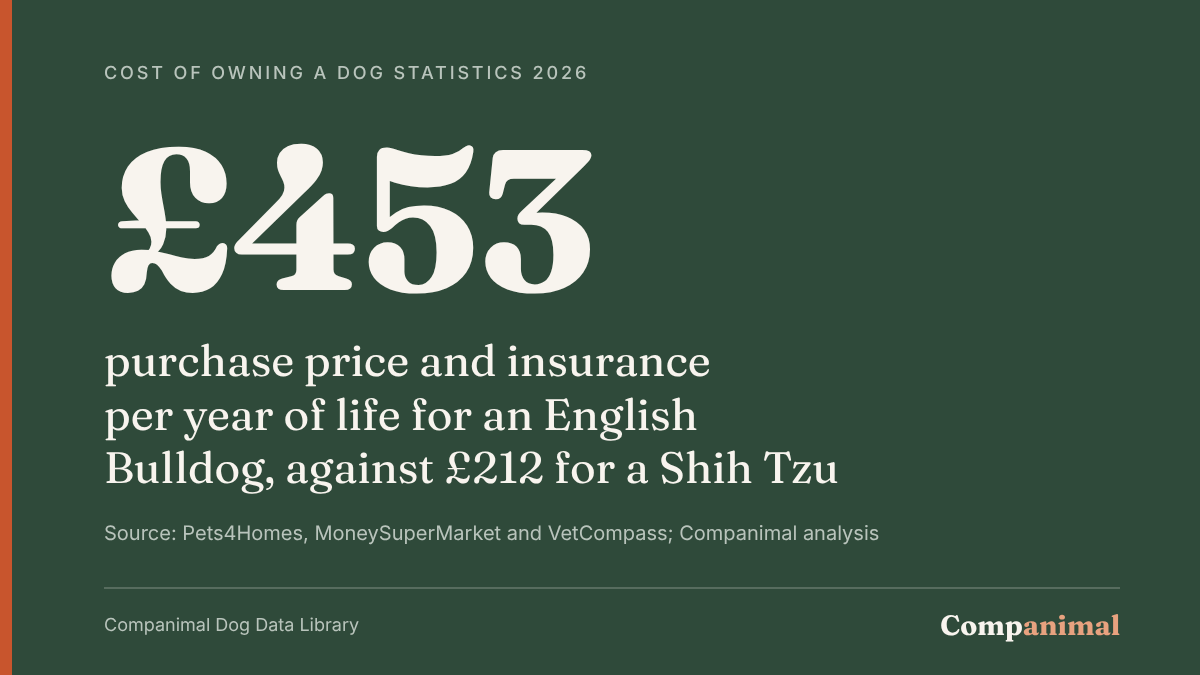
| Breed | Average asking price | Insurance a year | Life expectancy | Price per year of life | Price and insurance per year of life |
|---|---|---|---|---|---|
| English Bulldog | £1,515 | £248.40 | 7.39 years | £205 | £453 |
| Boxer | £1,589 | £219.96 | 10.04 years | £158 | £378 |
| French Bulldog | £855 | £176.04 | 4.53 years | £189 | £365 |
| Pug | £841 | £162.84 | 7.65 years | £110 | £273 |
| German Shepherd | £920 | £165.00 | 10.16 years | £91 | £256 |
| Labrador Retriever | £1,066 | £148.32 | 11.77 years | £91 | £239 |
| Staffordshire Bull Terrier | £1,278 | £124.80 | 11.33 years | £113 | £238 |
| Cocker Spaniel | £1,053 | £129.96 | 11.31 years | £93 | £223 |
| Shih Tzu | £989 | £122.52 | 11.05 years | £90 | £212 |
Source: Pets4Homes average asking prices, 12 months to November 2026 [3]; MoneySuperMarket average monthly quotes by breed, August to October 2026, times 12 [15]; life expectancy at birth from VetCompass life tables, Teng et al. 2022 [22]; per-year figures are our calculation
Treat this as a guide. The English Bulldog, French Bulldog and Pug have the shortest life expectancies in the table, so their up-front costs are spread over fewer years, and the English and French Bulldogs have two of the three highest premiums [15][22]. The French Bulldog's 4.53 years comes from a young population of dogs in vet records, which our dog life expectancy statistics explain in more detail. The health reasons behind those premiums are set out in our flat-faced breed health statistics.
How much do owners spend on food and everyday items?
Food can cost almost anything. For a 25kg dog, Which? found dry food from £0.35 a day and fresh delivered food at £3.89 a day [25]: about £128 a year for the cheapest dry food or £1,420 for fresh delivered food (our calculation), and some wet foods cost more than £10 a day [25]. Battersea budgets £10 to £50 a month for food, £10 to £30 for treats and £30 to £70 for grooming [2].
Everyday pet products have risen more slowly than vet bills. The ONS index for products for pets, which includes food, rose 32.9% from January 2015 to September 2026, less than prices overall (our calculation) [9]. Most of that came in two years: 12.0% in 2022 and 12.5% in 2023, followed by -1.6% in 2024 and 0.0% in 2025 [9].
| Item (Battersea guide) | A month | A year |
|---|---|---|
| Food | £10 to £50 | £120 to £600 |
| Insurance | £20 to £60 | £240 to £720 |
| Grooming | £30 to £70 | £240 to £600 |
| Treats | £10 to £30 | £120 to £360 |
| Routine health care and annual vet check | £26 | £312 |
| Poo bags | £3.50 | £42 |
| Pet sitting or day care | £390 to £1,200 |
Source: Battersea, updated October 2026 [2]
Across all UK households, with and without pets, the ONS Family Spending survey found average spending of £6.80 a week on pets and pet food in the year to March 2025, including £3.40 on pet food and £2.20 on vet and other services (all pets) [23]. That was down from £7.30 a week a year earlier [24]. Because these averages include households with no pet, they understate what a dog owner spends.
Do owners underestimate what a dog costs?
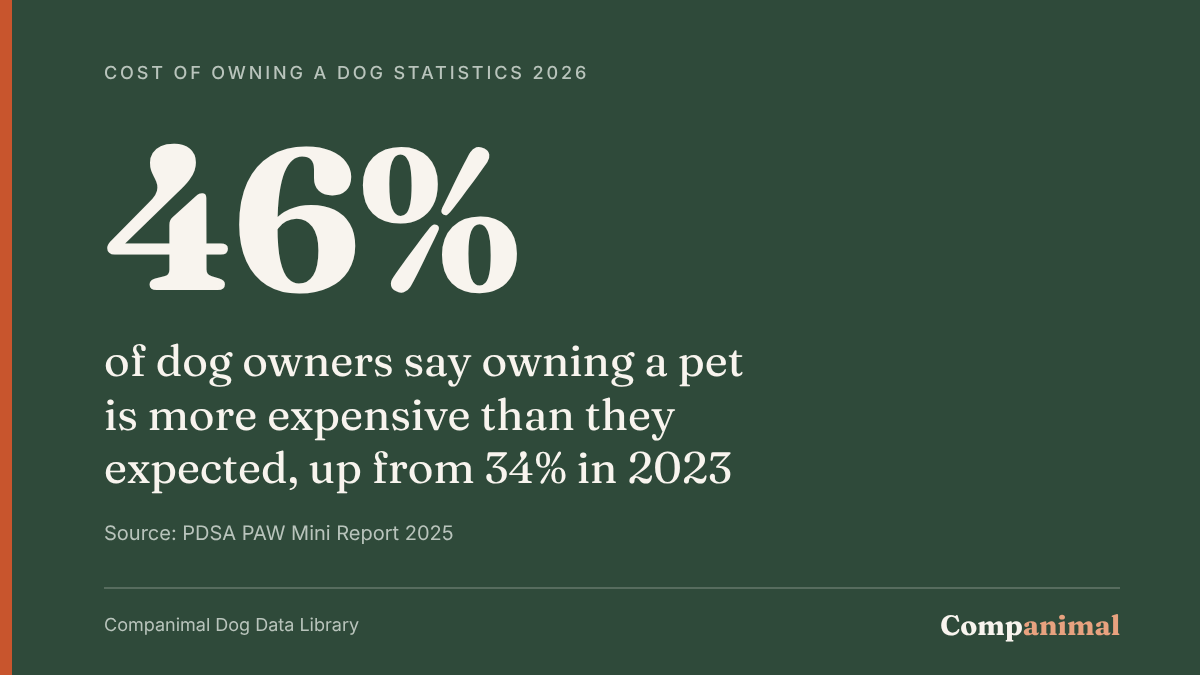
Many do. In 2023, 45% of dog owners underestimated the minimum monthly cost of a dog [26]. By early 2025, 46% of dog owners said owning a pet was more expensive than they expected, up from 34% two years earlier [27][26].
Vet bills are the biggest surprise. In the 2021 National Dog Survey, 52% of owners said vet visits cost more than they expected, the aspect most often reported as exceeding expectations [28]. Yet few owners check first: in 2025, only 27% researched the cost of buying or adopting a dog, and 22% the cost of vet bills [18].
| Measure (dog owners) | Figure | Survey |
|---|---|---|
| Underestimated the minimum monthly cost | 45% | PDSA, early 2023 [26] |
| Owning a pet costs more than expected | 34% (2023), 46% (2025) | PDSA [26][27] |
| Vet visits cost more than expected | 52% | Dogs Trust, 2021 [28] |
| Looked into the cost of owning a pet before getting one | 29% | PDSA, early 2024 [29] |
| Researched the cost of vet bills before getting a dog | 22% | Dogs Trust, 2025 [18] |
Source: as listed. PDSA surveys are weighted YouGov panels; the Dogs Trust survey is a large volunteer sample
How is the cost of living affecting dog owners?
About a quarter of dog owners say it has changed how they care for their dog. In early 2024, 26% of dog owners said the cost of living had affected how they care for their pet, up from 23% a year earlier, and 90% said the cost of owning their pet had risen [29]. 8% had delayed taking an ill dog to the vet because of the cost [29].
A study of 770 owners of dogs bought as puppies in 2020 found 36% had seen their household income hit by the cost-of-living crisis and 12.4% had made negative changes to their dog's care [30]. 8.88% had switched to lower insurance cover or a higher excess, and 7.86% to a cheaper brand of food [30]. Owners with household incomes up to £30,000 were far more affected: 23.2% said the crisis had hurt how they looked after their dog, against 6.9% of those on more than £90,000 [30].
The pressure has not eased. In March 2026, 56% of pet owners worried about affording vet bills, up from 49% in 2024, and 10% had cut spending on vet care in the past year (all pets) [31]. More than 47,000 people contacted Dogs Trust about giving up their dog in 2024, with financial reasons among the causes [32].
What this means if you're getting a dog
The figures point to a few checks that make a dog affordable for its whole life, not just on the day you bring it home. Each one is tied to a figure on this page.
- Budget for the year, not just the puppy. The purchase price is less than half of a minimum first-year bill: about £1,059 of £2,586 for a medium dog (our calculation) [1][3]. Our puppy price statistics show what each breed costs to buy.
- Price up the vet before you need one. Vet prices for all pets have risen 86.0% since January 2015 [7], and practices owned by the five largest groups charged 18.3% more than independents [10]. Ask local practices for their price lists.
- Insure early and expect the premium to rise. Quotes roughly double between a dog's first year and when it is over seven [15], and cruciate claims averaged £2,918 at one insurer in 2025 [14].
- Weigh breed health with breed price. The English Bulldog, Boxer, French Bulldog and Pug cost the most per year of life in our comparison, up to £453 for an English Bulldog [3][15][22].
- Ask for a written prescription. Vets appeared to sell medicines at two to five times what they paid, on average [10], and prescription fees will be capped at £21.40 at large vet businesses from March 2027 [13].
- Buy from someone you can check. Every Companimal listing shows what we've checked against official records, such as a council licence or Kennel Club registration, and says so plainly when we can't confirm something. Many rescues and rehomers list on Companimal too.
- Keep a buffer for the unexpected. 46% of dog owners found ownership cost more than they expected [27], and 8% had delayed vet treatment because of the cost [29].
Methodology, sources and credit
How we compiled these figures
We checked 63 sources across charity cost guides and surveys, ONS and Competition and Markets Authority data, insurers, comparison sites and peer-reviewed research, and opened every figure at its original publisher on 11 November 2026, except the Pets4Homes prices and the Teng et al. life tables, which we reused from our earlier puppy price and dog life expectancy statistics. Our own figures are labelled "our calculation". Price changes use the ONS consumer prices index (2015 = 100) for veterinary and other services for pets, products for pets and all items, comparing January 2015 with September 2026, the latest month published; these indices cover all pets. First-year costs add the Pets4Homes average asking price from our puppy price statistics to PDSA's 2024 minimum costs. Breed costs combine Pets4Homes asking prices, MoneySuperMarket average quotes and VetCompass life tables, and are a guide only, because insurance is held at today's quote for every year and the three sources cover different dogs. Insurance quotes are comparison site quotes, not prices paid, and some surveys cover all pets, which we label. Where two estimates disagree, as PDSA and Battersea do on the yearly cost, we show both and explain why.
Sources (32)
- PDSA, The cost of owning a dog, costs calculated 2024
- Battersea, The cost of owning a dog, October 2026
- Pets4Homes, Dog and puppy prices by breed, November 2026
- nidirect, Dog licensing and microchipping, March 2026
- GOV.UK, Get your dog or cat microchipped, October 2026
- Office for National Statistics, CPI index 09.3.4/5: pets, related products and services, October 2026
- Office for National Statistics, CPI index and annual rate 09.3.5.0: veterinary and other services for pets, October 2026
- Office for National Statistics, CPI index and annual rate 00: all items, October 2026
- Office for National Statistics, CPI index and annual rate 09.3.4.2: products for pets, October 2026
- Competition and Markets Authority, Veterinary services for household pets: final decision report, Part A, March 2026
- Competition and Markets Authority, Veterinary services market investigation: summary of final report, March 2026
- University of Liverpool Veterinary Practice, Price list, September 2026
- Competition and Markets Authority, Large veterinary businesses: complying with the CMA's Order, October 2026
- Animal Friends, How much do vet fees cost?, 2026
- MoneySuperMarket, Pet insurance facts, trends and statistics, October 2026
- Go.Compare, Pet insurance costs fall but breed and postcode could triple what you pay, July 2025
- PDSA, PDSA Animal Wellbeing (PAW) Report 2026, October 2026
- Dogs Trust, National Dog Survey 2025: State of the nation, 2026
- Association of British Insurers, Insurance payouts for pawly pets top £1 billion for third year in a row, May 2025
- Association of British Insurers, Insurers paid out over £1 billion to protect pets in 2022, 2023
- Association of British Insurers, Pet insurers handled claims worth the equivalent of £2.2 million every day in 2020, April 2021
- Teng et al., Life tables of annual life expectancy and mortality for companion dogs in the United Kingdom, Scientific Reports, 2022
- Office for National Statistics, Family spending workbook 1: detailed expenditure and trends, financial year ending 2025, June 2026
- Office for National Statistics, Family spending workbook 1: detailed expenditure and trends, financial year ending 2024, 2025
- Which?, Best cheap dog food, September 2026
- PDSA, PAW Report 2023, 2023
- PDSA, PAW Mini Report 2025, 2025
- Anderson et al., Owner expectations and surprises of dog ownership experiences in the United Kingdom, Frontiers in Veterinary Science, 2024
- PDSA, PAW Report 2024, 2024
- Brand et al., Impacts of the cost-of-living crisis on UK-based owners of pandemic puppies, Animals, 2026
- RSPCA, Animal Kindness Index 2026, August 2026
- Dogs Trust, Dogs Trust publishes annual report for 2024, September 2025
Key facts about this page
| What this page is | A cited reference of what it costs to own a dog in the UK in 2026, with Companimal's own calculations |
| Minimum monthly cost | £69 (small dog) to £116 (large dog), before vet treatment for illness (PDSA) |
| Minimum lifetime cost | £6,200 to £18,800 depending on size, not counting the purchase price (PDSA) |
| First-year cost | About £2,300 to £3,000 including an average £1,059 purchase price (our calculation) |
| Vet prices | Up 86.0% from January 2015 to September 2026, against 45.1% for all prices (ONS, all pets, our calculation) |
| Insurance | Typical quote £11.09 a month (MoneySuperMarket, September 2026); £933m paid for dogs in 2024 (ABI) |
| Costliest breed per year of life | English Bulldog, about £453 a year in purchase price and insurance (our calculation) |
| Sources | 32 cited here, drawn from 63 checked |
Using these figures? Please credit Companimal with a link to this page. It keeps research like this free.
Ready to look?
Looking for your next dog?
Browse sellers who show their working. Every listing tells you what has been disclosed, and what has not.
How Companimal shows you what a seller has disclosed
Account in good standing with a phone number confirmed by the seller.
A council licence number disclosed, or KC registration declared on the listing.
A credentialled breeder whose council licence we have checked against the register.
Information on a listing is self-declared by the seller and has not been independently checked. Read our methodology
More from this series
Calm, practical reads from the same hub.
Statistics · 10 min read
Puppy Price Statistics UK 2026: Up 16% in a Year, Back to 2019 in Real Terms
The average puppy advertised in the UK costs about £1,059 in 2026, and asking prices are up about 16% in a year. Figures from 19 sources, drawn from 47 checked, on what puppies cost, by breed and nation, and how prices compare with the pandemic peak.
Statistics · 14 min read
Dog Life Expectancy Statistics UK 2026: Between 11.2 and 12.5 Years
A UK dog lives about 11.2 to 12.5 years on average, depending on how it is measured, and breed can add or take away years. Figures from 33 sources, plus our analysis of 155 breeds and ten years of Kennel Club registrations.
Statistics · 16 min read
Most Popular Dog Breeds in the UK 2026: The Labrador Is Still Top Dog
The Labrador Retriever is the UK's most popular dog breed in 2026 on every measure of dogs owned. Our own analysis of 36 sources ranks the breeds across four measures and finds which have the most searches for every puppy advertised.