

Statistics
Crossbreed and Designer Dog Statistics UK 2026: Between 14% and 42% of Dogs Are Crossbreeds
Between 14% and 42% of UK dogs are crossbreeds, depending on who is counting, and designer crosses such as the Cockapoo are a growing share of puppies. Figures from 39 checked sources on numbers, health, behaviour and price.
What this guide covers
Between 14% and 42% of UK dogs are crossbreeds, depending on who is counting, and designer crosses such as the Cockapoo are taking a growing share of puppies: 26.1% of puppies bought in 2020, up from 18.8% in 2019, and 35% of puppies sold on Pets4Homes in 2025. The largest UK study found designer crosses no healthier and no less healthy than their parent breeds, some crosses showed more behaviour problems, and no dog is reliably hypoallergenic. This page draws on 39 checked sources, including vet records, charity surveys and peer-reviewed research.
42%
of dogs in the Dogs Trust National Dog Survey 2025 are crossbreeds
[2]
5.8%
of all dogs in that survey are Cockapoos, the most common named cross
[2]
26.1%
of puppies bought in 2020 were designer crosses, up from 18.8% in 2019
[8]
86.6%
of health comparisons found no difference between a designer cross and its parent breeds
[13]
44.4%
of behaviour comparisons found the designer cross scored worse than a parent breed
[22]
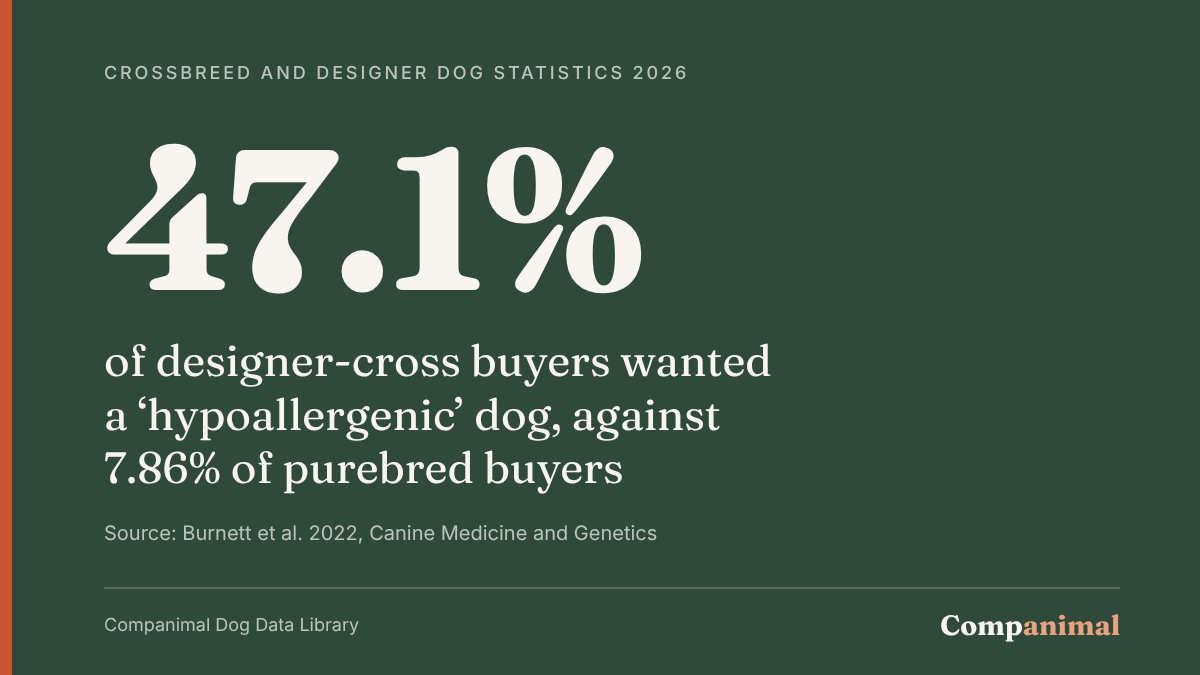
47.1%
of designer-cross buyers wanted a hypoallergenic dog, against 7.86% of purebred buyers
[7]
How many dogs in the UK are crossbreeds?
Somewhere between 14% and 42% of UK dogs are crossbreeds. The answer depends on whose records you count, because no official register covers them: the Royal Kennel Club's breed register covers pedigree dogs only.
Vet records are the most complete count. Of 2.2 million dogs under vet care in 2019, 6.7% were designer crossbreeds and 24.0% were other crossbreeds, about 30.7% in all (our sum) [1]. Owner surveys run higher: 42% in the Dogs Trust National Dog Survey [2][3], and 42% in PDSA's 2023 report, where 28% of owners called their dog a crossbreed and 14% a "specialist" crossbreed such as a Labradoodle (our sum) [4]. A 2019 population model that leans heavily on breed registry records puts it at 14.2% [5].
| Source | Year | Crossbreed share | How it counts |
|---|---|---|---|
| Population model [5] | 2019 | 14.2% | Modelled from 18 data sources, including The Kennel Club's breed register, which supplied 45% of records |
| VetCompass vet records [1] | 2019 | 30.7% (our sum) | Every dog under care at taking-part practices |
| Dogs Trust National Dog Survey [3] | 2021 | 42% (our sum of 27.6% known crosses and 14.4% unknown mixes) | Volunteer survey of 440,423 dogs |
| PDSA PAW Report [4] | 2023 | 42% (our sum of 28% crossbreed and 14% specialist crossbreed) | YouGov survey of owners describing their own dog |
| Dogs Trust National Dog Survey [2] | 2025 | 42% | Volunteer survey of 423,175 dogs; not nationally representative |
The same split in methods explains why estimates of the UK dog population vary so widely. Dogs Trust's 2026 survey, answered by about 180,000 people, did not publish a new crossbreed share; unknown mixes were again the largest single group, at 10% of dogs [6].
Designer crosses are concentrated in younger dogs: they made up 11.2% of dogs under one year old in 2019, against 2.2% of dogs aged ten or over [1].
What are the most popular crossbreeds in the UK?
The Cockapoo is the UK's most common named crossbreed, at 5.8% of all dogs in 2025, level with the Cocker Spaniel and behind only the Labrador among named types [2]. The Cavapoo (1.5%) and Labradoodle (1.3%) follow [2].
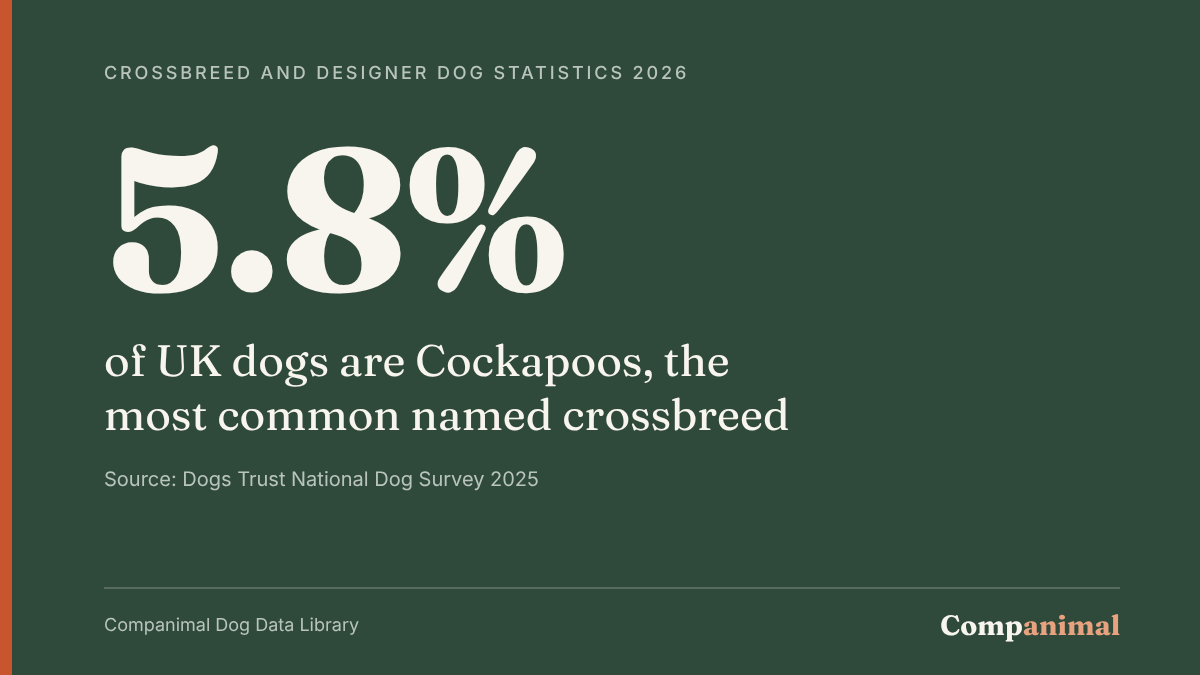
Because crossbreeds are not on the Royal Kennel Club's breed register, the Cockapoo never appears in the official breed rankings, even though owner surveys find it about as common as the Cocker Spaniel [2]. It stayed in the top five of Dogs Trust's 2026 survey [6].
| Cross | Parents | Share of all dogs, 2025 [2] | Share of crossbred dogs excluding unknown mixes, 2019 [5] | Dogs under vet care, 2019 [1] |
|---|---|---|---|---|
| Cockapoo | Cocker Spaniel x Poodle | 5.8% | 4.1% | 73,037 |
| Cavapoo | Cavalier King Charles Spaniel x Poodle | 1.5% | 1.1% | 14,146 |
| Labradoodle | Labrador x Poodle | 1.3% | 2.5% | 21,802 |
| Sprocker | Cocker Spaniel x Springer Spaniel | Not published | 1.0% | 9,348 |
Source: Dogs Trust [2]; McMillan et al. [5]; O'Neill et al. [1]
Among puppies bought in 2019 and 2020, the Cockapoo made up 32.1% of designer crosses, ahead of the Labradoodle (11.6%), Cavapoo (9.10%), Sprocker (6.00%) and Goldendoodle (3.20%) [7]. The Lurcher, an older working cross, is the fourth most common crossbreed overall [2].
Are designer crossbreeds becoming more popular?
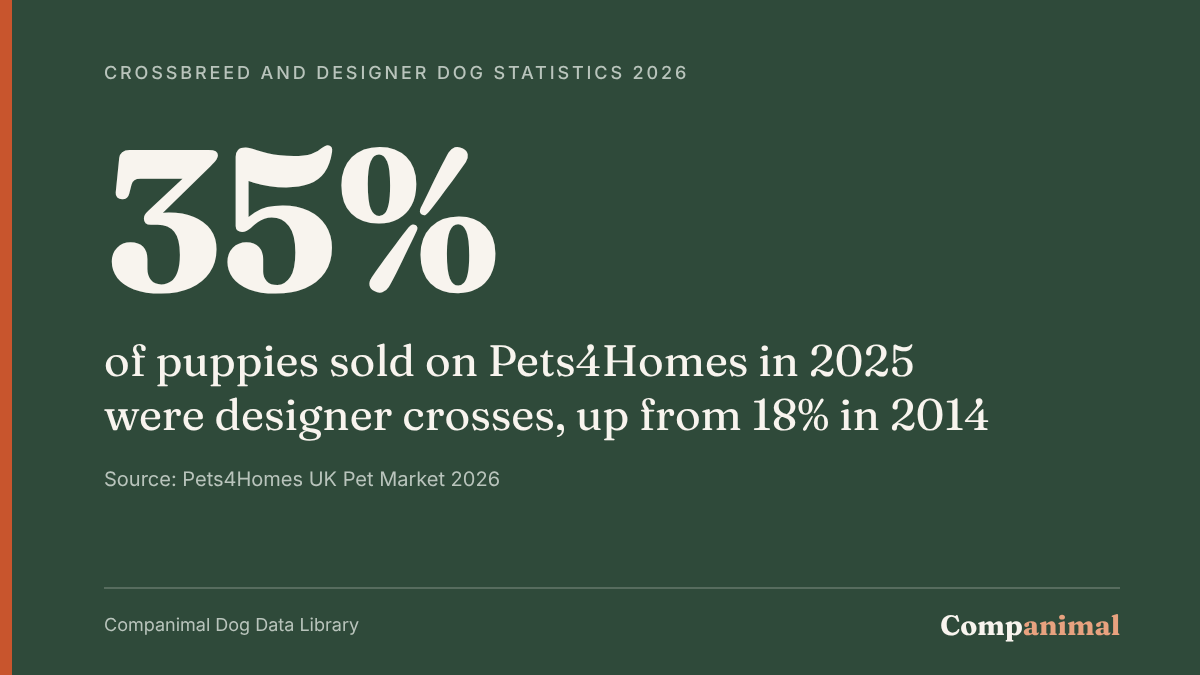
Yes, over the past decade, though the fastest growth has moved on from the Cockapoo. Designer crosses rose from 18.8% of puppies bought in 2019 to 26.1% in 2020 [8], and from 18% of puppies sold on Pets4Homes in 2014 to 35% in 2025 [9].
| Measure | Earlier | Later | Source |
|---|---|---|---|
| Designer crosses, share of puppies bought | 18.8% (2019) | 26.1% (2020) | [8] |
| Owners describing a "specialist crossbreed" | 8% (2017) | 14% (2023) | [4] |
| Designer crosses, share of puppies sold on Pets4Homes | 18% (2014) | 35% (2025) | [9] |
| Pedigrees, share of puppies sold on Pets4Homes | 82% (a decade earlier) | 65% (2025) | [9] |
PDSA's owner surveys show a steady climb: owners describing a "specialist crossbreed" rose from 8% in 2017 to 9% in 2018, 10% in 2019, 11% in February 2020 and 14% in 2023 [4].
Source: PDSA PAW Report 2023 [4]
The 2020 figure comes from fieldwork in February 2020. PDSA published no figure for 2021 or 2022.
Show the data
| Specialist crossbreed | |
|---|---|
| 2017 | 8% |
| 2018 | 9% |
| 2019 | 10% |
| 2020 | 11% |
| 2023 | 14% |
The pandemic boom was strongest in London, where designer crosses made up 33.3% of puppies bought in 2020, and grew fastest in the North East (+133.0%) and North West (+129.7%) [8].
Within the crosses, tastes are shifting. Dogs Trust found the Cockapoo "peaked in popularity during 2020", while Cavapoos and Maltipoos are "still rising" [10]. Its 2025 survey puts the Bernedoodle (+25% a year) and Maltipoo (+19% a year) among the fastest-growing types of any kind [2]. On Pets4Homes, the Goldendoodle has had the most buyers per puppy for three years running [11], although by 2026 Pets4Homes said terriers and working breeds had "overtaken crossbreeds" as the most sought-after puppies [12].
Are designer crossbreeds healthier than purebred dogs?
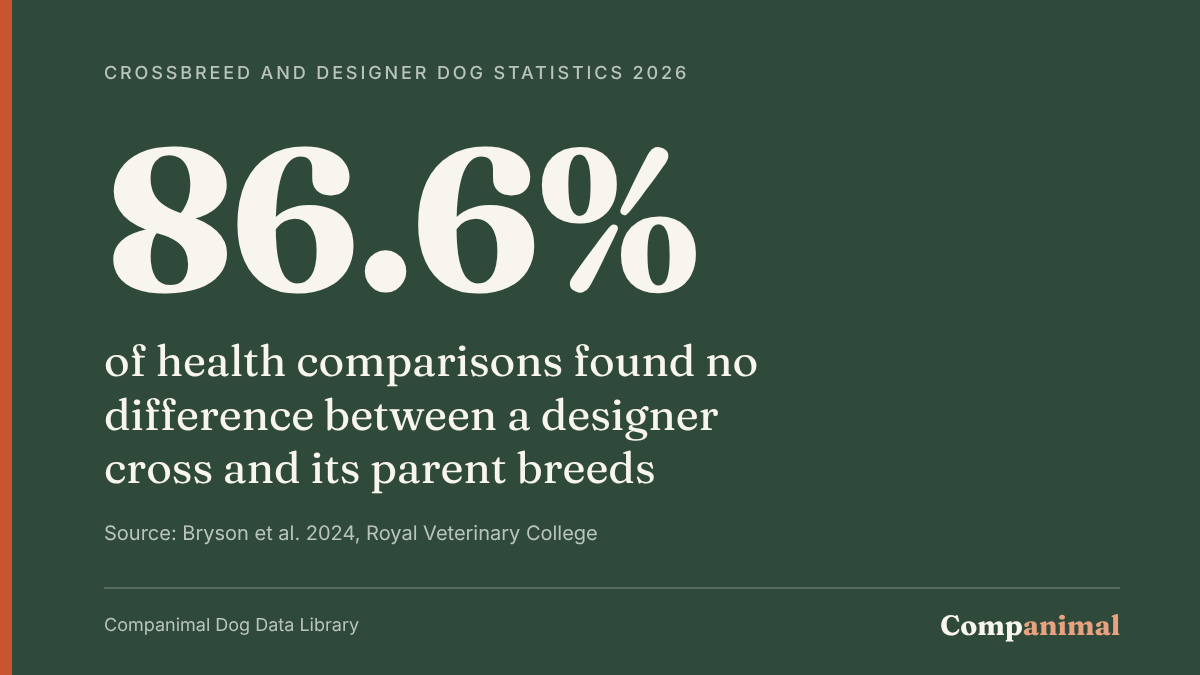
On average, no healthier and no less healthy. The largest UK study compared Cockapoos, Cavapoos and Labradoodles with their parent breeds on 57 health problems: in 86.6% of the 342 comparisons there was no difference, the cross had higher odds in 7.0% and lower odds in 6.4% [13].
The Royal Veterinary College study covered 9,402 dogs aged up to five, so it says little about problems that appear later in life [13]. Owners reported the problems themselves, and they chose to take part.
| Problem | Cross vs parent breed | What the study found [13] |
|---|---|---|
| Ear infections | Cockapoo vs Cocker Spaniel | Higher odds in the Cockapoo (OR 2.13) |
| Ear infections | Labradoodle vs Labrador | Higher odds in the Labradoodle (OR 1.80) |
| Itchy skin | Cockapoo vs Cocker Spaniel | Higher odds in the Cockapoo (OR 2.67) |
| Hip or elbow dysplasia | Labradoodle vs Labrador | Lower odds in the Labradoodle (OR 0.37) |
| Kneecap problems (patellar luxation) | Cockapoo vs Poodle | Lower odds in the Cockapoo (OR 0.49) |
Source: Bryson et al. 2024 [13]. OR is the odds ratio: above 1 means the problem was more likely in the cross, below 1 less likely.
Crossing does not clear a parent's inherited problems. An earlier UK eye study found multifocal retinal dysplasia in 4.6% of Labradoodles examined, more than in Labradors [14], and the British Veterinary Association lists the Labradoodle and Goldendoodle among breeds commonly at risk of hip dysplasia [15]. The Royal Kennel Club advises asking what health tests both parents have had [16].
The clearest benefit is in crosses of extreme flat-faced breeds. In a 2026 study, every Jug (Jack Russell x Pug) and 97.9% of Puggles (Beagle x Pug) breathed normally, against none of the Pugs, and median vet costs were about £10 a month against £41.67 for Pugs [17]. The sample was small: 150 dogs.
Outside the UK, a US study of 24 inherited disorders found 13 equally common in purebred and mixed-breed dogs, 10 more common in purebreds and 1, cruciate ligament rupture, more common in mixed breeds [18].
Do crossbreeds live longer?
The UK studies disagree, and none measures designer crosses on their own. Vet-record studies find crossbreeds living as long as or longer than purebred dogs; a Dogs Trust study found the reverse [19][20][21].
| Study | Data | Crossbred | Purebred |
|---|---|---|---|
| O'Neill et al. 2013 [19] | Vet records, England, deaths 2009 to 2011 | Lived 1.2 years longer than purebreds after adjustment | All dogs: median 12.0 years |
| Teng et al. 2022 [20] | Vet records, UK, deaths 2016 to 2020 | Life expectancy at birth 11.82 years | Not given (all dogs: 11.23 years) |
| McMillan et al. 2024 [21] | 584,734 dogs from 18 sources, including breed registries | Median 12.0 years | Median 12.7 years |
After adjusting for other factors, the 2013 study found crossbreeds outlived purebreds by 1.2 years [19]. The 2024 study drew 45% of its records from breed registries, which hold pedigree dogs only [21].
Every study groups designer crosses with all other crossbreeds, so there is no published lifespan for a Cockapoo, Cavapoo or Labradoodle. Treat any precise figure quoted for one with caution.
Do designer crossbreeds have more behaviour problems?
Some do. Comparing the same 9,402 dogs on 12 behaviour scales, the Royal Veterinary College found designer crosses scored worse than a parent breed in 44.4% of 72 comparisons, better in 9.7% and no different in 45.8% [22].
- Cross better
- No difference
- Cross worse
Source: Bryson et al. 2024 [13]; Bryson et al. 2026 [22]
For health, better means lower odds of the problem in the cross. Both studies used the same owner-reported sample of dogs up to five years old.
Show the data
| Cross better | No difference | Cross worse | |
|---|---|---|---|
| Health (342 comparisons) | 6.4% | 86.6% | 7% |
| Behaviour (72 comparisons) | 9.7% | 45.8% | 44.4% |
The results varied a lot by cross:
| Comparison | Scales that differed | Direction [22] |
|---|---|---|
| Cockapoo vs Cocker Spaniel | 10 of 12 | All worse, including aggression, fear, separation problems and excitability |
| Cavapoo vs Cavalier King Charles Spaniel | 9 of 12 | 8 worse; easier to train |
| Cockapoo vs Poodle | 6 of 12 | All worse |
| Labradoodle vs Poodle | 6 of 12 | All better |
| Labradoodle vs Labrador | 5 of 12 | All worse, including separation problems and trainability |
| Cavapoo vs Poodle | 3 of 12 | All worse |
Source: Bryson et al. 2026 [22]
Owners scored their own dogs using a standard questionnaire (C-BARQ), and the dogs were young, with a median age of 19 months for the crosses [22]. Puppies of any cross can turn out differently from either parent, so meeting the parents tells you more than the cross's name.
Are Cockapoos and other doodles hypoallergenic?
No dog is reliably hypoallergenic, Poodle crosses included. The RSPCA's advice is that "no pet is truly hypoallergenic" (all pets) [23].
It is still one of the main reasons people choose a designer cross: 47.1% of designer-cross buyers in 2019 and 2020 gave "hypoallergenic" as a reason, against 7.86% of purebred buyers [7].
The main dog allergen, Can f 1, comes from skin, saliva and dander, not just loose hair. A Dutch study measured it in dogs sold as hypoallergenic, Labradoodles among them, and found more of it in their hair than in other dogs (2.26 vs 0.77 µg/g). Labradoodle homes did have less allergen in settled floor dust, but airborne levels were no different, and the study found no evidence that any breed is hypoallergenic [24]. A low-shedding coat may mean less hair around the house, but that is not the same as fewer allergens.
Wally Conron, who bred the first Labradoodle as a guide dog for a blind woman whose husband was allergic to dogs, later said he regretted it, speaking on an Australian Broadcasting Corporation podcast, as reported by the New York Times via Boston.com [25].
Why do people buy designer crossbreeds?
Mostly for size, health and coat. Designer-cross buyers were far more likely than purebred buyers to want a "hypoallergenic" dog and one they believed was generally healthy, and far less likely to have owned that type before [7].
| Reason for choosing | Designer cross buyers | Purebred buyers |
|---|---|---|
| Size suits my lifestyle | 74.8% | 59.1% |
| Generally healthy | 61.2% | 42.3% |
| Easy to train | 54.3% | 36.4% |
| Hypoallergenic | 47.1% | 7.86% |
| Had owned this breed or cross before | 12.8% | 42.9% |
Source: survey of owners of 6,293 puppies bought in 2019 and 2020, Burnett et al. 2022 [7]
They also bought differently, in ways that give a buyer fewer chances to check the breeder [7]:
| How the puppy was bought | Designer cross | Purebred |
|---|---|---|
| Through an animal selling website | 55.7% | 37.4% |
| Saw the puppy in person before buying | 60.4% | 67.0% |
| Saw the puppy with its mother | 73.1% | 79.8% |
| Looked for a breeder who health tested | 59.3% | 66.2% |
Source: Burnett et al. 2022 [7]
Designer-cross owners were also more likely to be first-time dog owners (49.6% vs 33.7%) and slightly more likely to insure their dog (82.5% vs 77.1%) [13].
How much do designer crossbreeds cost?
Designer-cross buyers have tended to pay more than purebred buyers, but there is no official price series for any cross, so every figure here comes from research surveys, marketplaces or insurers. The average puppy on Pets4Homes cost £989 in December 2025, up 19% on a year earlier [9].
Prices peaked in the pandemic. Among puppies bought in 2019 and 2020, 25.7% of designer-cross buyers paid £2,000 to £2,999, against 15.1% of purebred buyers [7], and the average puppy on Pets4Homes rose from £808 in 2019 to £1,875 in 2020 before peaking at £2,237 in March 2021 [26][27].
Designer crosses can be cheaper to insure than the average dog. ManyPets' average 2021 premium was £358.51 for a Cockapoo and £337.02 for a Cavapoo, against £474.77 and £425.32 for all breeds in its two breed reports [28][29]. Cockapoo claims for kneecap problems (luxating patella) averaged £855.20, against £161.02 for ear infections [28].
Are designer crossbreeds ending up in rescue?
Some are, but no UK charity publishes how many. None of the rehoming charities we checked publishes its intake by breed type, so there is no reliable count of "pandemic doodles" given up.
| Evidence | Figure | Source |
|---|---|---|
| Cocker Spaniels and cocker crosses such as Cockapoos entering 14 RSPCA centres | 41 (2015) to 55 (2020), up 34% | [30] |
| Poodle-cross dogs found at one property in 2026 | More than 250; the RSPCA took 87 | [31] |
| Dogs from the same case in Dogs Trust's care | 159, of which 125 rehomed; 37 puppies born in care | [32] |
| Doodle Rescue, a charity for Poodle crosses | Registered March 2021; income £22,010 in its first year, £46,730 at its peak | [33] |
The 2026 case is one property, not a trend, and the RSPCA and Dogs Trust figures add to 246 rather than 250 (our sum); neither release explains the gap [31][32].
What this means if you're buying a crossbreed puppy
A designer cross can be a healthy, happy dog, but its name doesn't guarantee anything. The checks that matter are the same as for any puppy, plus a few for the breeds behind the cross.
- Ask for health tests on both parents, for both breeds. A cross can inherit either parent's problems [16]. For a Labradoodle or Goldendoodle, ask for hip scores [15] and eye test results [14].
- See the puppy with its mother, in person. Only 73.1% of designer-cross buyers saw their puppy with its mother, against 79.8% of purebred buyers [7].
- Don't rely on "hypoallergenic". 47.1% of designer-cross buyers chose one for that reason [7], but no dog is reliably allergen-free. If someone at home has a dog allergy, spend time with the parents before you commit [23][24].
- Meet the parents' temperament, not just their coats. Designer crosses scored worse than a parent breed in 44.4% of behaviour comparisons in the largest UK study [22].
- Budget for ear care. Cockapoos had more than twice the odds of ear infections of Cocker Spaniels (OR 2.13) [13].
- Check the breeder's licence. If they breed as a business, ask for their council licence number and check it with that council. Every Companimal listing shows what we've checked against official records, such as a council licence or Kennel Club registration, and says so plainly when we can't confirm something.
If you're looking for a Cockapoo puppy, the same checks apply whoever is selling, and many rescues and rehomers list on Companimal alongside breeders.
Methodology, sources and credit
How we compiled these figures
We checked 39 sources, and cite 33 of them here, across vet records, charity and PDSA surveys, peer-reviewed research, and marketplace and insurer data where nothing else exists, and opened every figure at its original publisher between 26 October and 1 November 2026. Where two reputable sources disagree, as the population model and the owner surveys do on the crossbreed share, we show both and explain why rather than picking the biggest number. Figures marked "our sum" add up categories a source publishes separately. The main UK health and behaviour studies rely on owners who chose to take part, describing their own young dogs: they are the best UK evidence available, not a random sample. A designer crossbreed here means a deliberate cross of two pedigree breeds sold under a combined name, such as the Cockapoo; other crossbreeds include mixes of unknown parentage.
Sources (33)
- O'Neill et al., Dog breeds and conformations in the UK in 2019, PLOS ONE, 2023
- Dogs Trust, National Dog Survey 2025 results and State of the Nation report, 2025
- Anderson et al., National Dog Survey: Describing UK Dog and Ownership Demographics, Animals, 2023
- PDSA, PDSA Animal Wellbeing (PAW) Report 2023, 2023
- McMillan et al., Estimation of the size, density, and demographic distribution of the UK pet dog population in 2019, Scientific Reports, 2024
- Dogs Trust, National Dog Survey 2026 results, 2026
- Burnett et al., How much is that doodle in the window? Exploring motivations and behaviours of UK owners acquiring designer crossbreed dogs (2019 to 2020), Canine Medicine and Genetics, 2022
- Brand et al., Pandemic Puppies: Demographic Characteristics, Health and Early Life Experiences of Puppies Acquired during the 2020 Phase of the COVID-19 Pandemic in the UK, Animals, 2022
- Pets4Homes, UK Pet Market 2026: the decisive turning point for pet parents and breeders, March 2026
- Dogs Trust, National Dog Survey 2024 report, 2025
- Pet Business World, Demand for puppies on the rise again, July 2025
- Pet Business World, Interest in terriers on the rise, says new report, August 2026
- Bryson et al., The doodle dilemma: how the physical health of designer-crossbreed Cockapoo, Labradoodle and Cavapoo dogs compares to their purebred progenitor breeds, PLOS ONE, 2024
- Oliver and Gould, Survey of ophthalmic abnormalities in the labradoodle in the UK, Veterinary Record, 2012
- British Veterinary Association, Hip dysplasia scheme
- Royal Kennel Club, What is a crossbreed dog?
- Youens et al., A solution right under our nose? Crossbreeding extreme brachycephalic dogs results in better health outcomes while preserving behavioural profiles and dog-owner relationship quality, Animal Welfare, 2026
- UC Davis, Purebred dogs not always at higher risk for genetic disorders, study finds, May 2013 (Bellumori et al., JAVMA, 2013)
- O'Neill et al., Longevity and mortality of owned dogs in England, The Veterinary Journal, 2013
- Teng et al., Life tables of annual life expectancy and mortality for companion dogs in the United Kingdom, Scientific Reports, 2022
- McMillan et al., Longevity of companion dog breeds: those at risk from early death, Scientific Reports, 2024
- Bryson et al., Comparing undesirable behaviours between 'designer' Poodle-cross dogs and their purebred progenitor breeds, PLOS ONE, 2026
- RSPCA, Are There Hypoallergenic Pets?
- Vredegoor et al., Can f 1 levels in hair and homes of different dog breeds: lack of evidence to describe any dog breed as hypoallergenic, Journal of Allergy and Clinical Immunology, 2012
- Boston.com (New York Times), Labradoodle creator says he wishes he never did it, September 2019
- Pets4Homes, Puppies in Lockdown: Covid-19's 2020 Impact on UK Pet Sales, 2021
- Pets4Homes, The slow return to a new normal: pet sales and pricing in 2022, May 2022
- ManyPets, Cockapoo breed report, 2022
- ManyPets, Cavapoo breed report, 2022
- Pet Business World, Rescues seeing more trendy breeds, May 2021
- RSPCA, A multi-animal welfare image is so shocking that it was thought to be generated by AI, May 2026
- Dogs Trust, 250 Doodle dogs found living in a single home, April 2026
- Charity Commission, Doodle Rescue, register of charities
Key facts about this page
| What this page is | A cited reference of UK crossbreed and designer dog statistics for 2026 |
| Share of UK dogs that are crossbreeds | 14.2% to 42%, depending on the source (2019 to 2025) |
| Designer crosses under vet care | 6.7% of all dogs in 2019 (VetCompass) |
| Designer crosses among puppies | 26.1% of puppies bought in 2020 (Brand et al.); 35% of Pets4Homes sales in 2025 |
| Most common named cross | Cockapoo, 5.8% of dogs (Dogs Trust, 2025) |
| Health compared with parent breeds | No difference in 86.6% of 342 comparisons (Bryson et al., 2024) |
| Hypoallergenic | No dog is reliably hypoallergenic; 47.1% of designer-cross buyers chose one for that reason |
| Sources | 33 cited here, drawn from 39 checked |
Using these figures? Please credit Companimal with a link to this page. It keeps research like this free.
Ready to look?
Looking for your next dog?
Browse sellers who show their working. Every listing tells you what has been disclosed, and what has not.
How Companimal shows you what a seller has disclosed
Account in good standing with a phone number confirmed by the seller.
A council licence number disclosed, or KC registration declared on the listing.
A credentialled breeder whose council licence we have checked against the register.
Information on a listing is self-declared by the seller and has not been independently checked. Read our methodology
More from this series
Calm, practical reads from the same hub.
 10 min read
Rising and Declining Dog Breeds UK 2026: Ten Years of Kennel Club Data
The UK's flat-faced dog boom is over: French Bulldog registrations fell 43.8% in 2025 while Jack Russells and Dachshunds climbed. Ten years of Kennel Club data for 216 breeds, checked against 18 sources.
 9 min read
Dog Owner Statistics UK 2026: 11.6 Million Adults Live With a Dog
About one in five adults in Great Britain lives with a dog, around 11.6 million people. Figures from 37 sources on who owns dogs by age, sex, family, income, ethnicity, housing and region.
 10 min read
UK Dog Ownership Statistics 2026: Between 10.2 and 15.5 Million Dogs
There are somewhere between 10.2 million and 15.5 million pet dogs in the UK in 2026, depending on who is counting. Figures from 51 sources on who owns them, where they come from, and why the surveys disagree.