

Statistics
UK Dog Ownership Statistics 2026: Between 10.2 and 15.5 Million Dogs
There are somewhere between 10.2 million and 15.5 million pet dogs in the UK in 2026, depending on who is counting. Figures from 51 sources on who owns them, where they come from, and why the surveys disagree.
What this guide covers
There are somewhere between 10.2 million and 15.5 million pet dogs in the UK in 2026, depending on who is counting. UK Pet Food says 41% of households now own a dog and the number is rising; PDSA says 27% of adults do and the number has started to fall. This page brings together figures from 51 sources, including charity surveys, government records and peer-reviewed research, and explains why the two headline numbers disagree.
15.5m
dogs live in UK households, according to UK Pet Food
[1]
10.2m
dogs in the UK by PDSA's 2026 estimate, down from 11.1m in 2025
[2]
41%
of UK households own a dog, up from 33% in 2021
[1]
52%
of households with children have a dog
[1]
56%
of dogs come from a breeder or private seller
[2]
48%
of owners who bought from a UK breeder checked the breeder was licensed
[14]
How many dogs are there in the UK?
The two annual surveys that track the UK dog population now sit 5.3 million dogs apart. UK Pet Food's January 2026 survey of 8,951 adults puts the figure at 15.5 million [1]. PDSA's survey, run in June and July 2026, puts it at 10.2 million, down from a record 11.1 million in 2025 [3][6].
- UK Pet Food
- PDSA
Source: UK Pet Food [1][4][26]; PDSA [2][3][6][25]
UK Pet Food did not publish 2025 figures. Its survey moved online in 2021, so earlier years are not directly comparable.
Show the data
| UK Pet Food | PDSA | |
|---|---|---|
| 2011 | 7.6m | 8.2m |
| 2024 | 13.5m | 10.6m |
| 2025 | – | 11.1m |
| 2026 | 15.5m | 10.2m |
The best independent check is a 2024 study that pooled 4.4 million dog records from vets, insurers, charities and the Kennel Club. It estimated 12.64 million pet dogs in the UK in 2019, with a plausible range of 8.54 million to 15.16 million [5].
Even government uses both numbers. Defra's Animal Welfare Strategy quotes PDSA's 10.6 million dogs for 2024 [25], while the Competition and Markets Authority's vets investigation used UK Pet Food's 13.5 million for the same year [26].
| Over time | 2011 | 2026 | Change |
|---|---|---|---|
| UK Pet Food | 7.6m [4] | 15.5m [1] | More than doubled |
| PDSA | 8.2m [3] | 10.2m [2] | Up about a quarter |
Why do the estimates differ?
The surveys measure different things, at different times of year, with different methods, so neither is simply wrong.
| UK Pet Food | PDSA | |
|---|---|---|
| What it counts | Share of households with a dog | Share of adults with a dog |
| 2026 fieldwork | January, 8,951 online interviews [1] | 25 June to 16 July, 3,440 owners plus a 10,000-adult incidence survey [2] |
| 2026 direction | Rising: 41% of households [1] | Falling: 27% of adults, from 30% [2] |
| Method changes | Moved from face-to-face to online in 2021, so earlier years are not directly comparable [4] | Moved fieldwork from winter to summer in 2026, with a smaller sample [2] |
| Gaps | Did not publish 2025 figures after results suggested a higher-than-expected dog population [4] | Full 2026 report available on request only [2] |
Until 2019 the two series tracked closely, both between about 8 and 10 million. The split opened when UK Pet Food moved its survey online. Earlier peer-reviewed studies, using household phone surveys, put the population at 10.5 million in 2006 [29], 9.4 million in 2009 [30] and 11.6 million in 2011 [24].
What share of UK households own a dog?
Roughly 3 in 10 UK adults and around 4 in 10 households have a dog, but the sources disagree on whether that share is still growing.
| Source | Measure | Figure | Year |
|---|---|---|---|
| UK Pet Food [1] | Households with a dog | 41% (33% in 2021, 36% in 2024) | 2026 |
| PDSA [2] | Adults with a dog | 27% (30% in 2025) | 2026 |
| PDSA [10] | Adults with a dog, long run | 23% in 2011 to 28% in 2024 | 2011 to 2024 |
| YouGov [8] | People who own a dog | 28% | 2025 |
| RSPCA [7] | Dog ownership | "dropped by 4%" | 2026 |
| Murray et al. [29][24] | Households with a dog | 31% in 2007, 30% in 2011 | 2007, 2011 |
The RSPCA's 2026 Animal Kindness Index, a YouGov survey of 5,797 adults, also reports a fall, which supports PDSA's direction of travel [7].
Who owns dogs in the UK?
Dog ownership is growing fastest among younger adults and families. UK Pet Food found 58% of 25 to 34-year-olds now own a dog, up from 41% in 2021, along with 53% of 16 to 24-year-olds [1]. More than half of households with children (52%) have a dog [1].
The Office for National Statistics gives the only official profile of people living with a dog in Great Britain, from its Opinions and Lifestyle Survey in September 2025 [9]:
- 57% are women and 43% are men.
- The largest age group is 16 to 29 (23%); the smallest is 70 and over (11%).
- 32% are disabled.
- Weighted to the population, that is about 11.6 million adults living with a dog.
Many owners are new to it. In 2024, 42% of dog owners had never owned a dog as an adult before [10].
Volunteer surveys lean further towards women: 73.5% of owners who answered the Dogs Trust National Dog Survey in 2021 were female, which is why this page uses the ONS figure for the national picture [11].
Where in the UK are dogs most common?
London has the highest share of dog-owning households at 49%, followed by Northern Ireland at 48%. UK Pet Food also singles out the North East, North West and Scotland as areas of high ownership [1].
Measured by dogs per person rather than per household, the picture shifts north. The 2019 population model found the most dogs per person in Telford, Darlington, Swansea, Harrogate, Llandrindod Wells and Sunderland, and the fewest in six London postcode areas [5]. The ONS profile agrees: 29% of adults living with a dog in Great Britain are in the North East, North West or Yorkshire, against 25% in London and the South [9].
| Nation | Estimated dogs (2019) | Share of UK dogs |
|---|---|---|
| England | 10,486,868 | 83.0% |
| Scotland | 1,155,625 | 9.1% |
| Wales | 733,714 | 5.8% |
| Northern Ireland | 266,367 | 2.1% |
Source: McMillan et al. 2024 [5]
Northern Ireland is the only part of the UK with an official dog count, because a dog licence is a legal requirement there. Councils issued 128,597 licences in 2025/26, down from 141,210 in 2017/18 [12]. Ards and North Down issued the most (20,642) [12]. With an estimated 266,367 dogs in Northern Ireland in 2019 [5], the licence count suggests many owners don't register.
Source: DAERA council dog summary statistics [12]
Show the data
| Licences issued | |
|---|---|
| 2017/18 | 141,210 |
| 2025/26 | 128,597 |
How many dogs does a dog-owning home have?
Most dog-owning homes have just one. In the 2024 National Dog Survey, 74% of homes had one dog, 20% had two, 4% had three and 2% had four or more, an average of 1.36 dogs per home [13]. PDSA's 2024 report also found 74% of owners with a single dog, and the share with three or more falling from 7% in 2019 to 5% [10].
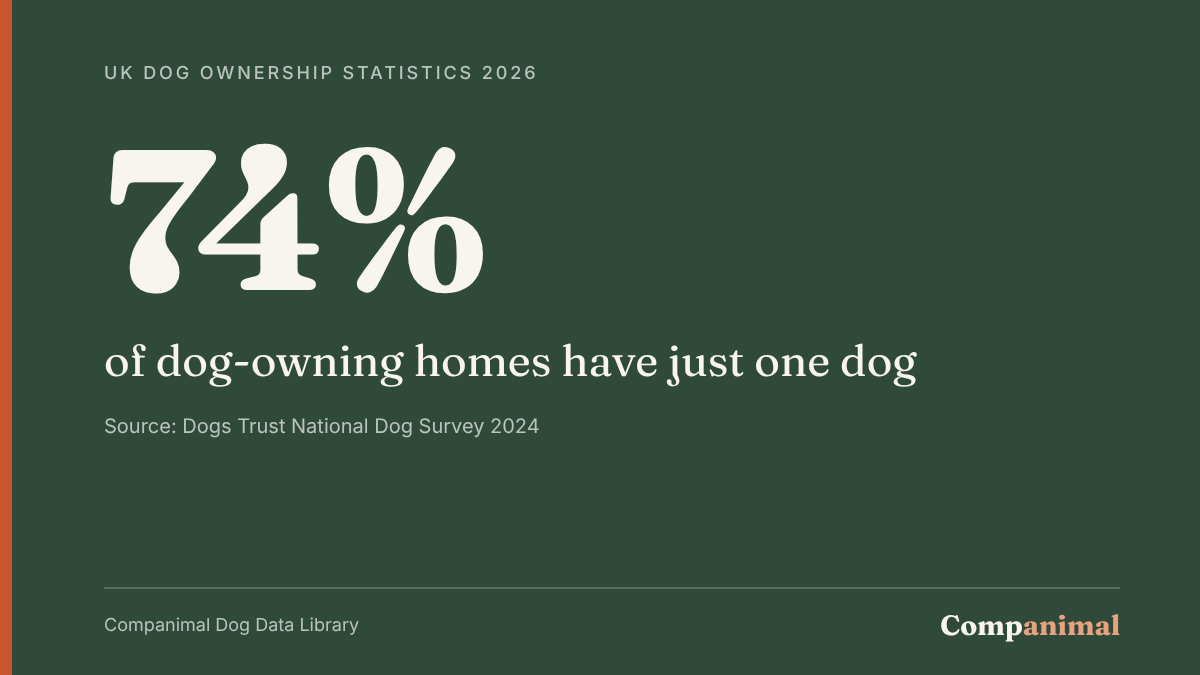
Homes in Northern Ireland (1.43) and Wales (1.42) keep the most dogs on average; London (1.19) keeps the fewest [13].
Where do UK dogs come from?
More than half of UK dogs (56%) come from a breeder or private seller, and a third (33%) come straight from a breeder [2]. UK rescues supply 13%, up from 11% in 2025, and 8% of dogs come from abroad [2].

| Source of the dog | PDSA 2026 [2] | RSPCA 2026 [7] |
|---|---|---|
| Breeder | 33% | 35% (registered breeders) |
| Rescue or rehoming centre | 13% (UK rescues) | 20% |
| Friends and family | 19% | |
| Online marketplace | 15% | |
| From abroad | 8% |
Most searches start online: 61% of pet owners found their pet on the internet [2]. Yet many skip the basic checks:
- Only 47% of dog owners saw their dog with its mother, and 39% visited more than once [2].
- 17% did no research at all before getting their dog [2].
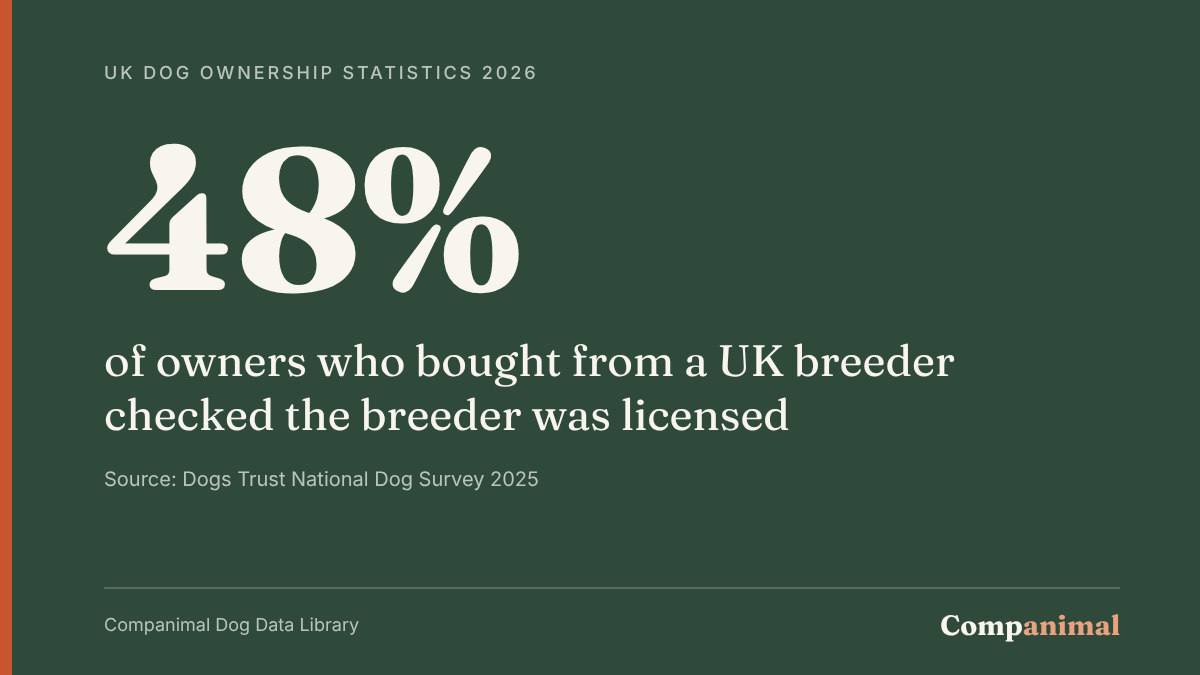
- Of owners who bought from a UK breeder, only 48% checked that the breeder was licensed [14].
- A quarter of puppies were taken home under eight weeks old, and 8.1% without the buyer seeing the mother [15].
Cross-border movements are rising too. About 32,000 dogs were commercially imported into Great Britain in 2024 [25], and non-commercial movements of dogs, cats and ferrets rose from about 100,000 in 2011 to over 368,000 in 2024 [28]. Pet dogs entering the UK under the pet travel rules reached 267,052 in 2022 [27].
Are UK dogs pedigrees or crossbreeds?
Most UK dogs are still pedigrees, but designer crossbreeds such as Cockapoos and Cavapoos are taking a growing share of puppies. How big that share is depends on whose records you count.
- Pedigree
- Crossbreed
- Designer cross
Source: PDSA [16]; O'Neill et al. [17]; Pets4Homes [18]; McMillan et al. [5]
Pets4Homes and the population model don't split out designer crosses, so their crossbreed figure includes them.
Show the data
| Pedigree | Crossbreed | Designer cross | |
|---|---|---|---|
| PDSA owner survey (2023) | 55% | 28% | 14% |
| VetCompass vet records (2019) | 69.4% | 24% | 6.7% |
| Pets4Homes puppy sales (2025) | 65% | 35% | – |
| Population model (2019) | 85.8% | 14.2% | – |
| Source | Pedigree | Crossbreed | Designer cross | Year |
|---|---|---|---|---|
| PDSA owner survey [16] | 55% | 28% | 14% (8% in 2017) | 2023 |
| VetCompass vet records, 2.25m dogs [17] | 69.4% | 24.0% | 6.7% | 2019 |
| Pets4Homes puppy sales [18] | 65% (82% a decade ago) | 35% combined | 2025 | |
| Population model, registry-heavy data [5] | 85.8% | 14.2% | 2019 |
The shift shows most clearly in young dogs. Designer crossbreeds made up 11.2% of dogs under one year old in vet records, against just 2.2% of dogs over ten [17].
The most common pedigree breeds in UK vet records are the Labrador Retriever (6.9%), the Jack Russell Terrier (4.5%) and the English Cocker Spaniel (4.3%) [17]. Flat-faced breeds are concentrated among the young: French Bulldogs were 3.0% of all dogs but 7.0% of puppies [17].
How well are UK dogs looked after?
On the basics, care is improving. PDSA's 2026 survey found more dogs neutered, microchipped and insured than a year earlier [2].
| Care measure | 2026 | 2025 |
|---|---|---|
| Microchipped | 88% | 82% |
| Neutered | 69% | 64% |
| Insured | 67% | 61% |
| Up to date with boosters | 82% | 79% |
| Registered with a vet | 92% |
Source: PDSA PAW Report 2026 [2]
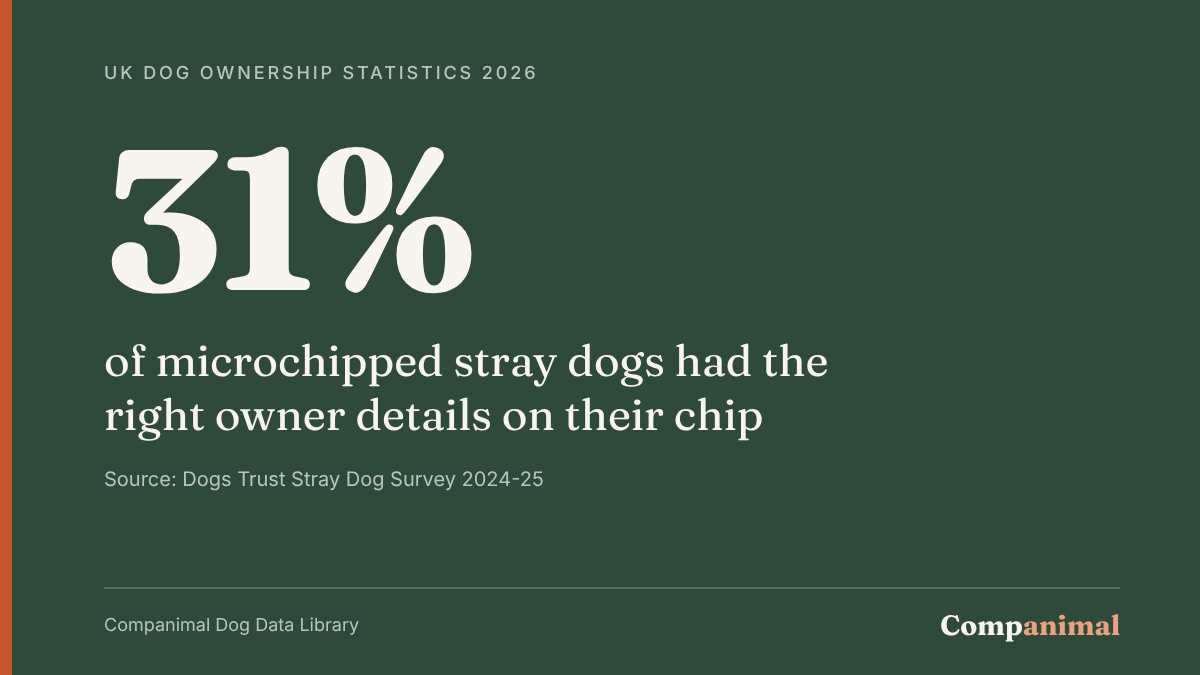
Microchips only work when the details are current. Councils handled an estimated 31,644 stray dogs in 2024-25. 61% were microchipped, but only about 31% of those chips had the right owner details, and just 38% of strays went home, the lowest rate since 1997 [19].
Insurance is a big business: 4.6 million pet owners took out a policy in 2024, and dogs accounted for £933 million of the £1.23 billion insurers paid out [20].
How has the pandemic changed dog ownership?
An estimated 4.1 million dogs were acquired in the UK between March 2020 and early 2023 [16]. The rush changed how people bought them:
| Buying behaviour | 2019 | 2020 |
|---|---|---|
| Paid a deposit before seeing the puppy | 8.9% | 17.2% |
| Paid £2,000 to £2,999 for a puppy | 1.8% | 24.3% |
Source: Packer et al. 2021, RVC Pandemic Puppies study [21]
The boom has since unwound. Kennel Club registrations peaked at about 349,000 in 2021 and fell to 161,901 in 2025 [22]. Puppy prices are still more than 50% below their 2021 peak, though the average price reached £989 in December 2025, up 19% on a year earlier [18].
Many pandemic owners are now under pressure: 36% say the cost-of-living crisis has hit their household income, and 12.4% have already cut back on their dog's care [23].
What this means if you're getting a dog
The numbers point to the same few checks that too many buyers skip. Each one below is tied to a figure on this page.
- See the puppy with its mother, and visit more than once. Only 47% of owners saw their dog with its mother, and 39% visited more than once [2].
- Check the breeder's licence. Of people who bought from a UK breeder, fewer than half (48%) checked [14]. Every Companimal listing shows what we have checked against official records, such as a council licence or Kennel Club registration, and says so plainly when we can't confirm something.
- Wait until the puppy is at least eight weeks old. A quarter of puppies go home younger than that [15].
- Don't pay a deposit before you've met the puppy. Deposits paid sight unseen doubled during the pandemic, from 8.9% to 17.2% of purchases [21], and that is the pattern scammers rely on.
- Research the breed before the litter. 17% of owners did no research at all [2]. Lifespan and health vary widely by breed, which our French Bulldog guide covers in detail.
- Consider a rescue. 13% of dogs now come from UK rescues, the highest share since 2021 [2], and many rescues and rehomers list on Companimal alongside breeders.
- Keep the microchip details current. Only about 31% of microchipped strays could be traced to the right owner [19].
Methodology, sources and credit
How we compiled these figures
We gathered figures from 51 sources across charity surveys, government records, peer-reviewed research and commercial data, and opened every figure at its original publisher on 25 October 2026. Where a primary source exists, we cite it rather than the sites that re-quote it. Where two reputable sources disagree, as UK Pet Food and PDSA do on the dog population, we show both and explain why rather than picking one. Figures are given as published; the Kennel Club's 2021 total is our sum of its breed group tables.
Sources (30)
- UK Pet Food, Britain's dog ownership boom as 15.5 million dogs now live in UK homes, March 2026
- PDSA, PDSA Animal Wellbeing (PAW) Report 2026, October 2026
- PDSA, UK pet populations of dogs, cats and rabbits
- UK Pet Food, Historical pet data
- McMillan et al., Estimation of the size, density, and demographic distribution of the UK pet dog population in 2019, Scientific Reports, 2024
- PDSA, PAW Mini Report 2025, 2025
- RSPCA, Animal Kindness Index 2026, August 2026
- YouGov, Top holiday types for people who travel with their pets, June 2025
- Office for National Statistics, Pet ownership by personal characteristics, Great Britain, 3 to 28 September 2025, August 2026
- PDSA, PAW Report 2024, 2024
- Anderson et al., National Dog Survey: Describing UK Dog and Ownership Demographics, Animals, 2023
- DAERA, Council dog summary statistics 2025/26, September 2026
- Dogs Trust, National Dog Survey 2024, 2025
- Dogs Trust, National Dog Survey 2025: State of the nation, 2026
- Kinsman et al., Puppy acquisition: factors associated with acquiring a puppy under eight weeks of age and without viewing the mother, Veterinary Record, 2020
- PDSA, PAW Report 2023, 2023
- O'Neill et al., Dog breeds and conformations in the UK in 2019, PLOS ONE, 2023
- Pets4Homes, UK Pet Market 2026, March 2026
- Dogs Trust, Stray Dog Survey 2024-25, 2026
- Association of British Insurers, Insurance payouts for pawly pets top £1 billion for third year in a row, May 2025
- Packer et al., Pandemic Puppies, Animals, 2021
- Royal Kennel Club, Breed registration statistics, 2026
- Brand et al., Impacts of the cost-of-living crisis on UK-based owners of pandemic puppies, Animals, 2026
- Murray et al., Assessing changes in the UK pet cat and dog populations, Veterinary Record, 2015
- Defra, Animal Welfare Strategy for England, December 2025
- Competition and Markets Authority, Veterinary services for household pets: final decision report, March 2026
- Animal and Plant Health Agency, FOI response ATIC3004, March 2023
- Defra, Impact assessment: non-commercial pet travel, March 2025
- Murray et al., Number and ownership profiles of cats and dogs in the UK, Veterinary Record, 2010
- Asher et al., Estimation of the number and demographics of companion dogs in the UK, BMC Veterinary Research, 2011
Key facts about this page
| What this page is | A cited reference of UK dog ownership statistics for 2026 |
| UK dog population | Between 10.2 million (PDSA, 2026) and 15.5 million (UK Pet Food, 2026) |
| Independent estimate | 12.64 million in 2019 (McMillan et al., Scientific Reports, 2024) |
| Households with a dog | 41% of UK households (UK Pet Food, 2026) |
| Adults with a dog | 27% of UK adults (PDSA, 2026) |
| Where dogs come from | 56% from a breeder or private seller; 13% from UK rescues (PDSA, 2026) |
| Highest ownership | London (49% of households) and Northern Ireland (48%) (UK Pet Food, 2026) |
| Sources | 30 cited here, drawn from 51 checked |
Using these figures? Please credit Companimal with a link to this page. It keeps research like this free.
Ready to look?
Looking for your next dog?
Browse sellers who show their working. Every listing tells you what has been disclosed, and what has not.
How Companimal shows you what a seller has disclosed
Account in good standing with a phone number confirmed by the seller.
A council licence number disclosed, or KC registration declared on the listing.
A credentialled breeder whose council licence we have checked against the register.
Information on a listing is self-declared by the seller and has not been independently checked. Read our methodology
More from this series
Calm, practical reads from the same hub.
 13 min read
Crossbreed and Designer Dog Statistics UK 2026: Between 14% and 42% of Dogs Are Crossbreeds
Between 14% and 42% of UK dogs are crossbreeds, depending on who is counting, and designer crosses such as the Cockapoo are a growing share of puppies. Figures from 39 checked sources on numbers, health, behaviour and price.
 10 min read
Rising and Declining Dog Breeds UK 2026: Ten Years of Kennel Club Data
The UK's flat-faced dog boom is over: French Bulldog registrations fell 43.8% in 2025 while Jack Russells and Dachshunds climbed. Ten years of Kennel Club data for 216 breeds, checked against 18 sources.
 9 min read
Dog Owner Statistics UK 2026: 11.6 Million Adults Live With a Dog
About one in five adults in Great Britain lives with a dog, around 11.6 million people. Figures from 37 sources on who owns dogs by age, sex, family, income, ethnicity, housing and region.