

Statistics
Dog Owner Statistics UK 2026: 11.6 Million Adults Live With a Dog
About one in five adults in Great Britain lives with a dog, around 11.6 million people. Figures from 37 sources on who owns dogs by age, sex, family, income, ethnicity, housing and region.
What this guide covers
About one in five adults in Great Britain lives with a dog, around 11.6 million people. Dog owners lean younger and female, more than half of families with children have a dog, and the over-70s are the least likely to own one but the most likely to choose a dog when they do have a pet. This page breaks UK dog ownership down by age, sex, family, income, ethnicity, disability, housing and work, using figures from 37 sources, drawn from 48 checked, including the ONS, PDSA and peer-reviewed research.
21%
of adults in Great Britain live with a dog, about 11.6 million people
[1]
58%
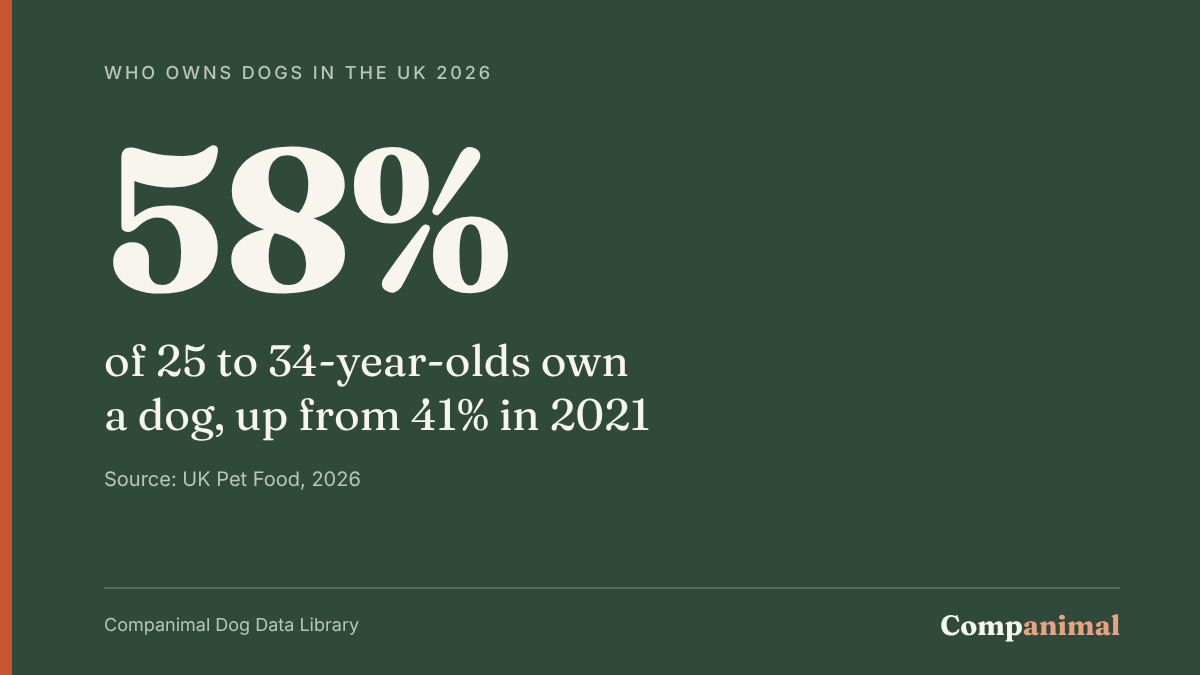
of 25 to 34-year-olds own a dog, up from 41% in 2021
[2]
52%
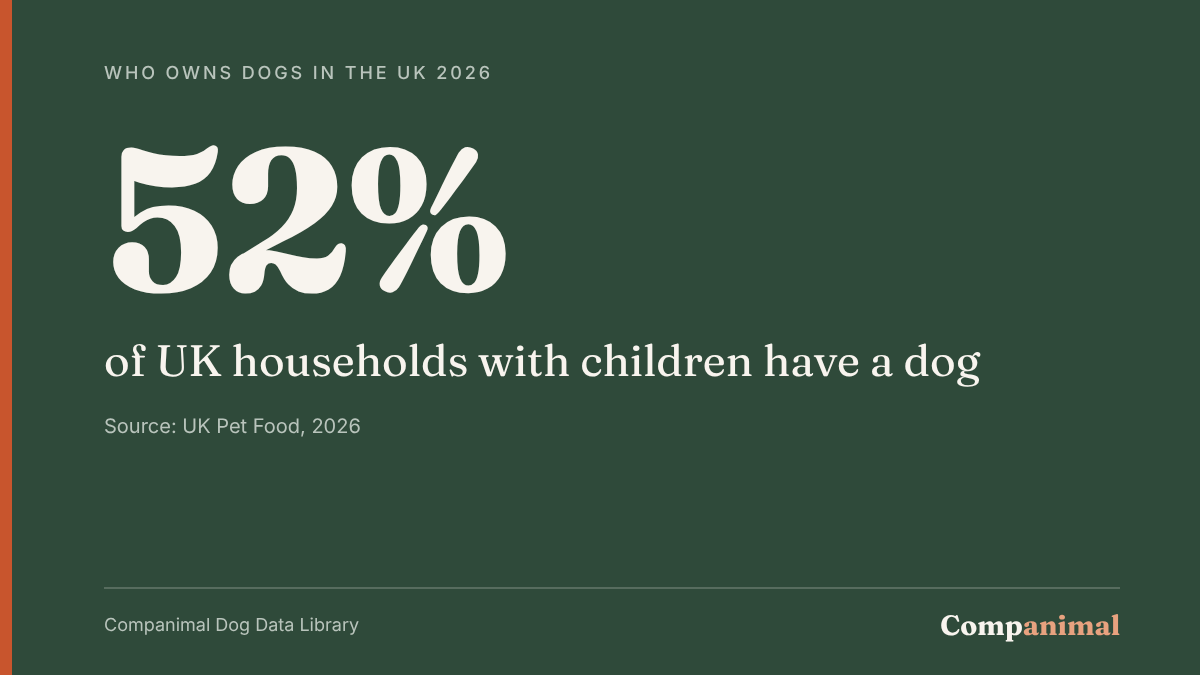
of households with children have a dog
[2]
57%
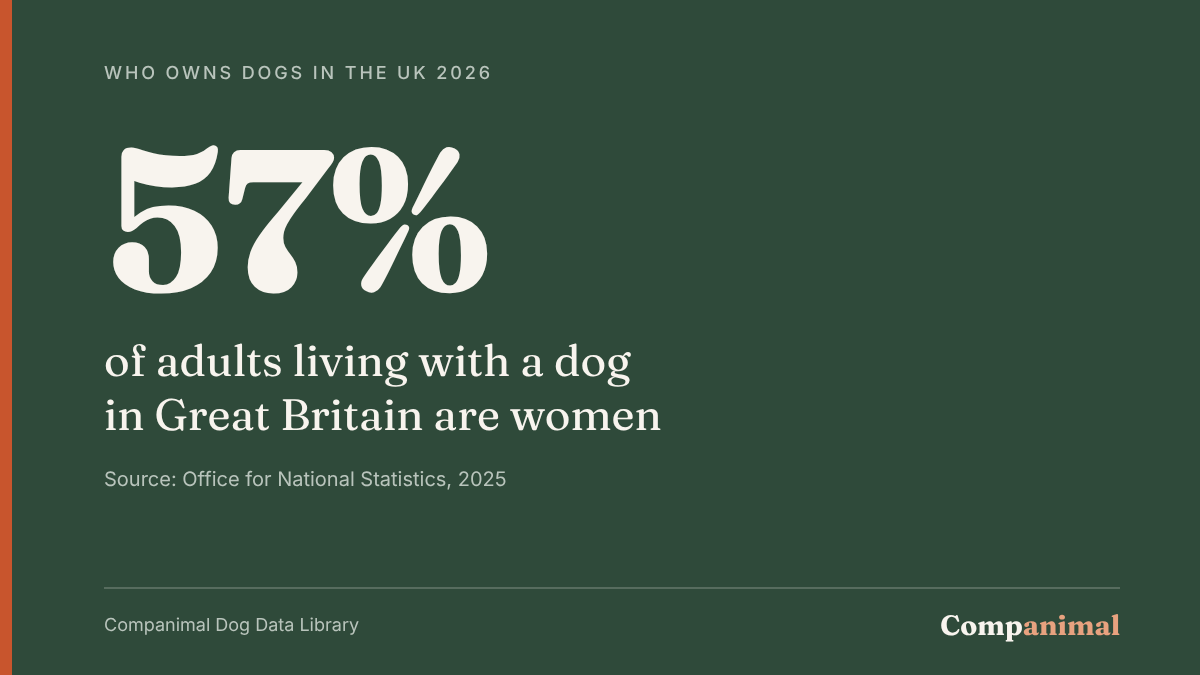
of adults living with a dog are women
[3]
62%
of pet-owning over-70s have a dog
[1]
44%
of private renters have a pet
[4]
How many people in the UK own a dog?
Between one in five and two in five, depending on whether you count adults or households, and how you ask.
| Measure | Figure | Year | Source |
|---|---|---|---|
| Adults in Great Britain living with a dog | 21.3%, about 11.6 million people | 2025 | ONS [1] (our calculation from weighted counts) |
| UK adults who own a dog | 27%, down from 30% in 2025 | 2026 | PDSA [5] |
| UK households with a dog | 41%, up from 33% in 2021 | 2026 | UK Pet Food [2] |
| Over-50s in England with a dog | 18% | 2010-11 | ELSA [6] |
The ONS figure comes from a single government survey question about pets living in the household, and gives the lowest figure. PDSA counts adults who say they own a dog, and UK Pet Food counts households, which is why its figure is highest: one dog in a family of four makes the whole household dog-owning. The same split in methods explains why the UK dog population is put anywhere between 10.2 million and 15.5 million.
How does dog ownership vary by age?
Under-50s are the most likely to live with a dog. Ownership drops sharply after 70, but older people who do have a pet are the most likely to choose a dog.
Source: ONS Opinions and Lifestyle Survey [1]
Our calculation from ONS weighted counts (adults living with a dog divided by all adults in each age band).
Show the data
| Live with a dog | |
|---|---|
| 16 to 29 | 23.6% |
| 30 to 49 | 23.2% |
| 50 to 69 | 21.7% |
| 70 and over | 13.8% |
| Age | Have any pet | Have a dog, among pet owners | Live with a dog |
|---|---|---|---|
| 16 to 29 | 49% | 48% | 23.6% |
| 30 to 49 | 45% | 51% | 23.2% |
| 50 to 69 | 41% | 53% | 21.7% |
| 70 and over | 22% | 62% | 13.8% |
Source: ONS, September 2025 [1]. The last column is our calculation from ONS weighted counts.
Younger adults are behind most of the recent growth. UK Pet Food found 58% of 25 to 34-year-olds and 53% of 16 to 24-year-olds now own a dog, both up from 41% in 2021 [2]. At the other end, dog ownership among over-50s in England fell from 19.8% in 2001 to 15.2% in 2010 [7].
Surveys disagree on which age group is most likely to rescue. In the ONS survey, a UK rescue charity was the source for 24% of dog owners aged 16 to 29, while 56% of owners aged 50 to 69 went to a UK breeder [1]. Petplan's 2026 survey found the reverse: 30% of owners over 61 had a rescue dog, against 15% of Gen Z owners [8].
Are dog owners more likely to be men or women?
Women. 57% of adults living with a dog in Great Britain are women and 43% are men [3]. Put another way, 23.5% of women live with a dog, against 18.8% of men (our calculation from ONS weighted counts) [1].
The gap is wider in volunteer surveys, which women are more likely to answer: around eight in ten respondents to the Dogs Trust National Dog Survey are women [9]. An older 2018 Mintel survey found the reverse, with 35% of men and 31% of women owning a dog [10], but the ONS figure is the better guide to the national picture today.
Among over-50s the gap almost disappears: 56% of older dog owners in England were women, against 55% of people without a pet [6].
Do families, couples or people living alone own more dogs?
Dogs are a family affair. More than half of UK households with children (52%) have a dog [2], and 40% of children aged 7 to 11 live with one [11]. Ownership climbs as children grow: in the long-running Children of the 90s study, dog ownership in families rose from 26% at age 11 to 37% by age 18 [12].
Most dog owners share their home. In 2022, 40% of dog owners lived in two-person households, 38% in households of three or four and 8% in households of five or more; only 12% lived alone [13].
Among older people, dog owners are more likely to have a partner: 75.7% of over-50 dog owners were married or living with a partner, against 68.9% of non-owners, and fewer were widowed (8.9% vs 14.2%) [14].
Does dog ownership depend on income?
Dogs are not a luxury of better-off households. The evidence points the other way for long-standing owners, while recent new pet owners skew better-off.
| Finding | Figure | Source |
|---|---|---|
| Children in the most deprived areas are more likely to live with a dog | 46%, against 38% to 39% elsewhere | Pet Education Partnership / YouGov [11] |
| Older dog owners are more likely to be in the lowest wealth fifth | 20%, against 16% of people without a pet | ELSA, 2010-11 [6] |
| Families with unskilled mothers were more likely to own a dog than those with professional mothers | Over twice the odds | Children of the 90s [15] |
| Dog owners' median household income | £25,000 to £29,999; 61.3% in social grades ABC1 | PDSA survey data, 2017 [16] |
| New pet owners (all pets) | More likely to be aged 18 to 44, degree-educated and on household incomes of £50,000 plus | PDSA, 2024 (unchanged since 2021) [17] |
Cost now weighs on owners at every income level. In 2026, 56% of pet owners worried about affording vet bills, up from 49% in 2024 (all pets) [18], and only 36% could cover the cost of unexpected surgery (all pets) [19].
How does dog ownership vary by ethnicity, disability and health?
Ethnicity. Most dog owners in Great Britain are White: 94% of adults living with a dog are White [3]. The gap starts young. In a 2009-10 survey of 11 to 15-year-olds across Great Britain, 57.5% of White children lived with a dog, against 14.9% of children from other ethnic backgrounds [20]. No current national survey publishes adult ownership rates by ethnicity.
Disability. A third of adults living with a dog (32%) are disabled [3]. Assistance dogs are a small but vital part of that picture:
| Charity | Working partnerships |
|---|---|
| Guide Dogs | 3,197 (end of 2024) [21] |
| Hearing Dogs for Deaf People | 1,119 (2025-26) [22] |
| Canine Partners | 290+ [23] |
| Dogs for Good | 221 [24] |
Together these four charities support more than 4,800 working partnerships (our sum).
Mental health. In a study of 68,362 adults in England, dog owners were less likely to report a long-standing mental illness than people without a dog [25].
Can you keep a dog if you rent?
Renting is one of the main practical barriers to owning a dog, and the rules changed in England this year.
- Many renters already have pets. 44% of private renters have a pet, and 20% have a small or medium-sized dog [4].
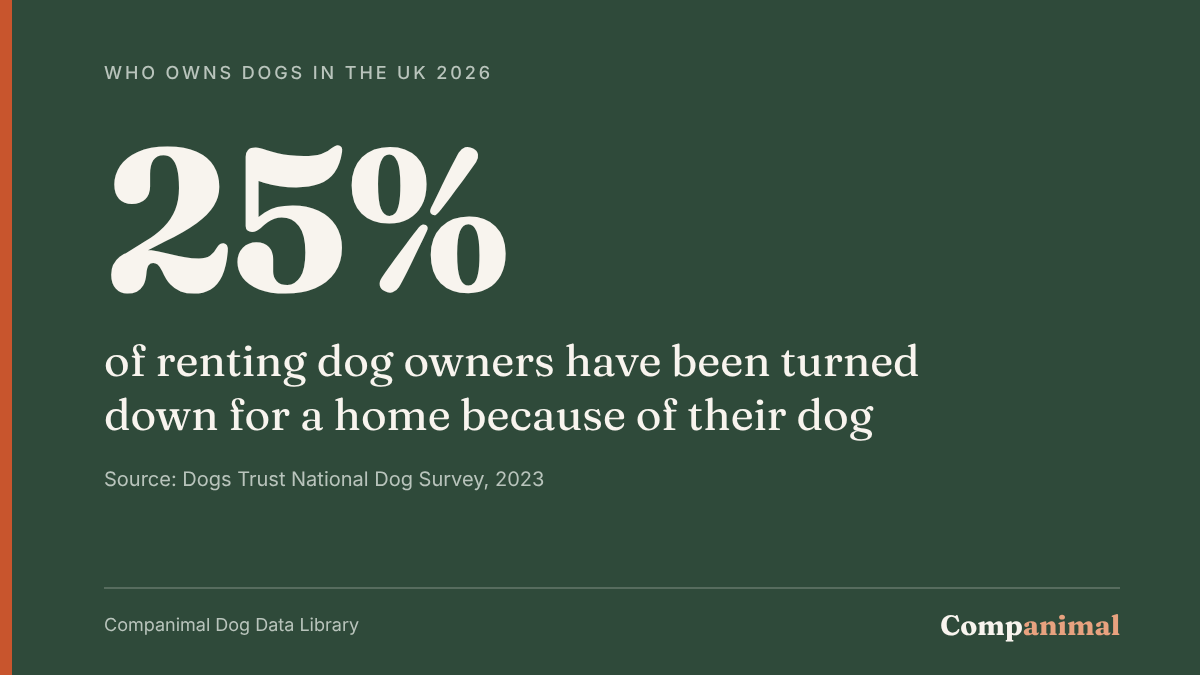
- Housing still costs dogs their homes. About one in seven owners asking Dogs Trust to take their dog cite housing [26], and 25% of renting dog owners said in 2023 that they'd been turned down for a home because of their dog [27].
- Flats make a difference. Families living in flats had about half the odds of owning a dog compared with those in detached houses [15].
- Pets still top renters' searches. "Pets" remained the most-searched rental term on Rightmove in June 2026, even though searches for pet-friendly homes fell year on year [28].
What the law now says
| Nation | Right to request a pet | Status |
|---|---|---|
| England | Private tenants can ask to keep a pet; landlords must reply within 28 days and can't unreasonably refuse | In force since 1 May 2026 [29][30] |
| Scotland | A similar right, with 30 days to respond | Legislated, not yet in force [31] |
| Wales | No legal right; pets are agreed case by case | No change yet; RSPCA Cymru is urging the new Welsh Government to legislate [32] |
In England, landlords can still refuse for reasons such as a superior landlord's ban, the property being too small, or another tenant's allergy, but not simply because they don't like pets [30].
How do work and location shape dog ownership?
Work. Home working helped drive the pandemic dog boom: 57.3% of people who bought a puppy in 2020 were working from home [33]. Dogs now shape careers too, with nearly 15% of owners saying they have changed jobs or working patterns for their dog [34].
Where owners live. Dog ownership is highest in London and Northern Ireland when measured by household, while Northern England is home to a larger share of the country's dog owners than London and the South:
| Measure | Finding | Source |
|---|---|---|
| Households with a dog | London 49%, Northern Ireland 48% | UK Pet Food, 2026 [2] |
| Households with a dog | The North, Wales and Scotland 40% to 42%; South East 29% | UK Pet Food, 2024 [35] |
| Adults living with a dog | 29% live in the North East, North West or Yorkshire, against 25% in London and the South | ONS, 2025 [3] |
A 2026 University of Leeds study of England and Wales found pet ownership (all pets) highest in more rural and suburban neighbourhoods and lowest in inner cities [36], and earlier national research also found rural households more likely to own a dog [37].
What this means if you're getting your first dog
If you're thinking about a first dog, you're in good company: 42% of dog owners had never owned a dog as an adult before getting their current one [17]. The figures above point to a few things worth planning for.
- Expect it to be hard work, especially in your twenties and thirties. 57% of owners aged 25 to 34 describe owning a dog as hard work, against 29% of owners over 75 [9].
- Line up back-up care. 37% of owners aged 75 and over have no one who could look after their dog for a week [9].
- If you rent, ask first and in writing. In England, landlords must answer a pet request within 28 days and can't refuse without a good reason [30].
- Budget for the vet. Only 36% of pet owners could cover an unexpected surgery bill [19].
- Decide between a breeder and a rescue early. Breeders, rescues and rehomers all list on Companimal, and every Companimal listing shows what we've checked against official records, such as a council licence, Kennel Club registration or charity registration, and says so plainly when we can't confirm something.
Methodology, sources and credit
How we compiled these figures
We checked 48 sources and cite 37 of them, including the ONS, PDSA, UK Pet Food, government guidance and peer-reviewed research, opened each one at its original publisher on 25 October 2026, and checked for newer editions on 29 October 2026. Many sources describe dog owners in two different ways: the share of a group that owns a dog (a rate) and the share of owners who belong to a group (a profile). We say which is which in every sentence. Where we calculated a rate ourselves, from ONS weighted counts, we say so. Figures marked "all pets" cover pet owners generally, not only dog owners.
Sources (37)
- Office for National Statistics, Public opinions and social trends: pet ownership and actions, 3 to 28 September 2025, October 2025
- UK Pet Food, Britain's dog ownership boom as 15.5 million dogs now live in UK homes, March 2026
- Office for National Statistics, Pet ownership by personal characteristics, 3 to 28 September 2025, August 2026
- Simcock, McCarthy, Kara and Brown (University of Huddersfield, funded by Battersea), The financial impact of pet ownership in rental properties, March 2024
- PDSA, PAW Report 2026: pet populations, October 2026
- Batty et al., Associations of pet ownership with biomarkers of ageing, BMJ, 2017
- Pikhartova, Bowling and Victor, Does owning a pet protect older people against loneliness?, BMC Geriatrics, 2014
- Petplan, 2026 Dog Breed Report, 2026
- Dogs Trust, National Dog Survey 2024, 2025
- Mintel, UK pet care buyers would rather cut back spending on themselves than on their pet, October 2018
- Pet Education Partnership, Children and Pets Survey 2025, 2025
- Purewal et al., Socio-demographic factors associated with pet ownership amongst adolescents from a UK birth cohort, BMC Veterinary Research, 2019
- PDSA, PAW Report 2022: pet populations across the UK, 2022
- Gong et al., The genetic architecture of dog ownership, G3, 2024
- Westgarth et al., Family pet ownership during childhood, IJERPH, 2010
- Philpotts et al., What do we know about dog owners?, Animals, 2024
- PDSA, PAW Report 2024, 2024
- RSPCA, Animal Kindness Index 2026, August 2026
- PDSA, Pet Health Inequality Report, 2026
- Marsa-Sambola et al., Sociodemographics of pet ownership among adolescents in Great Britain, Anthrozoös, 2016
- Guide Dogs, Guide dog facts
- Hearing Dogs for Deaf People, Impact report
- Canine Partners, Facts and figures
- Dogs for Good, Annual Report 2025, 2025
- Liu et al., Is dog ownership associated with mental health? A population study of 68,362 adults living in England, Anthrozoös, 2019
- Dogs Trust, Written evidence on the Renters' Rights Bill, 2024
- Dogs Trust, National Dog Survey 2023 results, 2023
- Rightmove, Fewer searches for pet friendly properties as Renters' Rights Act kicks in, July 2026
- MHCLG, Implementing the Renters' Rights Act 2025: our roadmap, November 2025
- GOV.UK, If a tenant wants a pet to live with them, October 2026
- Scottish Parliament, Housing (Scotland) Act 2025, section 35, 2025
- RSPCA Cymru, Supporting pet-owning renters in Wales, August 2026
- Packer et al., Pandemic Puppies, Animals, 2021
- Dogs Trust, National Dog Survey 2026 results, 2026
- UK Pet Food, London leads the pack as the UK's pet capital, March 2024
- Clark, Clarke, James and Lomax, Measuring the accessibility of veterinary care for companion animals in England and Wales, Animal Welfare, 2026
- Murray et al., Number and ownership profiles of cats and dogs in the UK, Veterinary Record, 2010
Key facts about this page
| What this page is | A cited reference of who owns dogs in the UK, by group, for 2026 |
| Adults living with a dog | 21% of adults in Great Britain, about 11.6 million (ONS, 2025, our calculation) |
| Most likely owners | Under-50s; 58% of 25 to 34-year-olds own a dog (UK Pet Food, 2026) |
| Sex | 57% of adults living with a dog are women (ONS, 2025) |
| Families | 52% of households with children have a dog (UK Pet Food, 2026) |
| Older people | 13.8% of over-70s live with a dog, but 62% of pet-owning over-70s have one (ONS, 2025) |
| Renting | Right to request a pet in force in England since 1 May 2026 |
| Sources | 37 cited here, drawn from 48 checked |
Using these figures? Please credit Companimal with a link to this page. It keeps research like this free.
Ready to look?
Looking for your next dog?
Browse sellers who show their working. Every listing tells you what has been disclosed, and what has not.
How Companimal shows you what a seller has disclosed
Account in good standing with a phone number confirmed by the seller.
A council licence number disclosed, or KC registration declared on the listing.
A credentialled breeder whose council licence we have checked against the register.
Information on a listing is self-declared by the seller and has not been independently checked. Read our methodology
More from this series
Calm, practical reads from the same hub.
 13 min read
Crossbreed and Designer Dog Statistics UK 2026: Between 14% and 42% of Dogs Are Crossbreeds
Between 14% and 42% of UK dogs are crossbreeds, depending on who is counting, and designer crosses such as the Cockapoo are a growing share of puppies. Figures from 39 checked sources on numbers, health, behaviour and price.
 10 min read
Rising and Declining Dog Breeds UK 2026: Ten Years of Kennel Club Data
The UK's flat-faced dog boom is over: French Bulldog registrations fell 43.8% in 2025 while Jack Russells and Dachshunds climbed. Ten years of Kennel Club data for 216 breeds, checked against 18 sources.
 10 min read
UK Dog Ownership Statistics 2026: Between 10.2 and 15.5 Million Dogs
There are somewhere between 10.2 million and 15.5 million pet dogs in the UK in 2026, depending on who is counting. Figures from 51 sources on who owns them, where they come from, and why the surveys disagree.