

Puppy advice: raising, training and caring for your puppy
How Long Are Dogs Pregnant? Signs of Pregnancy in Dogs, Week by Week
Dogs are pregnant for about 63 days. How to confirm a pregnancy, the signs week by week, caring for your pregnant dog, whelping and when to call your vet.
What this guide covers
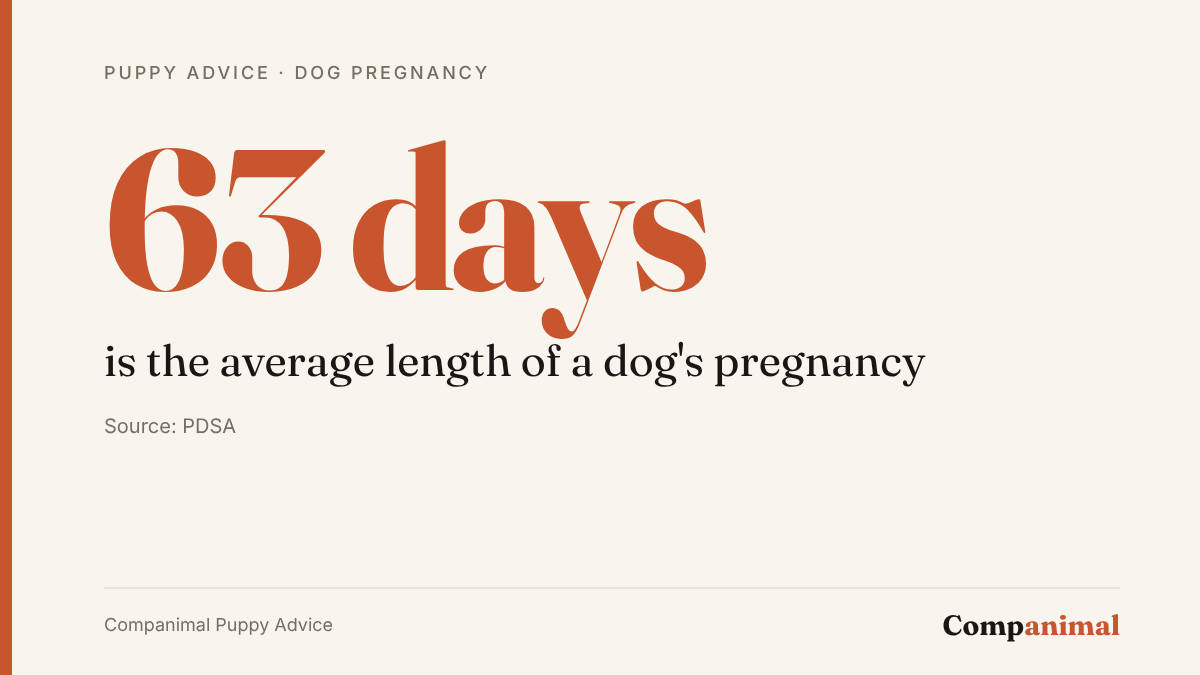
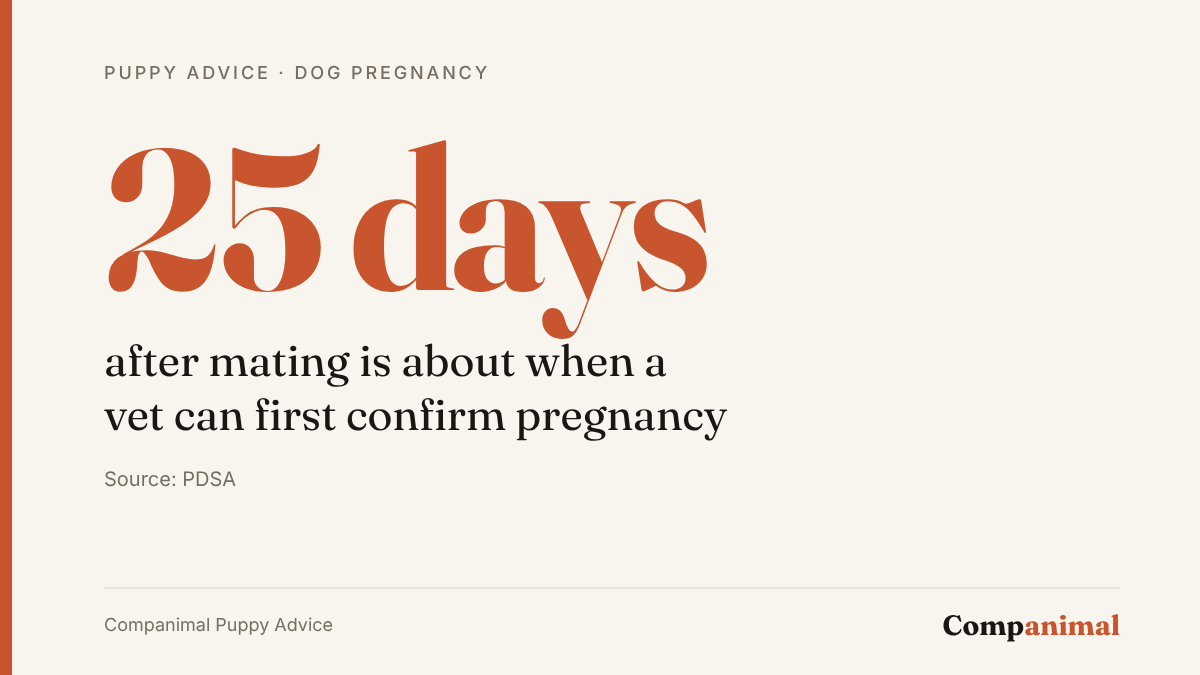
Dogs are pregnant for approximately 63 days, which is roughly nine weeks. A healthy pregnancy can run a little shorter or longer: PDSA gives a range of 56 to 72 days, and the Royal Kennel Club says plus or minus a week. A vet can usually confirm the pregnancy from about 25 days after mating, and the physical signs become obvious from around five or six weeks.
How long are dogs pregnant for?
The average dog gestation period is 63 days from conception. The exact length of a dog's pregnancy varies with breed, the size of the litter and how accurately you know when she conceived. Large litters in particular can arrive a few days early or late.
| Source | Normal range for canine gestation |
|---|---|
| PDSA, pregnancy guide | 56 to 72 days |
| PDSA, whelping guide | 57 to 71 days |
| Royal Kennel Club | About 9 weeks, plus or minus a week |
The ranges differ because conception is hard to pin down. A female dog may mate on more than one day, and she can only become pregnant once she ovulates, which is not always on the day of mating. The Royal Kennel Club notes you can estimate the due date from either the mating date or the ovulation date. If your vet has timed her ovulation, use their date.
If you have not yet decided to breed your dog, the health checks and timing covered in how to breed dogs responsibly come first, and they make the pregnancy period far easier to predict.
Good breeders start finding the right homes for your litter long before the new puppies arrive, so no decision is rushed once they are here.
How to work out your dog's due date
Count 63 days from the date of mating. A bitch mated on 1 March would be due around 3 May, and using PDSA's range of 56 to 72 days, the puppies could arrive anywhere from about 26 April to 12 May. If you do not know the exact date of mating, your vet can still confirm the pregnancy, and the late signs below tell you when birth is close.
- Mark the week before the due date. That is when you set up the whelping box and start taking her temperature.
- Do not wait long if she goes over. The Royal Kennel Club advises contacting your vet if she is a day or two overdue. PDSA says to call if there is no sign of labour a few days after the due date, around 70 to 72 days after mating. Ring as soon as she passes her date and follow your vet's advice.
How to confirm a dog pregnancy
You cannot reliably tell a dog is pregnant just by looking at her in the first few weeks, so a vet check is the way to confirm it.
| Method | When it works | What it tells you |
|---|---|---|
| Feeling the abdomen (palpation) | About 3 to 5 weeks | A vet may feel the puppies, but it is not always reliable |
| Blood test (relaxin hormone) | From about 25 days after mating, or 3 to 4 weeks | Usually accurate, but can read negative if done too early |
| Ultrasound scan | From about 25 days after mating; the Royal Kennel Club gives around the fifth week | Confirms the pregnancy, checks heartbeats and gives a rough number of puppies |
| X-ray | Later in pregnancy | A more accurate count and a check on the development of puppies' bones |
Human pregnancy tests do not work on dogs. They detect a hormone called hCG, which dogs do not produce. Any count of how many puppies your dog is carrying is an estimate, so treat it as a rough guide.
Signs of dog pregnancy
The early pregnancy symptoms are subtle and easy to miss. Many dog owners only spot the signs from around week five.
Early signs (around 4 to 5 weeks)
- Slightly larger, pinker nipples
- A swollen vulva
- A little clear vaginal mucus
- Possible sickness
More obvious signs (from about 5 to 6 weeks)
- Weight gain and a swollen abdomen, which may be smaller with a small litter
- Changes in appetite, with hunger increasing in the second half of pregnancy
- Mammary development from about week 5
- Lower energy and being quieter than usual
Late signs (the final days of pregnancy)
- A firm, round belly that starts to sag
- Each nipple enlarging further and possibly leaking milk
- Nesting behaviour
- Mood changes: some dogs become clingier, others want more space, and some can be grumpy near whelping
Be aware of phantom pregnancy. A bitch can show all of these signs without carrying puppies, especially after a season, so speak to your vet whether or not she has been mated.
Stages of dog pregnancy, week by week
This pregnancy timeline maps the stages of pregnancy using PDSA and Royal Kennel Club timings. Treat each week of pregnancy as a guide, not a deadline.
| Week | What you may notice | What to do |
|---|---|---|
| Weeks 1 to 3 (days 1 to 21) | Few or no outward signs by the end of the third week; her normal routine can carry on | Tell your practice she has been mated and register if you have not already |
| Week 4 (days 22 to 28) | Subtle signs may start | Book a check: a scan or blood test is possible from about day 25 |
| Week 5 (days 29 to 35) | Mammary development; belly may begin to enlarge | Ultrasound if not already done; switch to gentler exercise once her belly grows |
| Week 6 (days 36 to 42) | Clear weight gain, swollen belly, appetite changes | Move to several small meals a day and ask about her diet |
| Week 7 (days 43 to 49) | Hungrier; quieter and less active | Start preparing for the birth; limit visitors and big changes at home |
| Week 8 (days 50 to 56) | Nesting may begin in the last week or so | Set up the whelping box about a week before the due date and start taking her temperature two to three times a day |
| Week 9 (days 57 to 63 and beyond) | Milk may appear, restlessness, eating less, temperature drop | Keep the out-of-hours number to hand; call if she goes past her date |
Licensed breeders in England should also note that a breeding bitch must not be transported later than 54 days after successful mating, except to a vet.
How to care for your pregnant dog
A canine pregnancy needs little change to her routine in the first month. The care that matters most comes as the pregnancy progresses, when the developing puppies grow fastest and she gets hungrier and slower.
Feeding a pregnant dog
- Feed a high-quality diet. The amount and type may need to change as the pregnancy goes on.
- Her appetite can rise a lot, potentially to two or three times her normal amount near the end.
- PDSA suggests a high-quality puppy food or a food made for pregnant or nursing dogs.
- Split her daily food into several small meals, because the womb and growing puppies press on her stomach. Small, spread-out meals also help if she is sick.
- Ask your veterinarian how much to feed and when to switch foods, as this depends on her size and the expected litter.
Exercise during pregnancy
Normal exercise is fine until her belly starts to grow. After that, keep to gentle walks and light play, and avoid anything strenuous. Near the end, let her set the pace and give her plenty of rest. If she tires on long walks, swap them for shorter, more frequent ones.
Worming, flea treatment and vaccinations
Do not give any wormer, flea treatment or other medicine without asking your vet first, because some products are not suitable during pregnancy. PDSA explains that a pregnant dog needs worming more often to stop worms passing to the puppies, but not all wormers are licensed for use in pregnancy. Your vet can also advise on vaccinations and whether she needs extra check-ups.
Vet care, insurance and a calm home
Have the pregnancy confirmed and her general health checked, and save the practice's daytime and out-of-hours numbers in your phone. Check your insurance now too: PDSA notes that emergency caesareans often cost over £1,000, and not all pet insurers cover breeding-related problems.
The best care at home is calm: a space of her own away from busy areas and other dogs, no big changes late on, and few unfamiliar visitors.
Preparing a whelping area
Set up the whelping box about a week before the due date so she can explore it and settle in. Most dogs nest in the last week, and some dig, so an early introduction helps her choose the right spot.
Whelping box checklist
- A warm, quiet, draught-free room away from household traffic, at around 22°C
- Big enough for her to stretch out and turn around, without much spare room
- Sides low enough for her to step over but high enough to keep newborns in
- A waterproof base
- Absorbent, washable bedding; one large piece of vetbed is better than lots of small blankets a pup can get trapped under
- No hay, straw or wood shavings
- Pig rails about 3 to 4 inches high so puppies are not squashed against the sides
- Not a crate, as puppies can get their heads stuck in the bars
- A safe extra heat source placed so puppies can move away from it, and a thermometer
Also have ready
- Your vet's daytime and out-of-hours numbers
- Clean towels
- A notebook to record each puppy's birth time and weight
- A separate warm box in case you need to take her and the puppies to the practice
Labour in dogs: signs birth is imminent
Her temperature is the most useful clue that she is ready to give birth. The Royal Kennel Club says it drops by about 1°C one to two days before labour, and suggests taking it two to three times a day from about a week before the due date. BVNA guidance puts the drop at 8 to 24 hours before birth. Either way, a clear fall means labour is close.
Other signs that she will whelp soon:
- Restlessness, pacing, panting or shivering
- Nesting: digging, circling the box or seeking a quiet spot
- Eating less or refusing food
- Licking her vulva
- Vomiting or diarrhoea
- A clear or white mucus discharge, which may turn red or brown closer to birth
This first stage of labour usually lasts 6 to 12 hours but can take up to 36 hours, especially in first-time or nervous mothers.
What normal labour looks like
| Stage | Typical timing |
|---|---|
| First puppy | 30 minutes to 4 hours after contractions start |
| Gap between puppies | Usually 15 to 30 minutes; up to 1.5 hours can be normal if she is comfortable and not straining |
| Afterbirth (placenta) | Usually within about 15 minutes of each puppy |
| Whole litter | Usually 3 to 12 hours; labour should not go past 24 hours |
Puppies are usually born head first, though tail first is normal too. Count the placentas as they come, because a retained one can cause infection.
When to call your vet if your dog is in labour or unwell
If you see any of these, call your vet straight away, day or night. Do not wait to see if things improve.
During labour
- Straining for 20 to 30 minutes without producing a puppy
- A puppy or sac visible in the birth canal that has not moved for 20 to 30 minutes
- More than two hours between puppies when you expect more
- Thick, dark or green discharge with no puppy following
- Heavy bleeding, foul-smelling discharge or severe discomfort
- Waters broken two to three hours ago with no progress
- Restlessness with no contractions for more than 24 hours, or labour lasting over 24 hours
- Collapse, exhaustion, severe belly pain, or she seems unwell
During pregnancy or after the birth
- Weakness, wobbliness, collapse or seizures, which can be signs of pregnancy toxaemia
- Stiffness, twitching, weakness or seizures after she gives birth, which can be signs of eclampsia (low calcium)
- Signs of miscarriage, such as straining, discharge or milk appearing early
- Puppies that are not feeding or are crying constantly, or placentas you think have not all been passed
Ring for advice, rather than waiting, if she is vomiting, has vaginal discharge, is losing weight or just is not herself at any point in pregnancy. If you suspect a miscarriage, PDSA advises pregnant people to avoid handling her or anything she has touched until the cause is known.
The weeks after birth
Let your practice know the new litter of puppies has arrived and book a full check two to three days after the birth. Keep her calm, with food and water close to the whelping box. Watch for:
- A brick-red or dark-green discharge, which is normal for three to four weeks; bright green or foul-smelling discharge needs checking
- Hard, red or painful teats, which can be signs of mastitis
- Puppies that seem weak, to make sure each one is feeding and gaining strength
The puppies rely on their mum's milk in the early weeks. When they are ready for their first solid food, the move from milk to puppy food is the next stage, and weaning puppies gently makes the change easier on mum and litter alike.
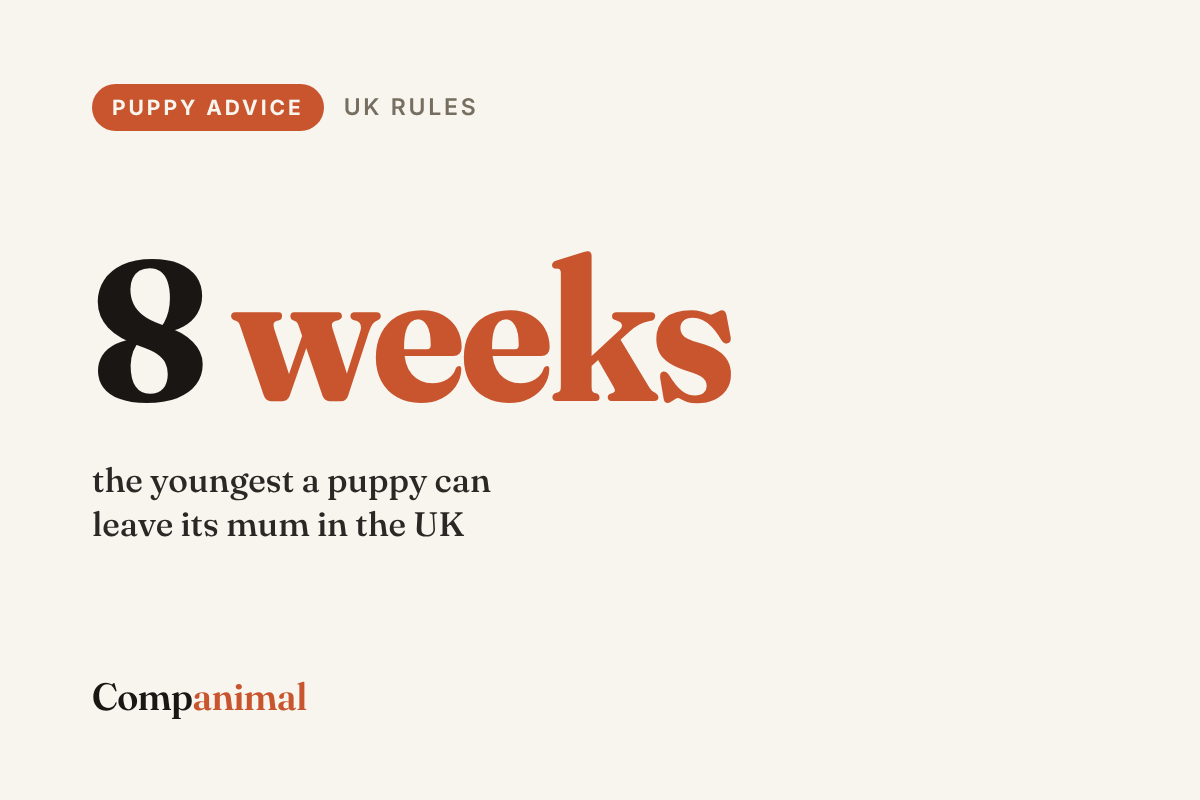
Puppies cannot go to new homes before they are 8 weeks old. For licensed breeders in England, the law says no puppy under 8 weeks may be sold or permanently separated from its mother, and knowing when puppies can leave their mum helps you set a realistic date for new owners.
While the litter grows, use the quieter weeks to gather photos and paperwork and plan your litter's listing, and ask your vet when the puppies should have their first health checks and first vaccinations. Every listing on Companimal is checked by a person before it goes live.
Frequently asked questions
Can a dog be pregnant for 70 days?
It is possible but at the long end. PDSA gives a range of up to 72 days, but you should contact your vet once she passes her due date rather than waiting.
How soon can you tell if a dog is pregnant?
A vet can usually confirm pregnancy with a scan or blood test from about 25 days after mating. Signs you can see at home tend to appear from around four to six weeks.
Can I use a human pregnancy test on my dog?
No. Human tests detect hCG, a hormone dogs do not produce, so they will not work.
How many puppies will my dog have?
An ultrasound gives a rough count and an X-ray later in pregnancy gives a more accurate one, but both are estimates. Count puppies and placentas during the birth and call your vet if you think more are due.
Ready to look?
Looking for your next dog?
Browse sellers who show their working. Every listing tells you what has been disclosed, and what has not.
How Companimal shows you what a seller has disclosed
Account in good standing with a phone number confirmed by the seller.
A council licence number disclosed, or KC registration declared on the listing.
A credentialled breeder whose council licence we have checked against the register.
Information on a listing is self-declared by the seller and has not been independently checked. Read our methodology
More from this series
Calm, practical reads from the same hub.

Puppy advice: raising, training and caring for your puppy · 12 min read
How to Sell Puppies in the UK: Safely, Responsibly and to Happy Forever Homes
How to sell puppies in the UK the right way: the law, matching each puppy to the right home, writing an advert serious buyers trust, vetting buyers and a safe handover.
Puppy advice: raising, training and caring for your puppy · 12 min read
When Can Puppies Leave Their Mum? UK Rules and Why 8 Weeks Matters
Puppies can leave their mum from 8 weeks old in the UK. Here is what the law says in each nation, why those first weeks matter, and what should be done before a puppy goes home.
Puppy advice: raising, training and caring for your puppy · 12 min read
Breeding Dogs: A Responsible UK Guide for First-Time Breeders
Thinking about breeding from your dog? What to weigh up first, the health tests both parents need, the right age, choosing a stud dog, the real costs and the UK licence rules.