

Puppy advice: raising, training and caring for your puppy
Weaning Puppies: A Week-by-Week Guide for Breeders
When to start weaning puppies, what to feed at each stage, how to support the mum, and why the litter stays together until at least 8 weeks. Written for UK breeders.
What this guide covers
Weaning puppies usually starts at around 3 to 4 weeks old and is normally finished by 6 to 8 weeks, as the litter moves gradually from their mum's milk to solid food: first a puppy food soaked to a porridge-like mush, then firmer food. Go slowly, offer small meals often, weigh every puppy regularly and keep the litter with their mum until at least 8 weeks, which is also the legal minimum age for a puppy to leave her in England.
Where weaning fits in your litter's first eight weeks
Weaning is the third stage of raising a litter, after mating and the pregnancy covered in our guide to how long dogs are pregnant. It is the point where the puppies stop relying entirely on their mother and start eating for themselves, and it overlaps with the weeks when they are learning the most about the world. If this is your first litter, our guide for breeders walks through the whole journey from planning to finding new homes.
For the first few weeks the puppies need no solid food at all. Their mother feeds them, keeps them warm and licks them, which keeps them clean and helps their bodies work properly. Her first milk, colostrum, also passes on antibodies, because newborn puppies have very little immunity of their own and will not develop it fully until around 16 weeks of age.
When to wean puppies
The Royal Kennel Club recommends starting the weaning process from around 3 weeks of age, and says it can last until the puppies are around 7 to 8 weeks old. PDSA's hand-rearing advice introduces puppy food at 4 weeks and expects puppies to be fully weaned at around 6 to 7 weeks. So the sensible working range is to begin weaning at around three to four weeks and expect to finish between 6 and 8 weeks.
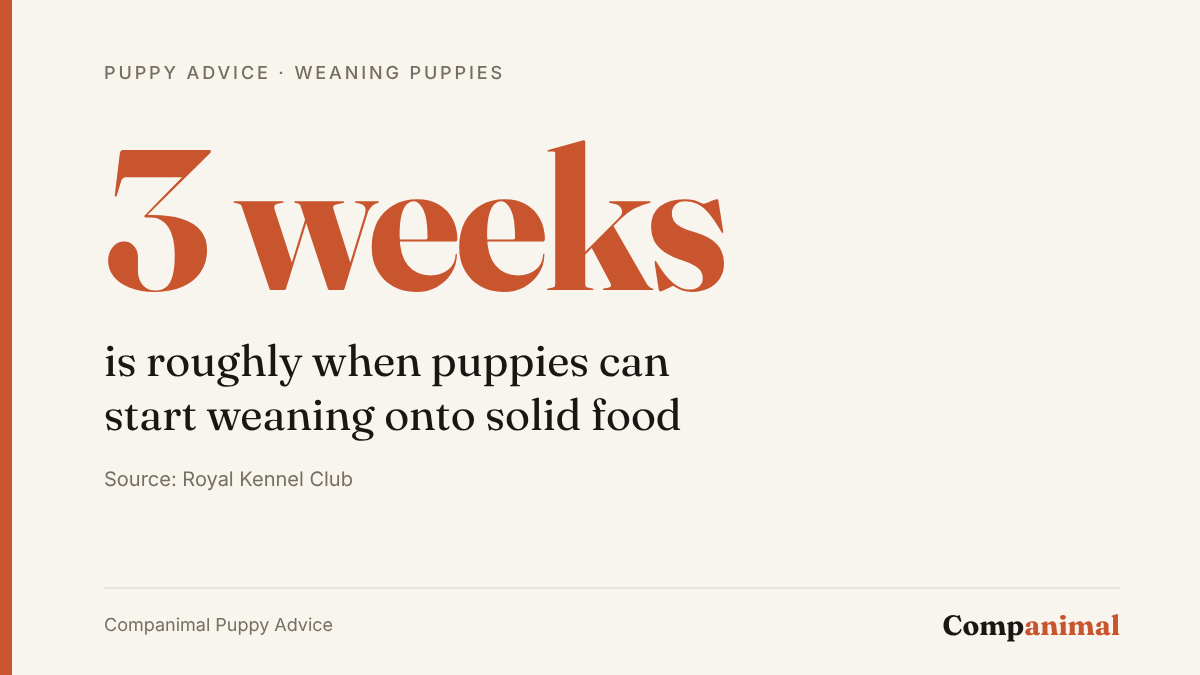
Licensed breeders in England have a legal duty here too: each puppy must start weaning as soon as it is capable of eating food on its own, and every licensed breeder must have a written plan for weaning.
In practice, puppies are ready for weaning when they are steady enough on their feet to reach a dish and show an interest in solid food. Every litter is different, so watch your puppies rather than the calendar.
A week-by-week puppy weaning schedule
Use this feeding schedule as a guide, not a rule. Large litters, small or slow puppies and a mum with less milk can all shift the timings.
| Age | What happens | What to offer |
|---|---|---|
| Birth to about 3 weeks | Puppies feed only from mum; she cleans and warms them | Nothing solid. Focus on mum's food and a warm, clean bed |
| About 3 to 4 weeks | First tastes of solid food | Puppy food soaked in warm water to a porridge texture, in small amounts they can lap; a shallow saucer of water |
| About 4 weeks | Puppies lap more confidently | Water available at all times from about a month old; small, regular meals |
| About 5 weeks | Solid food becomes a bigger share | Wet or soaked puppy food; puppies still feed from mum too |
| About 6 to 7 weeks | Most puppies are eating well on their own | Gradually less water in the food, moving towards firmer food |
| 7 to 8 weeks | Weaning complete for most litters | Complete puppy food and fresh water. Still with mum and littermates |
Licensed breeders should offer food up to 5 times a day during weaning, and the official guidance notes that the first diet may be liquid, moving to solid food over the following weeks. Increase portions as the puppies grow, following the feeding guide on the food's packaging.
How to wean puppies: step by step
- Choose a puppy food. Use a food made specifically for puppies, ideally labelled "complete", so it covers every nutrient they need except water.
- Make a mush. Mix dry food made for puppies with warm water and leave it to soak for a few minutes until it is like porridge. Blending the kibble first helps; a soft puppy mousse is another option.
- Start small. Offer a little at a time in a shallow dish and let the puppies lap at it. Expect mess and some confusion at first.
- Let mum lead. Hesitant puppies often copy their mother, so having her nearby can help.
- Clear up after 10 minutes. Remove any food that has not been eaten after about 10 minutes, so it does not sour or get trodden into the bedding.
- Little and often. Keep meals small and regular, building up towards several meals a day.
- Thicken gradually. Over the following weeks, add less water so the food moves from moist to dry.
- Share it fairly. Every puppy must get its proper share of food. With a big litter, use several dishes and watch for the quieter ones being pushed out.
If you are switching the puppies to a new food at any point, change over gradually. Licensed breeders must give new owners a day-by-day transition schedule when a change of food is planned.
What to feed puppies when weaning
The best puppy weaning food is usually the same complete puppy food you plan to send them home on, softened with water. That keeps things simple for the puppies' stomachs and for their new owners.
- Do: use a complete puppy food, soak it to a porridge-like mush at first, and keep fresh water down from about 4 weeks.
- Do: follow the packaging guide for amounts and adjust as the puppies grow.
- Do not: use adult dog food for weaning. Puppies need nutrients in the right amounts and proportions, and a shortfall in any of them can affect their health.
- Do not: leave food down all day. Lift it after about 10 minutes.
- Do: if a puppy needs topping up with milk, use a puppy milk replacer (formula milk) and always follow its instructions.
The mum's role during weaning
The mother dog is still doing a lot of the work. She keeps feeding her puppies while they learn to eat, and they rely on her milk less as they eat more solid food. Look after her as carefully as the litter.
- Feed her well. PDSA advises a high-quality puppy food or a food made for pregnant and nursing dogs.
- Watch her health. While she is feeding puppies, she should be monitored closely for complications such as eclampsia and mastitis.
- Give her space. Make sure she can step away from the puppies to rest, eat and drink in peace. As weaning goes on she will naturally spend more time away from them.
- Let her teach. Puppies learn from their mother and siblings in these weeks, which is one of the reasons they stay together.
Hygiene during weaning
Weaning is messy, and puppies' immunity is still developing, so a clean set-up matters.
- Wash food bowls after every meal, and lift uneaten food after about 10 minutes
- Clean bedding and the puppies' living area every day
- Pick up poo promptly; licensed kennels must remove faeces at least twice a day
- Use a whelping bed made of easily cleaned, waterproof material, and disinfect it thoroughly between litters
- Wash your hands before and after handling the puppies, and ask visitors to do the same
Weighing and monitoring your puppies
Weighing is the simplest way to spot a puppy that is struggling before it becomes a problem. Record each puppy's weight at birth and keep weighing regularly, at about the same time of day.
| Who | How often to weigh | What to look for |
|---|---|---|
| Hand-reared puppies | Every day, at about the same time | Steady daily weight gain |
| Licensed breeders (legal minimum) | Weekly weight and body condition records for each puppy | Significant weight loss or gain should be checked by a vet |
| Any litter | Daily kitchen scales in the early weeks is a good habit | Any puppy losing weight or not keeping up with the others |
Keep a simple chart for each puppy with their weight, what they ate and how their poo looked. Licensed breeders must also record the type, quantity and frequency of food each dog receives, and keep records for at least 3 years.
Worming puppies during weaning
Worming is part of weaning, not something to leave for the new owners. Many puppies pick up roundworm in the womb, so are born with it, or through their mother's milk.
- PDSA advises a first treatment at around 3 weeks old, repeated every 2 to 3 weeks until 16 weeks old.
- Every product has its own treatment schedule, so use one suitable for your puppies' age and weight and check with your vet.
- Mum needs worming more often while she is pregnant, to reduce the chance of passing worms to her puppies.
- Licensed breeders must have documented routine treatment for internal and external parasites, discussed with a vet before it is given.
Your vet's schedule always wins over any general guide. For more on products and timings once the puppies go home, our guide to worming puppies covers what new owners need to know.
Common weaning problems and when to call the vet
Most weaning hiccups are about patience: a puppy that is slow to take to food, or a litter that wears more than it eats. But some signs need a vet.
| What you see | What to do |
|---|---|
| A puppy losing weight or falling behind its littermates | Contact your vet |
| A puppy not feeding properly | Contact your vet |
| A puppy not pooing normally or straining; constipation can be dangerous and painful | Contact your vet |
| Diarrhoea, vomiting or a puppy that seems flat or cold | Get veterinary advice the same day |
| A puppy refusing food altogether | Call your vet; the licensing guidance says any dog refusing food for over 24 hours needs veterinary advice, and young puppies should be seen sooner |
| Mum off her food, restless, wobbly or with sore, swollen teats | Call your vet; nursing mums need watching for eclampsia and mastitis |
If a puppy or the mum collapses, struggles to breathe or has a seizure, contact your vet immediately. If anything seems wrong and you are not sure, ring your vet anyway.
Why puppies stay with mum until at least 8 weeks
A litter can be eating solid food by 6 weeks, but that does not mean they are ready to leave. Woodgreen Pets Charity puts it simply: weaning and readiness to leave the litter are not the same thing.
- It is the law. Puppies must remain with their mother for the first 8 weeks of life, and no puppy under 8 weeks may be sold or permanently separated from her. In England and Wales it is illegal to sell or give away a puppy under 8 weeks.
- Puppies learn from their family. This is a big period for social development: they learn to interact with other dogs, manage their own behaviour and make sense of their surroundings through their mother and siblings.
- Socialisation has begun. The socialisation window opens at around 4 weeks, and licensed breeders must get puppies used to everyday events from 3 weeks old. The next stage, puppy socialisation, explains how to build on this.
- Some need longer. Many vets and welfare organisations suggest 10 to 12 weeks, which may suit smaller or less confident puppies and those from larger litters.
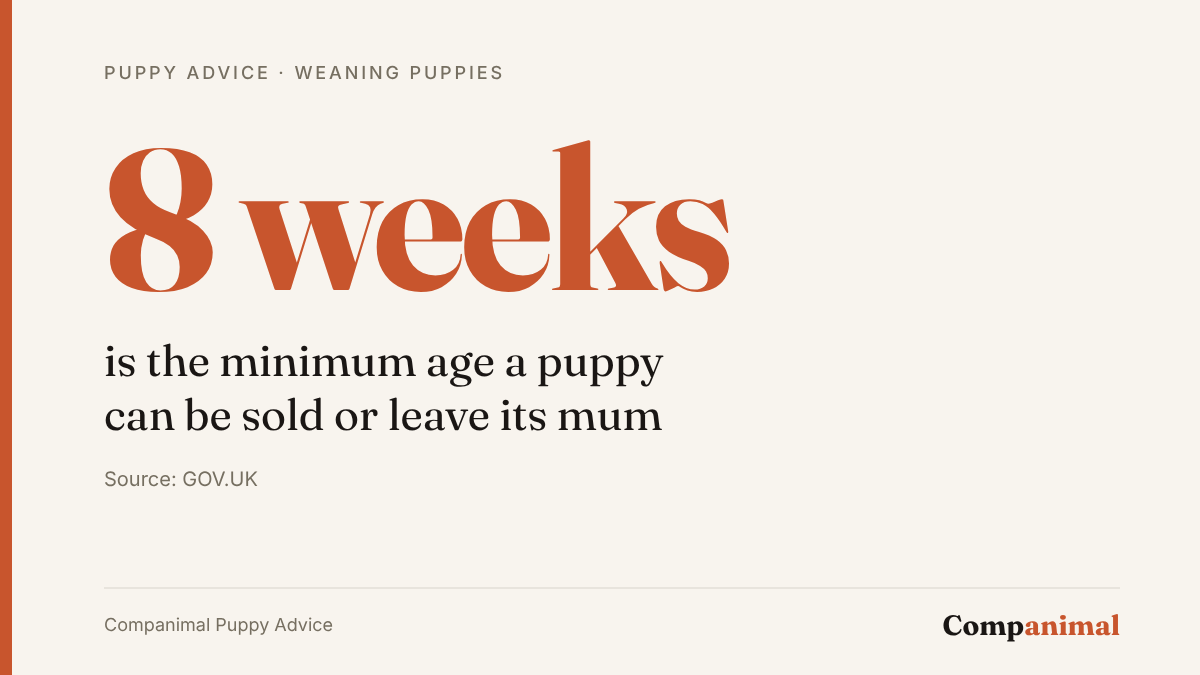
Our guide on when puppies can leave their mum goes into the age question in more detail.
The end of weaning: getting puppies ready for new homes
By 7 to 8 weeks your puppies should be eating a complete puppy food and drinking water confidently. This is when your attention turns to their new families.
- Send food home. Licensed breeders working to the higher standard include at least a week's supply of the puppies' current food. It is a kind thing for any breeder to do.
- Write down the routine. Note the food, amounts and meal times so new owners can carry on without upsetting tummies.
- Microchip before sale. Each puppy must be microchipped and registered before it is sold; our guide to microchipping puppies covers the details.
- Vet check. Under the higher licensing standard, a vet must check each puppy before sale and proof must be kept.
- Show puppies with mum. A puppy may only be shown to buyers together with its mother.
When the litter is thriving and you know your dates, you can list your puppies on Companimal, where every listing is checked by a person before it goes live. New owners can then follow our puppy feeding guide to keep things steady once their new puppy is home.
Frequently asked questions
What age do you start weaning puppies?
Most breeders start at around 3 to 4 weeks old. The Royal Kennel Club recommends from around 3 weeks, while PDSA's hand-rearing guide introduces food at 4 weeks.
How long does weaning puppies take?
Several weeks. Most litters start at 3 to 4 weeks and are fully weaned somewhere between 6 and 8 weeks old.
What do you feed puppies when weaning?
A complete puppy food soaked in warm water to a porridge-like texture, offered in small amounts, then made gradually firmer. Fresh water should be available from about 4 weeks.
How many times a day should weaning puppies eat?
Little and often. Licensed breeders are expected to offer food up to 5 times a day during weaning.
Can puppies be weaned at 6 weeks and go to new homes?
Puppies may eat solid food well by 6 weeks, but they must stay with their mother until at least 8 weeks; selling or rehoming a puppy younger than that is illegal.
Do weaning puppies need water?
Yes. Offer a shallow saucer of water when you introduce food, and keep fresh water available at all times from about four weeks old.
Can you wean puppies without their mother?
Yes. Orphaned puppies are hand-reared on puppy milk replacer, with puppy food introduced at about 4 weeks and full weaning at around 6 to 7 weeks. Ask your vet to help you plan it.
Should the mother stay with the puppies during weaning?
Yes. She keeps feeding them while they learn to eat, and the puppies often copy her when they first try food. Make sure she can also get away from them to rest.
Ready to look?
Looking for your next dog?
Browse sellers who show their working. Every listing tells you what has been disclosed, and what has not.
How Companimal shows you what a seller has disclosed
Account in good standing with a phone number confirmed by the seller.
A council licence number disclosed, or KC registration declared on the listing.
A credentialled breeder whose council licence we have checked against the register.
Information on a listing is self-declared by the seller and has not been independently checked. Read our methodology
More from this series
Calm, practical reads from the same hub.
Puppy advice: raising, training and caring for your puppy · 12 min read
How to Sell Puppies in the UK: Safely, Responsibly and to Happy Forever Homes
How to sell puppies in the UK the right way: the law, matching each puppy to the right home, writing an advert serious buyers trust, vetting buyers and a safe handover.
Puppy advice: raising, training and caring for your puppy · 12 min read
When Can Puppies Leave Their Mum? UK Rules and Why 8 Weeks Matters
Puppies can leave their mum from 8 weeks old in the UK. Here is what the law says in each nation, why those first weeks matter, and what should be done before a puppy goes home.
Puppy advice: raising, training and caring for your puppy · 12 min read
How Long Are Dogs Pregnant? Signs of Pregnancy in Dogs, Week by Week
Dogs are pregnant for about 63 days. How to confirm a pregnancy, the signs week by week, caring for your pregnant dog, whelping and when to call your vet.