

Puppy advice: raising, training and caring for your puppy
Breeding Dogs: A Responsible UK Guide for First-Time Breeders
Thinking about breeding from your dog? What to weigh up first, the health tests both parents need, the right age, choosing a stud dog, the real costs and the UK licence rules.
What this guide covers
Breeding dogs responsibly starts months before any mating: with an honest look at whether your dog should have puppies at all, health tests for both parents, the right age and timing, and a plan for every puppy's future home. This guide takes a first-time breeder through the dog breeding process, from deciding to breed to the law on selling.
Should you breed from your dog?
The PDSA advises against breeding from pets and recommends neutering instead, pointing out that breeding has no health benefits for the dog and that pregnancy puts a strain on her body. It also notes that thousands of pets are already waiting in rehoming centres. So every litter of puppies needs a good reason behind it.
The Royal Kennel Club is clear that if you own a bitch who has puppies, you become a dog breeder, and the role comes with responsibilities. Before you go further, answer these questions honestly:
- Is she a good example of her breed? Healthy, sound and with a calm, friendly temperament you would be happy to pass on.
- Will she pass the health tests her breed needs? If testing shows a problem, a responsible breeder doesn't breed from that dog.
- Can you cope if something goes wrong? Emergency veterinary treatment for complications during pregnancy or birth can sometimes reach thousands of pounds.
- Do you have the time? Puppies need a lot of care, from vet checks, worming and flea treatment to daily socialisation.
- Do you know where the puppies will go? Reputable dog breeders usually offer to take back any dog they bred if the owner can no longer keep it, which the PDSA calls a lifetime commitment.
If you can tick every box, the rest of this guide is the practical side, and our guide to selling a litter responsibly picks up where this one ends. If you can't, deciding against a litter is a responsible choice too, and our guide on when to neuter a dog covers that path.
Some breeds carry extra risk. The PDSA warns that flat-faced breeds such as pugs and bulldogs can struggle to breathe, and that breeds such as Chihuahuas, French bulldogs and Pekingese may need surgery to deliver their pups, although complications can arise in any breed. If you own a flat-faced breed, read our flat-faced breed health statistics first.
Breeding dogs at a glance
| Question | Short answer |
|---|---|
| Earliest season | As early as 6 months, depending on size and breed |
| When to breed her | After several seasons, and only once health tested |
| Hip and elbow scoring | From 1 year old |
| Peak fertility in a season | Usually days 10 to 14 |
| Earliest a puppy can leave mum | 8 weeks, the legal minimum for licensed breeders |
| Licence in England | 3 or more litters in 12 months with any puppies sold, or breeding as a business |
Health tests for both parents
Pre-breeding health checks apply to the stud dog as much as to your female dog, so you avoid passing on genetic conditions that cause pain or shorten a dog's life.
The BVA/Royal Kennel Club Canine Health Schemes
The Canine Health Schemes were set up by the British Veterinary Association (BVA) and the Royal Kennel Club to reduce inherited disease, and they are open to pedigree dogs and crossbreeds alike.
| Scheme | How it works | What breeders aim for |
|---|---|---|
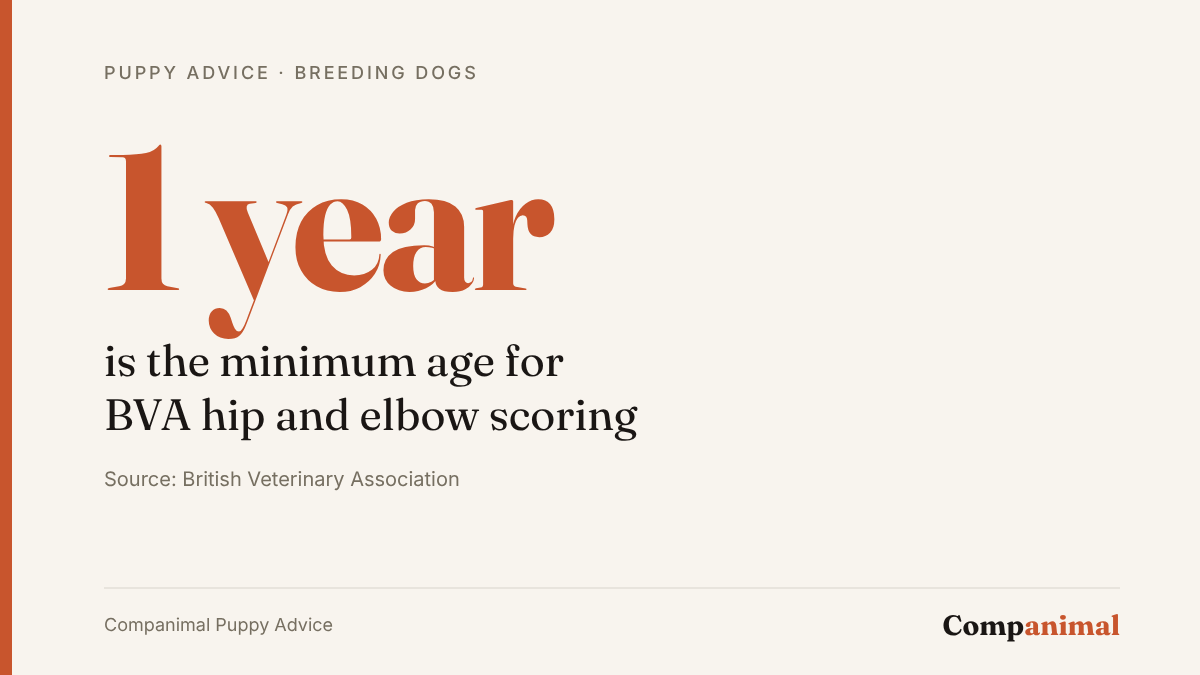
| Hip scheme | X-rays scored for signs of hip dysplasia. Each hip scores 0 to 53, a total of 0 to 106, and the lower the score the better. The dog must be at least 1 year old and microchipped. | Breed only from dogs scoring below or close to the published breed median. |
| Elbow scheme | X-rays graded 0 to 3 for elbow dysplasia, where 0 is normal. The overall grade is the higher of the two elbows. The dog must be at least 1 year old. | The scheme recommends breeding only from dogs graded 0. |
| Eye scheme | A clinical eye examination by an expert vet panellist, recording each condition as clinically unaffected or affected. Some breeds also need gonioscopy, which is graded 1 to 3. | Have both parents' eyes examined before you breed. |
| CM/SM scheme | Screening for Chiari malformation and syringomyelia, most often seen in the Cavalier King Charles Spaniel. | Follow your breed club's advice. |
Good results lower the risk of disease in puppies rather than removing it, and the hip scheme also advises checking relatives' scores.
DNA tests and breed-specific screening
Many breeds also have DNA tests, and some need extra screening, such as heart testing in Cavalier King Charles Spaniels, IVDD screening in Dachshunds or BAER hearing tests. The Royal Kennel Club's Breeds A to Z lists the tests recommended for each breed.
Check how closely related the pair are
High levels of inbreeding can affect the health of your puppies. The Royal Kennel Club's coefficient of inbreeding (COI) calculators show how closely related two potential mates are, and it will not register puppies from father to daughter, mother to son or brother to sister matings, except in exceptional circumstances.
The right age, and how often a dog can have puppies
A bitch can get pregnant in her first season, which can come as early as 6 months old. That is far too young. Responsible breeders usually wait until she has had several seasons, and some breeds should be health screened first. Because hip and elbow scoring both need the dog to be at least 1 year old, a properly tested bitch will be older than that at her first mating.
Male dogs can mate once they are sexually mature, but the Royal Kennel Club advises waiting until they are a little older.
Royal Kennel Club registration rules
If you plan to register the litter, the Royal Kennel Club sets these limits:
| Rule | What the Royal Kennel Club says |
|---|---|
| Minimum age of the mother | Over 1 year old on the date of mating |
| Maximum age of the mother | Under 8 years old when the puppies are born, unless permission was granted before the mating |
| Number of litters | No registration for a dam that has already whelped four litters, except in exceptional circumstances with permission sought before mating |
| Caesareans | No registration for a dam that has already had two litters by caesarean section, except for scientifically proven welfare reasons |
| Close relatives | Father to daughter, mother to son and brother to sister matings are not accepted |
| Both parents | Must be on the Breed Register; crossbred litters go on the Activity Register instead |
Limits for licensed breeders in England
Licensed breeders in England must meet legal conditions too. A bitch must not be mated before she is 12 months old, must not have more than one litter in any 12-month period or more than six litters in total, and must not be mated again after two litters delivered by caesarean section. They are sensible limits for any dog breeder.
Choosing a stud dog
Finding the right stud dog can take time. Look for a healthy, well-tested dog whose temperament and type complement your bitch, not simply the nearest one. Both dogs should be screened for the relevant health tests and checked over by a vet before mating. If your bitch is inexperienced, the Royal Kennel Club suggests pairing her with a more experienced dog where possible.
Questions to ask the stud dog's owner:
- Which health test results does he have, and can you see the certificates?
- What is the COI of the planned pairing?
- What happens if no pregnancy results?
Agree the terms in writing before the mating.
Timing the mating
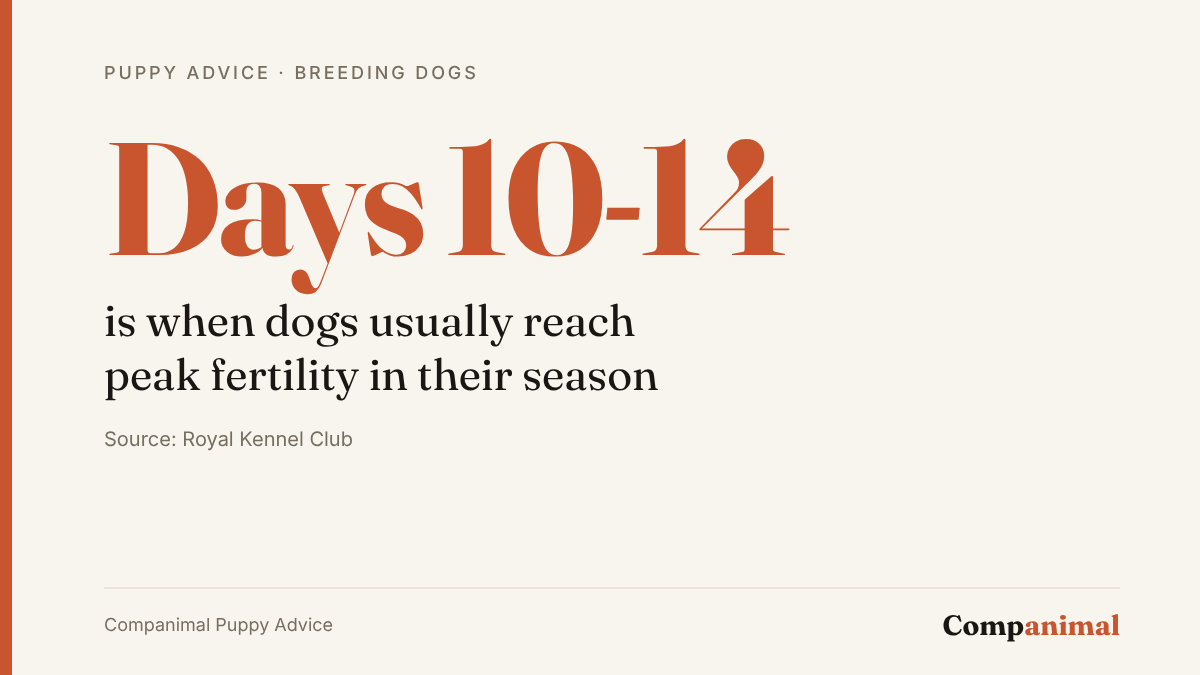
Most female dogs come into season twice a year, although this varies. Count day one as the first day you notice she is in heat; dogs usually reach peak fertility between days 10 and 14, though some are ready earlier or later.
Your vet can pinpoint ovulation more precisely than watching her behaviour. A vaginal smear test (vaginal cytology) looks for cell changes, while blood tests measure hormone levels over several days, with some vets checking progesterone levels and others LH. Once she is ovulating, plan your visit to the stud.
Mating two or three times, usually 24 to 48 hours apart, can make a pregnancy more likely, but mating the stud too often may reduce the quality of his semen. During a natural mating the dogs may stay joined in a "tie", and you should never try to separate two tied dogs. Some experienced breeders use artificial insemination instead.
If she refuses to mate
Never force her. Forcing a bitch to mate can cause stress, anxiety, pain and aggression towards the male. She may not be ovulating yet, may not like the stud, may be anxious or may be in pain, so try again a day or two later and speak to your vet if it continues.
Brucella canis
Brucella canis is a rare, incurable bacterial infection that can pass between dogs during mating and cause infertility and problems in pregnancy; the few UK cases are usually in imported dogs. Ask your vet about testing if either dog was imported.
Once she is mated, the next stage is the pregnancy itself, and our guide to how long dogs are pregnant explains the weeks of gestation ahead and how to care for her.
The cost and time of breeding a litter
Breeding dogs rarely makes the money people expect once every cost is counted, and most bills arrive before a single puppy goes home. Plan for each of these:
| Cost | When it comes |
|---|---|
| Health tests for your bitch | Months before mating |
| Pre-mating vet check and ovulation testing | Before and during her season |
| Stud fee | As agreed with the stud owner |
| Extra food and vet checks during pregnancy | The weeks of pregnancy |
| Whelping box, bedding and supplies | Before the birth |
| Emergency care, including a possible caesarean | Any time; it can reach thousands of pounds |
| Puppy vet checks, worming, flea treatment and microchipping | Before the puppies leave |
| Food and care for any puppy without a home yet | As long as it takes |
Time is the cost most first-time breeders underestimate: someone needs to be there when she starts to whelp, and the work grows as the puppies do. Weaning is the next big job, and our guide to weaning puppies shows what each week involves.
Dog breeding licence rules in the UK
Whether you need a dog breeding licence depends on where you live, how many litters you breed and whether you run a business, as regulations differ across the UK.
England
You need a licence from your local council if you run a business that breeds and advertises dogs for sale, or if you breed three or more litters in any 12-month period and sell any of the puppies. Under the statutory guidance, a business needs a licence whatever the number of litters, and the three-litter test applies unless you can prove none of the puppies were sold.
Councils judge the business test on factors such as selling for profit, advertising widely and selling in high volumes, alongside HMRC's badges of trade; trading income below the HMRC trading allowance means no licence is needed.
The council inspects your premises before granting a licence, and licences last 1, 2 or 3 years. Breeders who meet higher standards earn a 4 or 5 star rating, a longer licence and a lower fee. Breeding without a licence when you need one can lead to up to 6 months in prison or an unlimited fine.
Wales and Scotland
| Nation | You need a licence if you... |
|---|---|
| Wales | keep 3 or more breeding bitches and breed, advertise or supply 3 or more litters a year, or advertise a business of breeding or selling puppies |
| Scotland | breed 3 or more litters in any 12-month period, whether you sell the puppies or give them away |
A single planned litter from your family pet is usually below these thresholds, but your council's licensing team can confirm where you stand.
Lucy's Law and selling puppies directly
Lucy's Law came into force in England on 6 April 2020 and bans third-party sales of puppies under six months old, so buyers must buy direct from the breeder or adopt from a rescue. For you, that means selling your own puppies, with no dealer or pet shop in between. Buyers are told to see puppies with their mother where they were born, so plan for prospective owners meeting the litter with mum.
Planning ahead for the puppies' homes
An ethical dog breeder starts thinking about homes before the mating, not after the birth, and is honest about how many puppies they could keep if homes fall through.
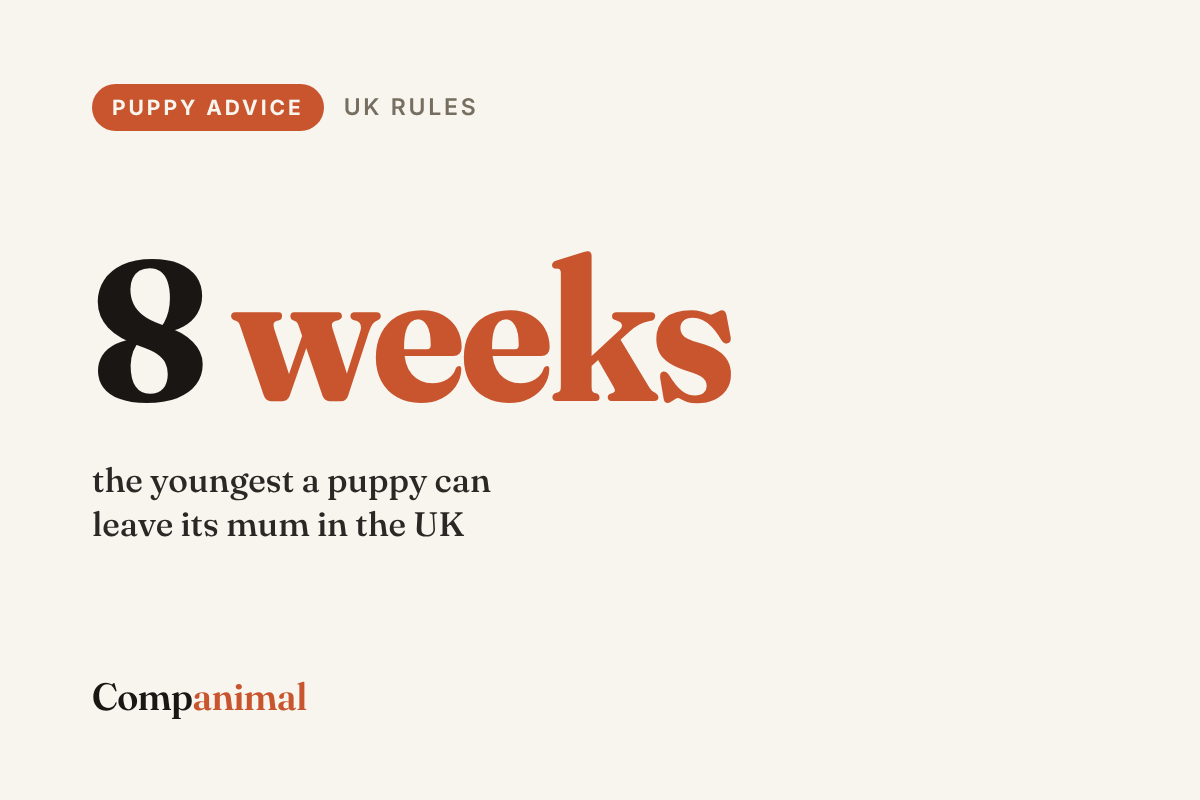
Licensed breeders must not sell a puppy or separate it from its mother before 8 weeks old, which is the right minimum for any litter, and every puppy must be microchipped by you before it goes; our guide to microchipping puppies explains how to register as the first keeper. A written puppy contract protects you and the new owners, and if you plan to register the litter, the Royal Kennel Club form is part of that paperwork.
When you are ready to advertise, Companimal is a dogs-only marketplace where every listing is checked by a person before it goes live and you choose who takes each puppy home, which makes it a calm place to start selling your first litter.
Frequently asked questions
Should my dog have one litter before being spayed?
No. Breeding has no health benefits for your dog, according to the PDSA, which recommends neutering pets that are not being bred. Ask your vet about the right time to spay.
How many litters can a dog have?
The Royal Kennel Club will not register a litter from a dam that has already whelped four, except in exceptional cases. Licensed breeders in England are limited to six litters per bitch, and no more than one in any 12 months.
What age should a dog start breeding?
A bitch must be over 1 year old for the Royal Kennel Club to register her litter, and responsible breeders usually wait until she has had several seasons and passed her health tests.
Do you need a licence to breed dogs in the UK?
Not for a single litter, usually. In England you need one for three or more litters in 12 months with any puppies sold, or if you breed as a business; Wales also requires 3 or more breeding bitches, and Scotland uses a similar three-litter test.
How can you tell when a dog is ready to mate?
Most bitches are most fertile between days 10 and 14 of their season, and your vet can confirm ovulation with a smear or blood test.
Ready to look?
Looking for your next dog?
Browse sellers who show their working. Every listing tells you what has been disclosed, and what has not.
How Companimal shows you what a seller has disclosed
Account in good standing with a phone number confirmed by the seller.
A council licence number disclosed, or KC registration declared on the listing.
A credentialled breeder whose council licence we have checked against the register.
Information on a listing is self-declared by the seller and has not been independently checked. Read our methodology
More from this series
Calm, practical reads from the same hub.

Puppy advice: raising, training and caring for your puppy · 12 min read
How to Sell Puppies in the UK: Safely, Responsibly and to Happy Forever Homes
How to sell puppies in the UK the right way: the law, matching each puppy to the right home, writing an advert serious buyers trust, vetting buyers and a safe handover.
Puppy advice: raising, training and caring for your puppy · 12 min read
When Can Puppies Leave Their Mum? UK Rules and Why 8 Weeks Matters
Puppies can leave their mum from 8 weeks old in the UK. Here is what the law says in each nation, why those first weeks matter, and what should be done before a puppy goes home.
Puppy advice: raising, training and caring for your puppy · 12 min read
How Long Are Dogs Pregnant? Signs of Pregnancy in Dogs, Week by Week
Dogs are pregnant for about 63 days. How to confirm a pregnancy, the signs week by week, caring for your pregnant dog, whelping and when to call your vet.