

Puppy advice: raising, training and caring for your puppy
Puppy Recall Training: How to Teach Your Puppy to Come When Called
A step-by-step guide to puppy recall training, from the first lessons at home to a long line and the park, with rewards, adolescence and livestock safety covered.
What this guide covers
Puppy recall training works best when it starts at home on the day your puppy arrives. Pick one recall word, pay for every return with something your puppy loves, and move from the house to the garden, then a long line, then the park, only when each stage is reliable. Expect a wobble in adolescence and keep the long line on until recall holds up around real distractions.
What recall is and why it matters so much
Recall simply means your dog comes back to you when you call, whatever else is going on. A good recall keeps a dog safe near a busy road, other dogs and livestock, and it is what earns a dog the freedom of off-lead exercise. The RSPCA puts it neatly: you need to be more exciting than the rest of the world.
For a puppy, recall is not a separate skill to bolt on later. It sits alongside name response, settling and toilet habits as part of the basics of puppy training, and the dog training habits you build in the first few weeks shape your dog's recall for years.
When to start recall training with a puppy
Start as early as you can. Blue Cross advises beginning as soon as possible and notes that puppies who have not finished their vaccinations can practise at home and in the garden. That makes the first weeks ideal: your pup is close to you, keen to follow, and the home environment has very little to compete with you.
You do not need to wait until your puppy can go outside for walks. By the time your vet gives the all-clear for public places, a puppy who has been practising indoors will already know what the recall cue means and that it always pays.
It is also never too late. Blue Cross points out that dogs keep learning throughout their lives, so an older puppy or a rescue dog can still build a solid recall.
Choosing a recall word or whistle
Choose one short, clear recall cue and stick with it. Dogs Trust suggests a short, snappy word such as "come" or "here", or a whistle. Battersea gives the same advice and adds that once you have chosen, you should not change it.
| Cue type | Works well because | Watch out for |
|---|---|---|
| A word ("come", "here") | Always with you, easy for the whole family | Overuse in daily chat makes it lose meaning |
| A whistle | Carries further and sounds the same whoever blows it | You need to carry it every walk |
| A hand signal | Helps at a distance or if your dog cannot hear you | Only works when your dog is looking at you |
A few rules make any cue stronger:
- Everyone in the household uses the same word and the same gesture, such as opening your arms wide, so the hand signal backs up the verbal one.
- Teach your puppy their name first, so saying their name gets their attention before you give the recall cue.
- Use the cue sparingly. If you have already called and your puppy is unlikely to come, repeating it teaches them that ignoring it is fine.
Rewards your puppy will run back for
The reward is what makes a puppy choose you over whatever is under their nose. Battersea recommends finding out what your dog values most, often food, or a toy during play, and keeping it special so your puppy does not get it all the time.
| Reward | Best for | Tip |
|---|---|---|
| Small pieces of cheese, ham, sausage or chicken | Early sessions, most puppies; high value for most | Blue Cross suggests food as the easiest place to start |
| A quick game of tug or a favourite toy | Toy-mad puppies | Keep a special toy just for recall |
| Several treats in a row, or a handful | Big wins, such as coming away from another dog | Blue Cross lists a larger handful as one way to vary rewards |
| Praise and a fuss | Puppies who love touch | Pair with food while learning |
Blue Cross also recommends that you vary the rewards so your puppy stays excited about coming back, and calling them for food or games during the walk rather than only when it is time to go home. Dogs Trust says that once recall improves you can reward less often, but you should still reward occasionally to keep your dog motivated.
Breed plays a part too. Blue Cross notes that gundogs and herding breeds tend to keep an eye on their owners, while terriers and hounds are often more interested in sounds and smells. If your puppy's nose rules their world, expect to work harder for a great recall.
How to teach a puppy recall in four stages
Each stage builds on the last. Only take the next step when your puppy comes back reliably at the current one; if they start to fail, Battersea's advice is to go back to the beginning, because either the cue is not understood yet or the reward is not motivating enough.
Stage 1: in the house
- Have a tasty treat or toy ready and let your puppy see it.
- Take a few steps away, say your dog's name and the cue in a happy voice. Crouching down helps.
- When they reach you, gently hold their collar, then reward straight away. Blue Cross explains why: in real life you will often need to take hold of it.
- Repeat a few times, then stop while they are still keen. Battersea suggests repeating this throughout the day, so keep each training session short.
- Once that is easy, call from another room and reward the moment they appear.
Stage 2: in the garden
Move to the garden once indoor recalls are near perfect, and check the fence is secure first. Increase the distance slowly, building up to calling across the garden.
This is also the stage for a helper game. One person gently holds the puppy or keeps them busy with play while the other moves away and calls with an equally good treat or toy. Take turns calling the puppy back and forth over a few short sessions. Then add a small distraction, such as calling your puppy away from a sniff.
Stage 3: on a long line
When your puppy is ready for walks, use a long line (a long training lead, called a long leash in some countries) to take recall training into the real world. Battersea and Dogs Trust both recommend attaching it to a harness rather than a collar, which reduces the risk of injury if your puppy runs to the end of the line.
- Long lines range from 3 to 30 metres; Battersea uses a 5 metre line as an example, and it does not need to be fully extended.
- Pick a lightweight fabric line for a small puppy and a more robust biothane or webbing line for bigger dogs.
- Hold it with two hands: the hand nearest the puppy manages the slack, the other holds the rest.
- Use it well away from roads, never beside a busy road.
- Call only when your puppy is likely to respond, not mid-play or with their nose deep in a smell.
- If they do not respond, stay calm and guide them in gently, or walk over and collect them. Never pull your puppy towards you on the line.
- Practise throughout the walk, not just at the end.
Keep these outings short. Young puppies tire quickly, so match each training session to how long to walk a puppy at their age and finish while they are still enjoying it.
Stage 4: in the park, off lead
Once your puppy returns reliably on the long line, Battersea suggests letting the line trail on the ground without holding it, as a step before going fully off lead. Only let your dog off lead in open spaces when you are confident they will come back; if your dog runs off or keeps running away, go back to the long line and use secure areas for off-lead time.
Meeting other dogs is the biggest test of all. Good puppy socialisation helps, because a puppy who has learned that other dogs are normal, rather than thrilling, finds it easier to leave them and run towards you instead.
Long line safety checklist
- Clip to the back ring of a harness if it has front and back fastenings, to keep the line away from your puppy's feet.
- Unravel the line before you start and loop it loosely in your hand.
- Watch for tangles, other people and branches: a long line can trip someone or catch on things.
- Stay alert and hold the line properly: if your puppy bolts and it runs through your hands, it can hurt.
- Keep a collar with an ID tag on your dog in public and your microchip details up to date, which Dogs Trust notes is a legal requirement in the UK.
Why recall wobbles in adolescence
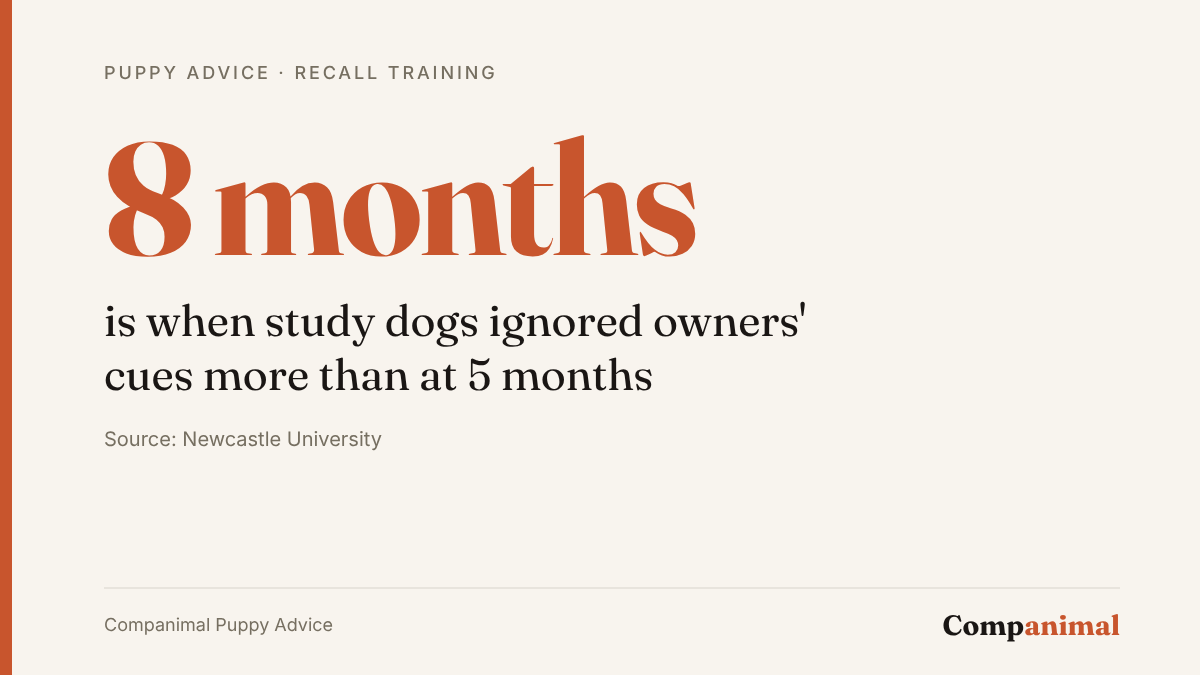
Many dog owners find that a puppy with a good recall at five months suddenly seems deaf at eight. There is evidence behind that. A 2020 study by the universities of Newcastle, Nottingham and Edinburgh, published in Biology Letters, found dogs were more likely to ignore cues from their main carer and were harder to train at 8 months than at 5 months. The dogs did not show the same drop with strangers, so the "teenage" response is aimed at the people they know best.
The researchers advised owners not to punish disobedience or withdraw from their dog during this stage, and described it as a passing phase. In practice, that means:
- Go back a stage or two and put the long line back on for walks.
- Raise the value of your rewards for a while.
- Keep sessions short and positive so coming back still feels like the best option.
- Avoid using your recall cue when you know you will not get a response.
Our guide to adolescent dogs covers the wider changes in this period.
Recall near livestock and the law
The Countryside Code says it is good practice to keep your dog on a lead around livestock, and that between 1 March and 31 July you must keep your dog on a lead on Open Access land, even if no animals are present. It also states that a farmer can shoot a dog that is attacking or chasing livestock, and may not have to compensate the owner.
Under the Dogs (Protection of Livestock) Act 1953, the owner, and anyone else in charge of a dog at the time, commits an offence if the dog attacks or worries livestock on agricultural land. Worrying includes chasing livestock in a way that could cause injury or suffering, and a dog being at large, meaning not on a lead or otherwise under close control, in a field or enclosure with sheep. In England and Wales the offence now also covers roads and paths.
So, however reliable your puppy's recall is, put them on a lead near farm animals, as even a friendly young dog may chase sheep. If you ever feel threatened by livestock or horses, the Countryside Code advises letting your dog off the lead rather than risking injury.
Common puppy recall mistakes
| Mistake | Why it backfires | Do this instead |
|---|---|---|
| Calling only to clip the lead on or go home | Your puppy learns that coming back ends the fun | Call, reward, then let them go again, many times per walk |
| Telling your puppy off when they finally return | They learn that coming back is unpleasant | Praise every return, however long it took |
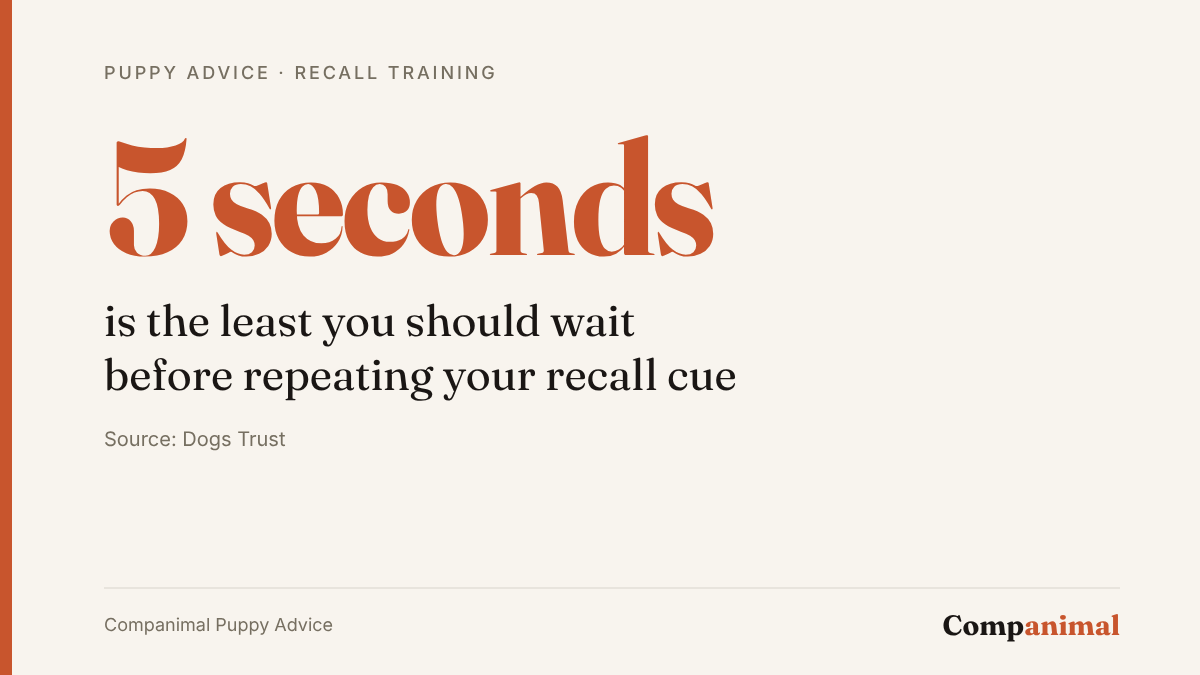
| Repeating the cue over and over | It teaches them the cue is optional | Give at least five seconds before calling again |
| Moving outdoors too soon | The world is more exciting than you are | Make each stage reliable before moving on |
| Using a reward your puppy does not care about | There is no reason to leave the fun | Find the reward they value most and save it for recall |
| Different words from different people | Your puppy cannot tell what is being asked | Agree one cue and one gesture as a household |
| Pulling the puppy in on the long line | Coming back becomes a struggle, not a choice | Guide gently or walk over and collect them |
When to get extra help
If your puppy's recall is not improving despite consistent, positive practice, Battersea suggests contacting a certified dog behaviourist. A qualified trainer can spot small things, such as timing, that make a big difference to your training journey. If your dog's behaviour changes suddenly, or they seem slow, sore or unwilling to move, speak to your vet to rule out a health problem.
Frequently asked questions
At what age can I start teaching my puppy recall?
From the day you bring them home. Blue Cross advises starting as early as possible, with unvaccinated puppies practising at home and in the garden.
How long does it take to teach a puppy recall?
It depends on your puppy, their breed and how often you practise. Dogs keep learning throughout their lives, so treat recall as ongoing practice, and expect a dip in adolescence.
Should I use a whistle or a word for recall?
Either works. Dogs Trust suggests a short word such as 'come' or 'here', or a whistle, as long as everyone uses the same one.
Why does my puppy come back in the garden but not in the park?
The park is full of smells, people and dogs that compete with you. Go back to the long line, call only when your puppy is likely to respond, and use better rewards until the recall holds up there too.
Is it safe to let my puppy off lead near sheep or cows?
No. Keep your dog on a lead around livestock, and on Open Access land from 1 March to 31 July. A dog at large in a field with sheep can count as worrying livestock, which is an offence.
Ready to look?
Looking for your next dog?
Browse sellers who show their working. Every listing tells you what has been disclosed, and what has not.
How Companimal shows you what a seller has disclosed
Account in good standing with a phone number confirmed by the seller.
A council licence number disclosed, or KC registration declared on the listing.
A credentialled breeder whose council licence we have checked against the register.
Information on a listing is self-declared by the seller and has not been independently checked. Read our methodology
More from this series
Calm, practical reads from the same hub.
Puppy advice: raising, training and caring for your puppy · 13 min read
Puppy Training: The Complete UK Guide From 8 Weeks to Adolescence
When to start puppy training, a simple plan by age, the reward-based methods UK vets and charities recommend, the core skills, classes and how to fix common problems.
Puppy advice: raising, training and caring for your puppy · 12 min read
Teenage dog: what to expect from canine adolescence and how to cope
When does a teenage dog phase start, what behaviour changes to expect, and how to get through canine adolescence calmly, with advice from UK welfare charities.
Puppy advice: raising, training and caring for your puppy · 12 min read
Puppy separation anxiety: how to teach your puppy to be left alone
Why puppies struggle to be left alone, the signs of separation-related problems, a step-by-step plan to build calm alone time, and when to ask a vet or behaviourist for help.