

Puppy advice: raising, training and caring for your puppy
Puppy Training: The Complete UK Guide From 8 Weeks to Adolescence
When to start puppy training, a simple plan by age, the reward-based methods UK vets and charities recommend, the core skills, classes and how to fix common problems.
What this guide covers
Puppy training starts the day your puppy comes home, usually at around 8 weeks old, and the method that works best is reward-based training: you mark and reward the behaviour you want, and ignore or redirect the rest. UK vets and charities including PDSA, Blue Cross, the RSPCA and BSAVA all advise against punishment. Keep sessions to a few minutes, train little and often, and expect a wobble when your puppy hits adolescence.
When should you start training a puppy?
Start as soon as your puppy is home. Puppies often come home at about 8 weeks old, which falls inside the socialisation period that PDSA puts at roughly 4 to 12 weeks of age. The Royal Kennel Club describes the early learning phase as running up to the first 16 weeks. Either way, the first weeks are when your puppy learns fastest what is normal and safe.
That does not mean formal obedience lessons on day one. In the first week, training is mostly routine: where to toilet, where to sleep, responding to their name and getting used to being handled. Our guide to your puppy's first week covers how to set it up so good habits start straight away.
It is also never too late, so this applies to older dogs and rescue dogs too. The RSPCA says all dogs, young or old, benefit from learning basic commands.
A puppy training plan by age
Every puppy's development runs at its own pace, and breed and temperament both play a part, so treat this as a rough programme rather than a timetable. Your vet's advice on vaccination decides when your puppy can go on the ground in public places and join a training class.
| Age | Main focus | Skills to work on |
|---|---|---|
| 8 to 10 weeks | Settling in, routine, gentle socialisation | Name, toilet training, crate or bed, being handled, short car trips, being carried outside to see the world |
| 10 to 16 weeks | Foundations and confidence | Sit, down, first recall games, wearing a collar or harness, short spells alone, gentle mouthing rules |
| 4 to 6 months | Building reliability | Loose-lead walking, wait and stay, recall with mild distractions, settling on a mat, a puppy class |
| 6 months to 2 years | Adolescence | Keep practising the basics, long-line recall, impulse control, calm greetings, more mental enrichment |
The best puppy training tips are simple: one new behaviour at a time, lots of repetition, and plenty of success at home and on walks.
How to train a puppy with rewards
Reward-based training, also called positive reinforcement, is the method PDSA calls the kindest and most effective. The idea is simple: behaviour that earns a reward is more likely to happen again. Every dog training session follows the same pattern.
- Ask or wait for the behaviour. For a sit, hold a treat at your puppy's nose and lift it slowly back over their head. Do not push their bottom down.
- Mark it instantly. Say "yes" or use a clicker the moment it happens.
- Reward fast. PDSA advises giving the reward during the behaviour or within half a second of it.
- Add the cue word once the behaviour is reliable. Everyone in the family should use the same words so your puppy is not confused.
- Fade the lure. Phase out the food in your hand gradually, so your puppy responds to the cue rather than the treat.
Choosing rewards your puppy will work for
Some dogs love food, others prefer praise or a favourite toy, and many owners use a mix of praise and reward. The RSPCA suggests finding out which rewards your dog likes best. PDSA suggests healthy food rewards, such as a very small slice of carrot, and a smaller main meal on days you use richer treats.
How long should a training session be?
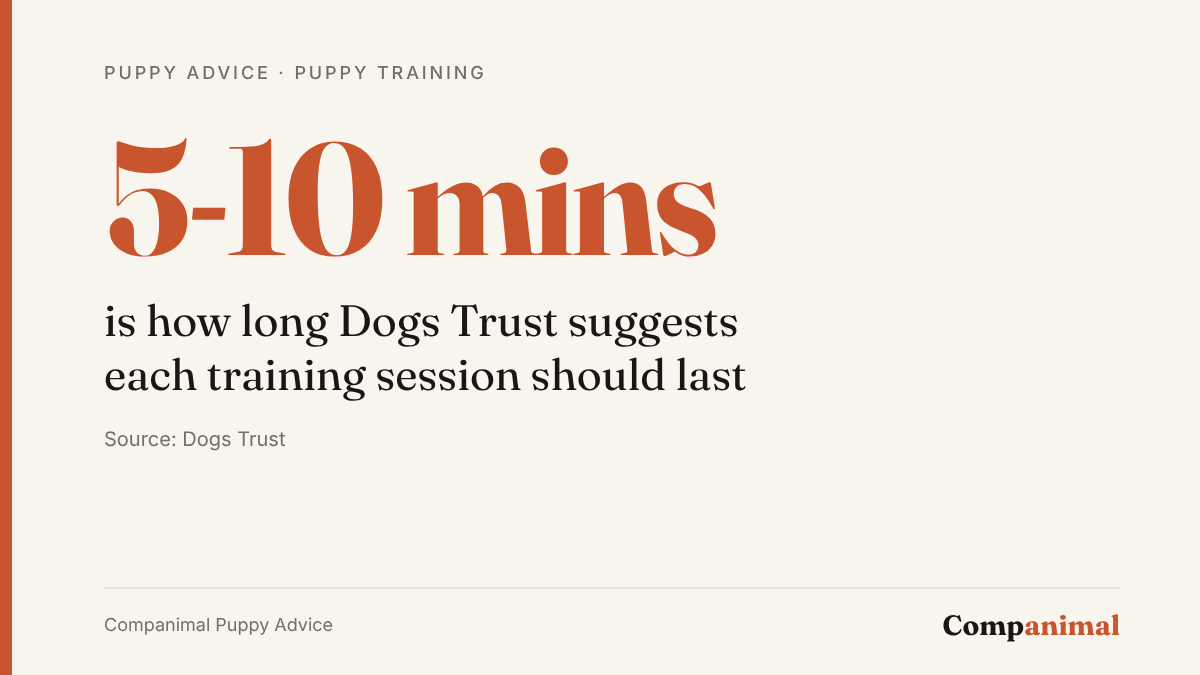
Short. Dogs Trust recommends five to 10 minutes at a time, focused on one behaviour, ending with a fun game. Blue Cross suggests about two to five minutes, little and often. For a young puppy, the shorter end is usually right, and indoor sessions are easiest to start with. Train when your puppy has eaten and been to the toilet, in a calm space with no distractions, and always finish on a success.
Why UK charities and vets say no to punishment
Punishment includes shouting, smacking, water pistols, rattle cans and choke chains. PDSA says these cause anxiety and fear, which are proven to make animals learn more slowly, and teach your dog that people cannot be trusted, which can lead to behaviour problems later in life.
The veterinary view is just as clear. BSAVA recommends against aversive training methods, warning that they are likely to be stressful, painful and frightening, and can cause long-term fear and aggression, with implications for public safety as well as welfare. Blue Cross does not use or advise aversive equipment or methods, because dogs learn best when they are not stressed or scared.
Some of the harshest tools are already restricted. Wales banned electronic shock collars in 2010, and BVA campaigns for similar rules across the rest of the UK and a UK-wide ban on their sale.
PDSA also calls the "pack leader" dominance idea a myth: your puppy needs to trust you, not fear you. Telling a puppy off after the event rarely works either, because owners usually find the problem after it has happened.
The first weeks: toilet training, crate training and night-time
House training is usually the first big project. Take your puppy out after waking, eating and playing, and regularly in between, then reward them the moment they finish toileting in the right spot. Our step-by-step guide on how to toilet train a puppy covers timings, accidents and night-time trips.
A crate or a cosy pen gives your puppy a safe den and helps with toilet training and settling. Introduce it slowly and never use it as a punishment; our guide to crate training a puppy walks you through each stage.
Crying in the first few nights is normal for a puppy who has just left their mum and littermates. Understanding why puppies cry at night and when they are left helps you respond with comfort rather than frustration, and without accidentally rewarding the crying.
The core skills every puppy needs
These basic commands make daily life easier and keep your puppy safe. Start teaching them in this rough order, using rewards throughout.
| Skill | Why it matters | Quick start |
|---|---|---|
| Name response | Gets attention before any other cue | Say their name once, reward when they look at you |
| Sit | A polite default for greetings, doors and meals | Lure the treat over the head, reward as the bottom touches the floor |
| Down | Foundation for settling | Lure from nose to floor between the front paws |
| Recall (come) | The most important safety skill | Start a few feet away in a quiet, secure space and build up distance |
| Loose-lead walking | Makes walks pleasant | Reward your puppy for being by your side |
| Wait or stay | Safety at doors, kerbs and car boots | Build duration first, then distance |
| Settle | Teaches calm in a busy home | Reward your puppy for lying quietly on a mat |
| Being alone | Prevents separation problems | Short, calm absences, built up very gradually |
Time alone is on PDSA's list of things a puppy should experience early. Start with seconds while your puppy is tired, and use our guide to puppy separation anxiety to build up from there.
Recall: the skill to start early
Blue Cross says it is best to start recall training as early as possible, though it is never too late. PDSA suggests getting down to your puppy's level, using a happy tone and rewarding them when they arrive, then moving to quiet public places with a long, loose lead as a backup. Our guide to puppy recall training has games that make coming back the best thing your puppy can do.
Socialisation: the training that cannot wait
To socialise a puppy is to give them positive experiences of a wide variety of people, sounds, smells and places, along with new dogs, car travel and being handled with collars and harnesses. Because the window is short, it shapes your puppy's future around other dogs and people as much as any obedience cue.
The early part of that window happens before your puppy leaves the litter, so breeders who handle puppies daily in a busy home give owners a head start; it is a core part of breeding and raising a litter responsibly.
Before your puppy is fully vaccinated, PDSA suggests carrying them when you are out so they can meet new people and see new places, while avoiding unvaccinated dogs and higher-risk areas until their vaccines have taken effect. Check our guide to the puppy vaccination course for when your puppy can safely walk on the ground outside and join classes. For a full checklist of sights and sounds, see our puppy socialisation guide.
Puppy training classes and how to choose a trainer
Puppy training classes teach you as much as your puppy, and give them a chance to meet other puppies and get used to a range of other dogs. Classes are run by local clubs and training centres, and some trainers also offer one-to-one sessions or a home visit, which can suit a nervous puppy. Check with your vet which vaccines your puppy needs before the first class.
Many dog training classes across the UK follow the Royal Kennel Club's Good Citizen Dog Training scheme, which has four levels: Puppy Foundation, Bronze, Silver and Gold. Depending on the club, puppies can start the Puppy Foundation from 8 weeks of age and complete it up to 12 months, with the instructor assessing them over at least four weeks.
What to look for in a trainer
Dog training is not regulated in the UK in the way you might expect. The RSPCA warns that anyone can call themselves a dog trainer, even without the right knowledge and skills, and Dogs Trust says the same of behaviourists.
Use this checklist before you book:
- The trainer is registered with the Animal Behaviour and Training Council (ABTC), which sets standards of competence and welfare
- Methods are reward-based, using food, play or toys
- You have watched a class without your puppy first
- The class is calm and quiet, and anxious puppies get help to relax
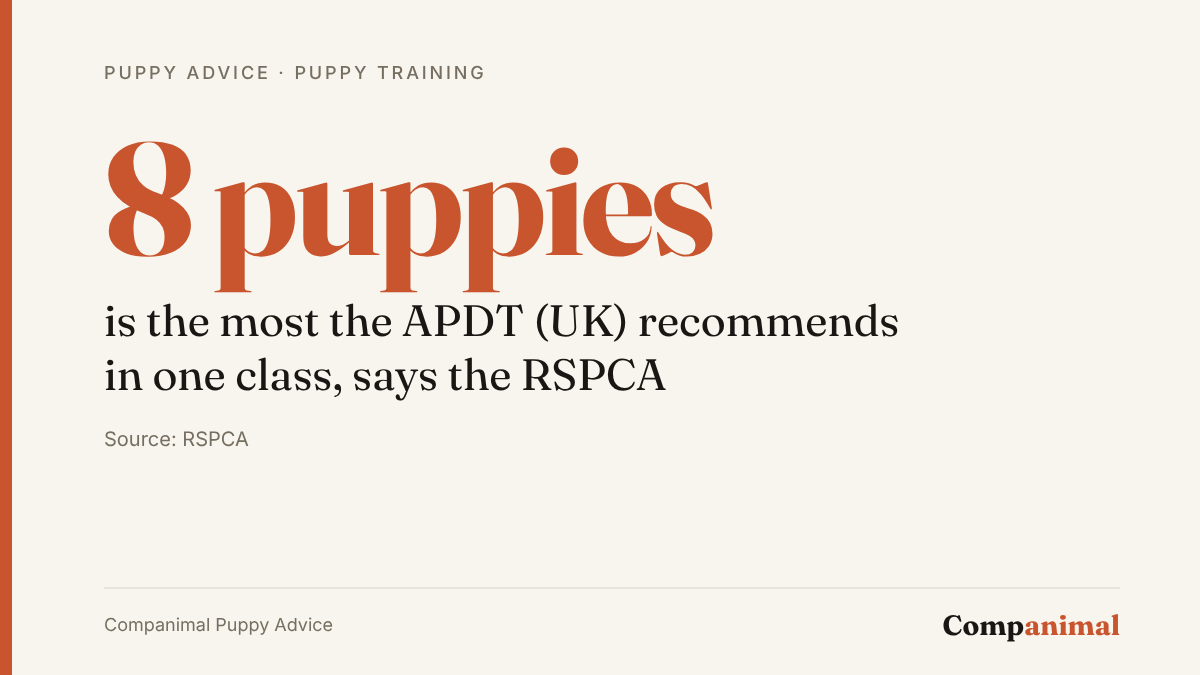
- The class is small: the APDT (UK) recommends no more than 8 puppies with an instructor and one assistant
- Medical or serious behaviour problems are referred to a vet or clinical animal behaviourist
Red flags: methods that rely on fear, pain, choke chains, shouting or hitting; puppies cowering with tucked tails; and lots of shouting or barking, which signals high stress.
Trainer, behaviourist or vet?
A trainer teaches you to use rewards to build skills such as loose-lead walking or settling. A behaviourist helps with behavioural issues rooted in emotional problems such as anxiety, fear and frustration, which simple training will not fix. Speak to your vet first if your puppy shows a sudden change in behaviour, growls, snaps or bites in a way that is more than play, cannot settle or seems to be in pain, or starts having accidents after being reliably clean. Medical conditions can affect behaviour, and your vet can refer you to an accredited behaviourist if needed. PDSA notes that many behaviour problems get worse over time, so getting help early is key.
Training through the teenage months
Just as you think the hard work is done, adolescence arrives. Blue Cross says it typically starts at around five to six months and finishes at around 18 months to two years, depending on the dog and breed. PDSA puts the start at around 8 to 12 months, with larger breeds maturing more slowly. Most dogs do not reach full social maturity until around three years old.
Common changes include boisterous behaviour, recall that suddenly fails, ignoring cues they knew well and a second fear period, when a confident dog may become wary of new things. Blue Cross suggests a long line for safety on walks and going back to low-distraction training before building up again. PDSA warns that punishing a teenage dog can harm their mental wellbeing and make problems worse. Our guide to adolescent dogs covers this stage month by month.
Common puppy training problems and what to do
| Problem | What is usually going on | What helps |
|---|---|---|
| Biting and mouthing | Normal play and teething | Redirect to a toy, pause play when teeth touch skin |
| Jumping up | Seeking attention | Do not shout, as any attention can feel like praise; reward a sit instead |
| Accidents indoors | Too much freedom, too soon | More frequent trips outside, reward outdoor toileting, clean up thoroughly |
| Not coming back | Distractions win, or recall has been used to end fun | Go back to easier settings, use a long line, reward every return |
| Pulling on the lead | Walking faster than you is rewarding | Stop when the lead tightens, reward when it is loose |
Biting is normal, but it needs gentle, consistent handling from the start; our guide to puppy biting explains how to teach a soft mouth and when it should stop.
If progress stalls, go back a step and move on more slowly, and if neither of you is enjoying a session, try again another day.
Frequently asked questions
How many sessions does it take to train a puppy?
There is no fixed number. Short sessions several times a day add up quickly, and the Royal Kennel Club's Puppy Foundation is assessed over at least four weeks, but training carries on throughout your dog's life.
Are puppy training classes worth it?
A good class is worth it for most owners: your puppy learns around other dogs, and you get coaching from a trainer. Choose a small, reward-based class with an ABTC-registered instructor.
How do you train a puppy to walk on a lead?
Start indoors, reward your puppy for walking by your side, and stop whenever the lead goes tight.
Can my puppy go to training classes before their vaccinations are finished?
Some classes accept young puppies, but check with your vet which vaccines your puppy needs before the first class.
Is it too late to train a 6 month old puppy?
No. All dogs, young or old, can benefit from learning basic commands. Adolescence can make it feel harder, but steady reward-based training still works.
Do I need a clicker to train my puppy?
No. A clicker is a consistent marker, and a short word like "yes" works the same way. The RSPCA suggests a class if you want to learn clicker training.
Ready to look?
Looking for your next dog?
Browse sellers who show their working. Every listing tells you what has been disclosed, and what has not.
How Companimal shows you what a seller has disclosed
Account in good standing with a phone number confirmed by the seller.
A council licence number disclosed, or KC registration declared on the listing.
A credentialled breeder whose council licence we have checked against the register.
Information on a listing is self-declared by the seller and has not been independently checked. Read our methodology
More from this series
Calm, practical reads from the same hub.
Puppy advice: raising, training and caring for your puppy · 12 min read
Teenage dog: what to expect from canine adolescence and how to cope
When does a teenage dog phase start, what behaviour changes to expect, and how to get through canine adolescence calmly, with advice from UK welfare charities.
Puppy advice: raising, training and caring for your puppy · 12 min read
Puppy separation anxiety: how to teach your puppy to be left alone
Why puppies struggle to be left alone, the signs of separation-related problems, a step-by-step plan to build calm alone time, and when to ask a vet or behaviourist for help.
Puppy advice: raising, training and caring for your puppy · 12 min read
How to Stop Puppy Biting and Nipping: Why Puppies Bite and When It Stops
Why puppies bite and nip, the age most puppies grow out of it, and calm, reward-based ways to stop a puppy biting hands, feet, clothes and children.