

Puppy advice: raising, training and caring for your puppy
Puppy separation anxiety: how to teach your puppy to be left alone
Why puppies struggle to be left alone, the signs of separation-related problems, a step-by-step plan to build calm alone time, and when to ask a vet or behaviourist for help.
What this guide covers
Most puppies are not born knowing how to be alone, so separation anxiety is far easier to prevent than to fix. Start in the first days at home with absences of a few seconds, build up slowly while your puppy stays relaxed, keep goodbyes and hellos calm, and never punish what you find when you get back. If your puppy panics, howls for long periods or hurts themselves when left, speak to your vet, who can refer you to an accredited behaviourist.
What is puppy separation anxiety?
Separation anxiety in dogs is when a dog feels anxious when they are alone, or away from the person they are most bonded to. Vets now often use the wider term "separation-related problem", because not every dog that struggles alone is anxious: some are bored, frightened of a noise, or simply need the toilet. The RSPCA calls it separation-related behaviour and stresses that, in many cases, the behaviour comes from distress rather than naughtiness, and that it is both preventable and treatable. So puppies can develop separation anxiety, but with the right help most dogs improve.
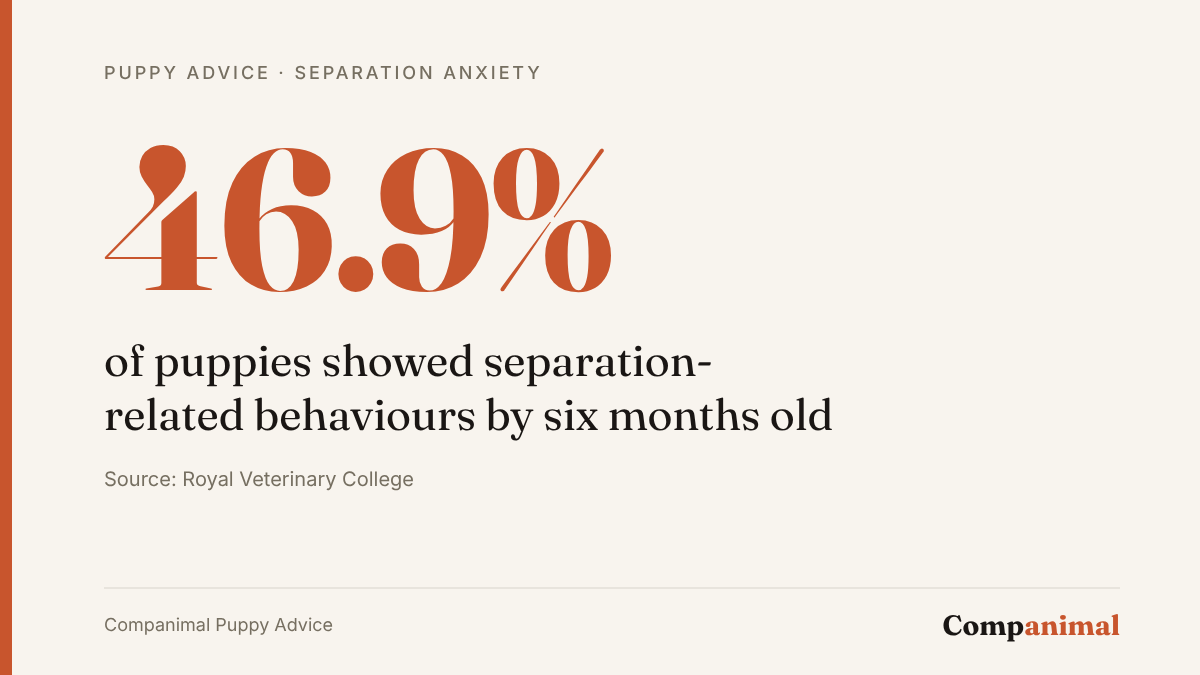
It is very common. The RSPCA cites research suggesting 8 out of 10 dogs find it hard to cope when left alone, and that around half of dogs with separation-related behaviour show no obvious signs while their owners are around. In a UK study of 145 puppies followed by the Royal Veterinary College (RVC) and Dogs Trust, 46.9% showed separation-related behaviours by six months old.
Teaching home-alone skills is one of the most useful parts of training your puppy, and the Royal Kennel Club suggests giving it the same priority as toilet training.
Why do puppies struggle to be left alone?
Dogs are social animals that have evolved alongside people, and most would choose to spend much of their time with us. Being alone does not come naturally to most of them. A puppy has also just left their mother and littermates. The University of Bristol's behaviour clinic says puppies who never learn that being alone is safe are one of the most common causes of separation problems in adult dogs.
Common causes and risk factors include:
- No gradual practice when young. Not getting used to short absences as a puppy.
- A bad experience when left. Being frightened or hurt while alone, including by a loud noise.
- Over-attachment. Being very attached to one or more people in the household.
- Boredom. Not enough mental stimulation, so the puppy chews or digs to pass the time.
- Changes at home. Changes to the household or routine, or a bereavement.
- Pain or illness. A medical problem can cause similar worry, so a vet should check any dog that seems anxious.
The RVC study also found that puppies whose owners fussed over them after unwanted behaviour on reunion were six times more likely to show separation-related behaviours, and that punishment at 16 weeks was linked to higher risk. Puppies confined to a crate or room overnight before 16 weeks, and those sleeping 9 or more hours a night, had lower risk. Poor house training before 16 weeks was also linked to higher risk. These are associations, not proof of cause, but they point to calm reunions, kind training, good sleep and steady toilet training. If your puppy struggles at night, our guide to why puppies cry covers settling them.
Signs of separation anxiety in puppies
Symptoms of separation anxiety usually show up when your puppy is alone or about to be left. Some puppies bark or howl; others show quieter signs of distress. The RSPCA says the behaviour often starts within a few minutes and up to 30 minutes of you leaving.
| Common signs | Less obvious signs |
|---|---|
| Barking, whining or howling | Pacing, circling or spinning |
| Chewing or scratching near doors and windows | Panting, trembling or drooling |
| Toileting indoors | Not eating treats or food while you are out |
| Over-the-top excitement when you come home | Licking or biting their own paws or tail |
| Looking worried when you pick up keys, a coat or a bag | Vomiting, or lying still but tense and alert |
Many puppies are quiet but stressed: in the RVC study, the most common behaviours when alone were pacing (14.5%), whining (7.6%) and spinning (6.9%). Also, the flattened ears, lowered body and tucked tail that owners read as "guilt" are appeasement signals, a response to your upset, not proof your puppy knows they did wrong.
The simplest way to find out is to film your puppy while you are out. Point a camera at their bed or the door you leave through, and act on signs even if they seem mild.
Is it true separation anxiety or boredom?
Not every chewed cushion means a puppy is unhappy. The PDSA notes that destructive behaviour can simply be a dog having fun, and that a veterinary behaviourist can often tell the difference by watching a video of the dog. A bored puppy usually settles with a food toy. A puppy with true separation anxiety is often too worried to eat at all.
Step-by-step: how to teach your puppy to be left alone
This plan shows you how to teach your puppy how to be alone using positive reinforcement: rewarding calm behaviour rather than punishing mistakes, which is the only approach the RSPCA recommends. The aim is for your puppy to learn that you leaving is ordinary, and that you always come back. Go at your puppy's pace. Repeat each stage until your puppy is calm before moving on, and if they get worried, go back to the last step they managed calmly.
- Set up a safe space. Use a puppy-proofed room behind a stair gate, a playpen or a crate, with a comfortable bed, water and safe chews. An old item of your clothing can help them settle. Do not use this space only when you go out, or it can become a signal that they are about to be alone. If you use a crate, our guide to crate training a puppy explains how to make it a place they choose.
- Start with distance, not doors. While your puppy settles on their bed, take a step or two away, then come back and reward calm behaviour.
- Add a long-lasting chew. Give a stuffed food toy or chew behind the gate, close it and carry on nearby within sight and earshot. After a few minutes, open the gate. Make sure any toy is puppy-safe and cannot be chewed up or swallowed.
- Step out of sight for seconds. Leave the room for a few seconds and return before your puppy gets upset. Reward calm, quiet behaviour.
- Build time slowly. Over days or longer, stretch the time you are out of sight, working up to about half an hour while you are busy elsewhere in the house. Vary the length of absences rather than always adding time.
- Take the sting out of departure cues. Pick up your keys, put on your coat or grab your bag and then sit back down. Only start leaving the house once these cues no longer worry your puppy, which can take several days.
- Practise real absences. Leave the house for a minute or two and come back before anxiety starts. Repeat these short training sessions several times a day and build gradually. The RSPCA says that once a dog can stay calm for up to an hour, longer periods should be manageable.
Before each practice, make sure your puppy has had some exercise, a chance to toilet and perhaps a small meal, so they are ready to rest.
Leaving and coming back
Keep both moments low-key. Leaving without a fuss means your puppy does not have time to get wound up. When you return, wait until your puppy is calm before greeting them or giving a treat. In a small RVC trial of 34 new puppy owners, puppies whose owners were given calm departure and reunion advice rested more quietly when alone.
What about the radio or TV?
Advice differs. The RSPCA and Blue Cross suggest a radio to muffle outside noise, but the same small RVC trial found puppies showed more passive anxiety signs, and ate and played less, when a TV or radio was left on. Try both and film the results: your puppy's behaviour is the best guide.
How long can you leave a puppy alone?
How long a dog can be left depends on age, toilet needs and training, and the UK welfare charities do not give an age-by-age chart for puppies. What they do agree on:
| Guideline | What the source says |
|---|---|
| Early training | Start with a few seconds out of sight, building only while your puppy stays calm |
| First milestone | About half an hour alone in the house, built up gradually |
| Toilet breaks | Young puppies need to go out every 2 to 3 hours during the day, and shortly after each meal |
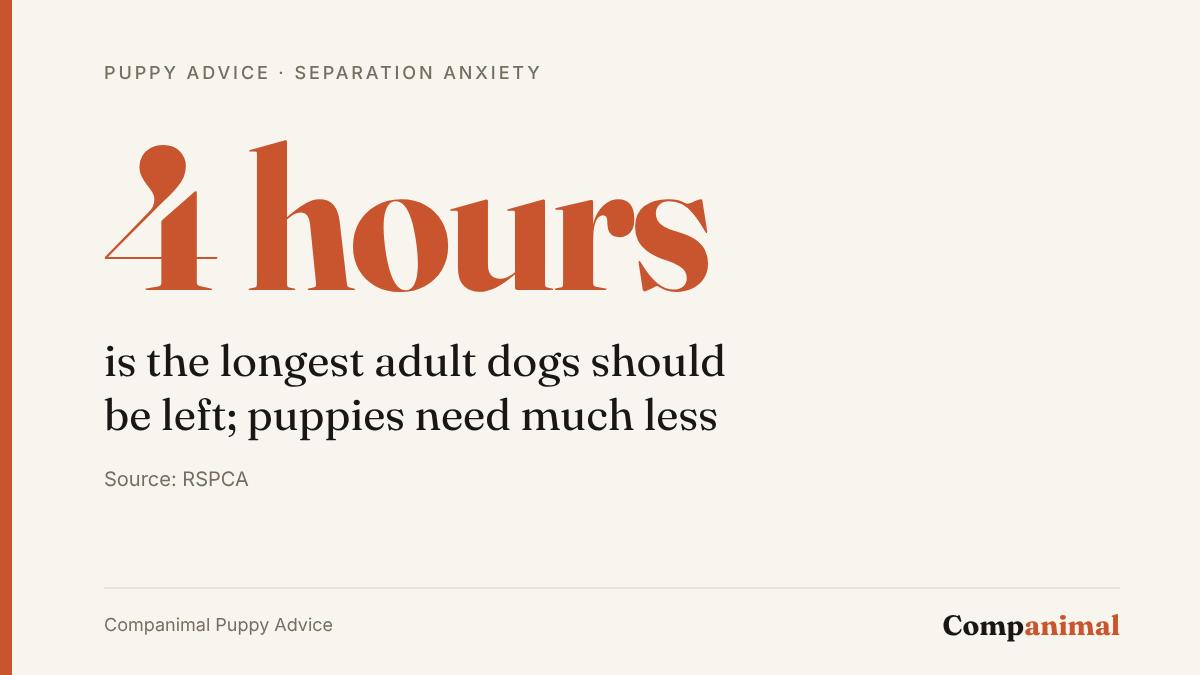
| Adult dogs | No more than four hours at a time |
| Puppies | Much less than four hours; four hours may be too long for a very active young puppy |
In practice, the limit for a young puppy is set by their bladder and by how far their training has got, not by the clock. If you work long days, plan for a neighbour, friend, dog walker or pet sitter to visit, and only use doggy day care once your puppy is up to date with their vaccinations. Our guide to the first weeks with a new puppy has more on planning ahead.
What not to do
- Do not punish. Telling off or punishing your puppy on return will not stop the behaviour and can increase anxiety, because they link your anger with your arrival. Greet them normally, let them out and clean up calmly.
- Do not leave the dog to "cry it out". The RSPCA warns that dogs left to cry learn that being alone is terrifying, stress hormones can take days to fall, and some stop calling and suffer in silence.
- Do not make a fuss over unwanted behaviour when you get home.
- Do not rush. Blue Cross advises taking the steps very slowly and, if your puppy becomes worried, going back to the last length of time they handled well.
- Do not rely on chews alone. Treats and toys only help in a small number of cases, such as boredom or hunger, and most dogs in real distress will not eat. An uneaten chew is a useful warning sign.
- Do not use calming products without advice. Ask your vet before trying a pheromone diffuser or collar.
Puppies growing into adolescence
Puppies who coped well can struggle again as life changes, for example after a holiday when routines return to normal. The PDSA suggests easing back in with short absences and building up again, and says the same puppy steps work for adult dogs, though older dogs may take longer. Our guide to adolescent dogs explains the other changes to expect. Early, positive experiences matter too: the PDSA notes puppies' brains are most receptive to new experiences at around three to twelve weeks, which is why puppy socialisation and alone-time practice go hand in hand.
When to get help from a vet or behaviourist
Separation problems do not usually go away on their own and tend to get worse. Contact your vet if:
- your puppy howls, barks or pants for long periods every time you leave
- they hurt themselves, for example chewing at doors until their mouth or paws are sore
- they vomit, drool heavily or refuse food when alone
- their behaviour changes suddenly
- you have tried the steps above and they are not improving
Your vet will check for pain or illness first, because medical problems can look like anxiety. They can then refer you to a clinical animal behaviourist. Look for an ABTC-registered behaviourist: the Animal Behaviour and Training Council sets standards and keeps a national register of assessed trainers and behaviour practitioners. The University of Bristol also recommends a qualified behaviourist, such as a Certified Clinical Animal Behaviourist or a full member of the Association of Pet Behaviour Counsellors.
To treat separation anxiety, a behaviourist usually combines an assessment, gradual desensitisation and counterconditioning, changes at home and a consistent routine. The PDSA says medication prescribed by your vet is often needed alongside behaviour therapy and can usually be stopped once the dog has learnt to cope. Dogs Trust also runs a free behaviour support line.
Frequently asked questions
Is it normal for a puppy to cry when left alone?
Yes, at first. A puppy who has just left their litter will often call for company. Short, calm absences that end before they panic teach them you come back. Crying that goes on for long periods, or gets worse, needs a slower plan and possibly a vet's advice.
Can puppies have separation anxiety?
Yes. In a UK study, 46.9% of puppies showed separation-related behaviours by six months old. Signs can be quiet, such as pacing, which is why filming your puppy home alone is so useful.
How long does it take to teach a puppy to be alone?
It varies. Blue Cross describes building up over days or longer to about half an hour, and moving only at your puppy's pace.
Do puppies grow out of separation anxiety?
Do not count on it. The Royal Kennel Club warns that separation problems do not go away on their own and usually get worse, so start training early and get help if signs persist.
How long can I leave my dog alone while at work?
The RSPCA and PDSA advise no more than four hours at a time for adult dogs, and much less for puppies. If you work full days, arrange for a friend, neighbour, dog walker or pet sitter to visit.
Should I leave my puppy in a crate when I go out?
A crate, playpen or gated room can be a safe space if your puppy is already relaxed in it. Avoid using that space only when you go out, so it does not become a signal that you are leaving.
Is getting a second dog a fix for separation anxiety?
Not reliably. The RVC trial found puppies left with another dog showed fewer passive anxiety signs, but over-attachment to a particular person is one cause of separation problems, so another dog is not a substitute for training.
Ready to look?
Looking for your next dog?
Browse sellers who show their working. Every listing tells you what has been disclosed, and what has not.
How Companimal shows you what a seller has disclosed
Account in good standing with a phone number confirmed by the seller.
A council licence number disclosed, or KC registration declared on the listing.
A credentialled breeder whose council licence we have checked against the register.
Information on a listing is self-declared by the seller and has not been independently checked. Read our methodology
More from this series
Calm, practical reads from the same hub.
Puppy advice: raising, training and caring for your puppy · 13 min read
Puppy Training: The Complete UK Guide From 8 Weeks to Adolescence
When to start puppy training, a simple plan by age, the reward-based methods UK vets and charities recommend, the core skills, classes and how to fix common problems.
Puppy advice: raising, training and caring for your puppy · 12 min read
Teenage dog: what to expect from canine adolescence and how to cope
When does a teenage dog phase start, what behaviour changes to expect, and how to get through canine adolescence calmly, with advice from UK welfare charities.
Puppy advice: raising, training and caring for your puppy · 12 min read
How to Stop Puppy Biting and Nipping: Why Puppies Bite and When It Stops
Why puppies bite and nip, the age most puppies grow out of it, and calm, reward-based ways to stop a puppy biting hands, feet, clothes and children.