

Puppy advice: raising, training and caring for your puppy
Microchipping Puppies: The UK Law for Breeders and Buyers
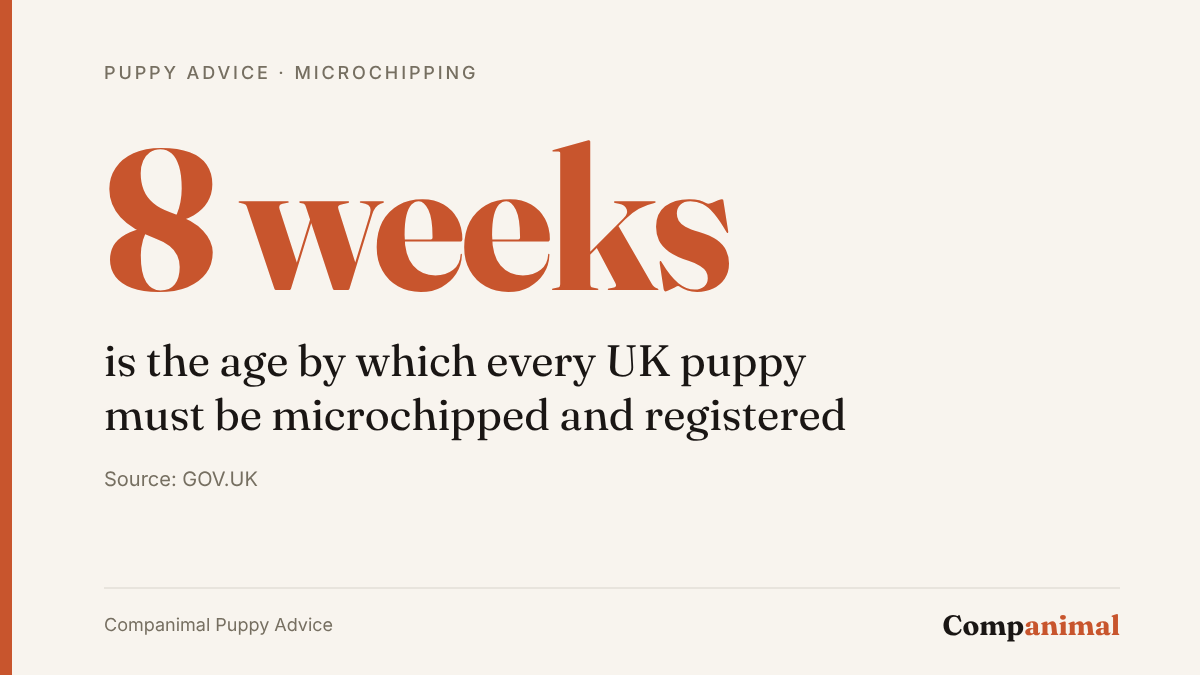
Every UK puppy must be microchipped and registered by 8 weeks. What the law asks of breeders, how keepership passes to the new owner, and what buyers should check.
What this guide covers
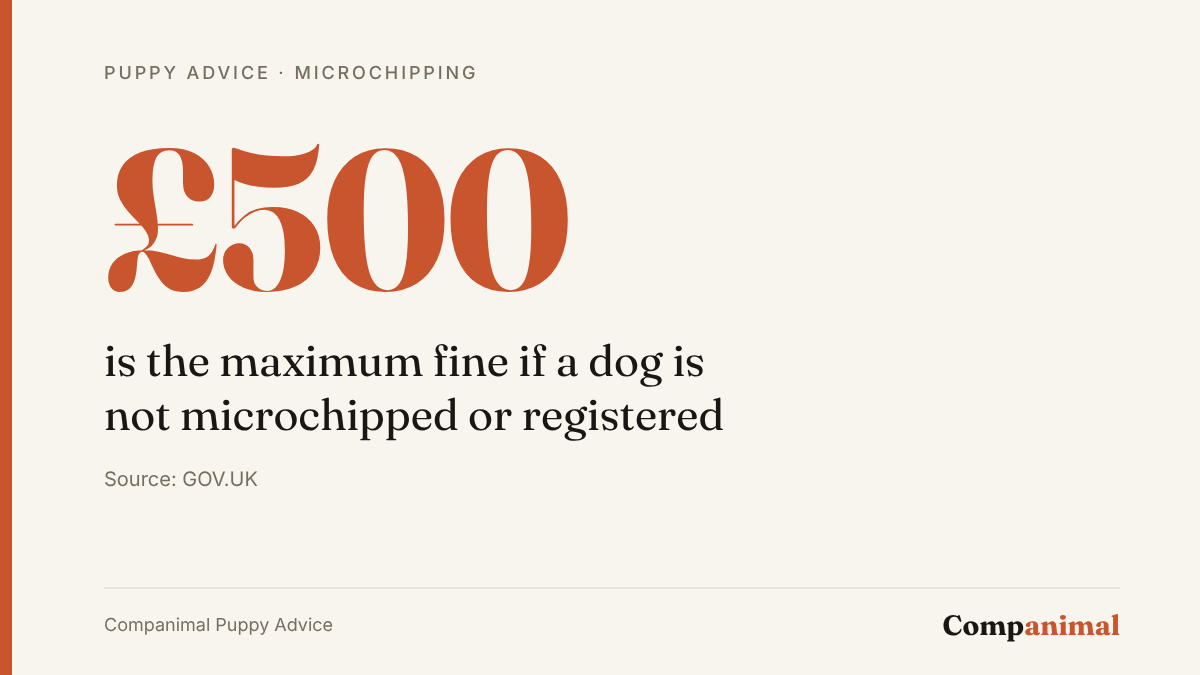
Microchipping puppies is a legal requirement across the UK: every puppy must be microchipped and registered on an approved database by the time it is 8 weeks old. The breeder is responsible for this, is recorded as the puppy's first keeper, and must not hand over a puppy that has not been chipped. The new owner then transfers the record into their own name, and a dog that is not chipped or registered can lead to a fine of up to £500.
What the law says about microchipping puppies
Compulsory microchipping is the rule for dogs in the UK. It is a legal requirement that a dog older than eight weeks is microchipped, and "microchipped" in law means two things together. A compliant chip has to be implanted, and the dog's and keeper's details have to be recorded on a database run by an approved operator. A chip with no registration does not count.
In England the rules now sit in the Microchipping of Cats and Dogs (England) Regulations 2023, which revoked and replaced the original Microchipping of Dogs (England) Regulations 2015. Compulsory microchipping of dogs has applied in England since 6 April 2016. Wales, Scotland and Northern Ireland have their own rules, but the 8-week deadline for dogs is the same everywhere in the UK.
| Nation | Main rules for dogs | Deadline for puppies |
|---|---|---|
| England | Microchipping of Cats and Dogs (England) Regulations 2023 | By 8 weeks old |
| Wales | Microchipping of Dogs (Wales) Regulations 2015 | By 8 weeks old |
| Scotland | Microchipping of Dogs (Scotland) Regulations 2016 | By 8 weeks old |
| Northern Ireland | Microchipping is tied to the dog licence | At 8 weeks old |
For breeders, microchipping is one fixed legal step between the birth and the handover, and it slots into a breeder's step-by-step guide alongside vaccinations, paperwork and finding the right homes.
Why microchipping a puppy matters
A microchip is a permanent form of identification: it stays with the dog even if a collar or tag comes off, and it lasts for the dog's lifetime. If a dog goes missing or is lost or stolen, the unique number on the chip is how a vet or rescue centre finds the keeper's contact details, as long as those details are up to date. Blue Cross scans every pet that comes into its care, and says that for many of the lost pets it looks after, without a microchip there is no way of reuniting them with their owners.
When to microchip a puppy
The law sets a deadline rather than a start date. A puppy must be chipped and registered before it is older than 8 weeks, and before it changes hands at any age. In practice, breeders book the vet during the busy final weeks with mum, the same stretch when puppy socialisation is in full swing, so the chips are done and registered well before anyone collects.
Two timings are worth knowing:
- Selling and collection. Puppies cannot be sold until they are 8 weeks old, and they must already be microchipped when they go. Our guide to when puppies can leave their mum covers the welfare side of that handover.
- Imported dogs. A dog brought into England must be microchipped within 30 days of arriving, whatever its age.
If a vet says a puppy should wait
A vet can certify that a dog should not be microchipped for health reasons, on an approved form that states how long the dog is unfit to be chipped. In Scotland, the reasons given include serious illness, infection at the implant site, a blood clotting condition, or the puppy being too small. The exemption can be temporary or permanent, and if the dog changes hands while it is exempt, the signed certificate must go with it. Blue Cross advises buyers that a breeder who delays chipping should be able to show a vet-signed certificate.
There is also a narrow exclusion in England for certified working dogs, as defined in the Animal Welfare Act 2006. If you think it applies to your litter, check with your vet rather than assuming.
Who can microchip a puppy
Not just anyone can implant a microchip in a dog. In England, the law says only these people may implant a microchip:
- a veterinary surgeon
- a veterinary nurse acting under the direction of a veterinary surgeon
- a veterinary student under a vet's supervision
- someone assessed on a training course approved for implanting, or with practical experience of implanting a microchip from before 24 February 2015
Your veterinary clinic is the usual place to get a puppy microchipped, but local councils and rescue and rehoming centres can do it too, though they may charge. Unless you hold the training, you cannot microchip your own litter.
How much it costs to microchip a puppy
Blue Cross puts the cost at around £15 to £25 per dog from a UK vet or vet nurse. The RSPCA says vets usually charge around £15, and that some charities, organisations and local authorities offer microchipping, sometimes free.
| Cost | Typical amount | Source |
|---|---|---|
| Microchip implanted by a vet | Around £15 to £25 | Blue Cross |
| Microchip implanted by a vet | Around £15 | RSPCA |
| Charity or council microchipping | Sometimes free | RSPCA |
| Updating details on the database | £6 to £20 admin fee, or a one-off fee for lifetime changes on some databases | Blue Cross |
So how much does microchipping cost for a litter? The fee is per puppy, so ask your vet whether they price a litter together. The quoted fee often covers only the chip, so check whether registration and keeper transfers carry extra charges on the database the vet uses.
What happens when a puppy is microchipped
A microchip is a tiny chip about the size of a grain of rice. It carries a unique identification number that links to the dog's details on the database. It is implanted under the skin, usually around the scruff of the neck, with a needle, and is designed to last the dog's lifetime. In England, chips must operate at 134.2 kHz so that standard scanners can read them.
The needle may be uncomfortable for a few seconds. A microchip is not a GPS tracker: it does nothing until someone passes a handheld scanner over the neck, which picks up the number.
When to speak to your vet
Chips are designed to last, but they occasionally fail, move, or cause a reaction. If a vet's scanner cannot read your dog's chip, that counts as a failure of a microchip and should be reported. Contact your vet straight away if you think a puppy has reacted to the chip, for example if the area stays swollen or sore. Anyone who identifies an adverse reaction or chip failure must report it; to report an adverse reaction, the RSPCA points owners to the microchip adverse event reporting scheme. If a puppy seems unwell for any reason, call your vet, and contact a vet immediately in an emergency.
The breeder is the puppy's first registered keeper
Under the microchipping law for dogs in England, the owner of the mother is the keeper of a new-born puppy, so the breeder is the puppy's first keeper. Anyone who keeps a bitch that whelps counts as a breeder for microchipping purposes, whether or not they run a breeding business. That includes a family with a single accidental litter.
When the puppy is registered on a microchip database, the breeder's details should be the first listed. The record must include:
| Detail | Notes |
|---|---|
| Keeper's full name and address | The breeder, at first registration |
| Dog's original name or ID number | Plus any other name it is given later |
| Sex | |
| Breed, or a description of the cross | |
| Colour | |
| Date of birth | As accurately as the keeper knows it |
| Microchip number | |
| Breeder status | Including the licence number and issuing council, if licensed |
Transferring keepership to the new owner
A keeper must not transfer a dog to a new keeper unless it is microchipped, or covered by a vet's health certificate. Once the puppy moves, the new keeper must record their own details on the database, unless the previous keeper has already done it. In Wales, a dog whose new keeper never updates the database is treated as not properly microchipped.
How the transfer works depends on the database. When you buy from a breeder you should get a form or a code that lets you add your contact details to the record. A smooth handover usually looks like this:
- The breeder gives the buyer the microchip number and the name of the database it is registered on.
- The breeder hands over the transfer form or code, plus the chip certificate or vet record.
- The buyer completes the transfer and registers their own name, address and phone number, and any new name for the puppy.
- The buyer checks the database record now shows them as keeper.
The owner is responsible for keeping these details up to date from then on.
Get chip details ready before you advertise
If you are breeding, sort the paperwork before you start creating a puppy listing, not on collection day. A puppy buyer is told to ask for evidence of microchipping and to expect genuine paperwork from a responsible breeder, and many will ask about it in their first message.
Have these ready for each puppy:
- Chip number matched to the right puppy (by colour, markings or collar colour)
- Name of the database each chip is registered on
- Your details recorded as first keeper, with your licence number and council if you are licensed
- Chip certificate or vet record showing the implant date
- Transfer form or code for the buyer
- A vet-signed certificate for any puppy whose chipping is delayed
It makes sense to note the chip number in your puppy contract too, so the puppy, the paperwork and the database record all match.
Fines and enforcement
Failure to microchip a dog is an offence. If a dog is not chipped, an authorised person, such as a council officer or dog warden working for local authorities, can serve a notice requiring the keeper to have it microchipped within 21 days. If the keeper does not comply, the authority can arrange the microchipping and recover the cost, and the keeper can appeal a notice to the First-tier Tribunal.
| Situation | Consequence |
|---|---|
| Dog not microchipped when required | Fine of up to £500 |
| Dog not registered on an approved database | Fine of up to £500 |
| Contact details not updated | Possible notice and a £500 fine |
| Northern Ireland: keeping a dog without a valid licence | Fine of up to £1,000; a licence is not valid if the chip details are inaccurate |
Checking the microchip when you collect your puppy
When buying a puppy, make the chip part of your collection-day checks. The breeder should have chipped the puppy before the sale and registered their own details first. Ask for proof that a chip has been fitted, such as a microchip certificate, vet records, a pet passport or pet insurance papers.
Use this checklist before you take them home:
- The breeder can show the chip certificate or vet record
- The breeder is registered as first keeper on the database
- The chip number on the paperwork matches the puppy (a vet can scan it)
- You know which database it is on, or can find out at check-a-chip.co.uk
- You have the transfer form or code
- If the puppy is not chipped, there is a vet-signed certificate explaining why
Blue Cross advises walking away if a breeder has not registered the puppy and cannot show a reason for the delay. Then complete the transfer as soon as you get home, alongside everything else on your new puppy checklist.
Keeping microchip details up to date
A chip is only as useful as the details behind it. Contact the database whenever you move house or change phone number; updates may carry a fee. If you do not know which microchipping database your dog is on, a vet, dog warden or rescue centre can scan the chip, or you can enter the number on check-a-chip.co.uk.
A few other points from GOV.UK:
- Your dog must still wear a collar and tag with your name and address in public places, chip or no chip.
- Only use a database that meets government standards; Track Your Paws was removed from the approved list for not meeting them.
- Emails from databases you do not recognise asking for payment may be scams, and can be reported to the National Cyber Security Centre.
Our guide covers what else to sort out in the first weeks.
Frequently asked questions
Is it illegal to sell a puppy that is not microchipped?
Yes. A keeper must not transfer a dog to a new keeper unless it is microchipped or has a vet's health exemption certificate, and doing so is an offence.
Can I microchip my own puppies?
Only if you have completed an approved implanting course or equivalent training. Otherwise it must be done by a vet, a vet nurse under a vet's direction, or a supervised vet student.
How old does a puppy have to be to be microchipped?
The law sets a deadline of 8 weeks rather than a minimum age. Your vet will decide when a puppy is ready, and can certify a delay if a puppy is too small or unwell.
Does microchipping hurt a puppy?
The needle may be uncomfortable for a few seconds. Contact your vet if you think your puppy has reacted to the chip.
Do I have to pay to transfer my puppy's microchip?
It depends on the database. Blue Cross reports admin fees of £6 to £20 for changing details, and some databases charge once for lifetime changes.
Can a microchip track where my dog is?
No. A microchip holds a unique number that links to your details on a database, and it is read by a handheld scanner. It does not show your dog's location.
Can you change microchip details without the previous owner?
Contact the database company the chip is registered with; if you do not know which one, a vet can scan the chip for the number. The law expects the new keeper to record their details after a transfer, so ask the breeder for the transfer form or code at collection.
What should I do if my dog's microchip stops working?
Ask your vet to scan again and, if the chip still cannot be read, report it as a microchip failure. Your vet can advise on fitting a new chip so your dog stays microchipped and registered.
What if my puppy has no microchip when I get it?
The breeder should have chipped and registered the puppy before the sale. If they cannot show a vet-signed certificate explaining a delay, Blue Cross advises walking away.
Ready to look?
Looking for your next dog?
Browse sellers who show their working. Every listing tells you what has been disclosed, and what has not.
How Companimal shows you what a seller has disclosed
Account in good standing with a phone number confirmed by the seller.
A council licence number disclosed, or KC registration declared on the listing.
A credentialled breeder whose council licence we have checked against the register.
Information on a listing is self-declared by the seller and has not been independently checked. Read our methodology
More from this series
Calm, practical reads from the same hub.

Puppy advice: raising, training and caring for your puppy · 12 min read
How to Sell Puppies in the UK: Safely, Responsibly and to Happy Forever Homes
How to sell puppies in the UK the right way: the law, matching each puppy to the right home, writing an advert serious buyers trust, vetting buyers and a safe handover.

Puppy advice: raising, training and caring for your puppy · 12 min read
When Can Puppies Leave Their Mum? UK Rules and Why 8 Weeks Matters
Puppies can leave their mum from 8 weeks old in the UK. Here is what the law says in each nation, why those first weeks matter, and what should be done before a puppy goes home.

Puppy advice: raising, training and caring for your puppy · 12 min read
How Long Are Dogs Pregnant? Signs of Pregnancy in Dogs, Week by Week
Dogs are pregnant for about 63 days. How to confirm a pregnancy, the signs week by week, caring for your pregnant dog, whelping and when to call your vet.